What Is Keyword Density? Why Old Metrics Fail (And What Actually Works)
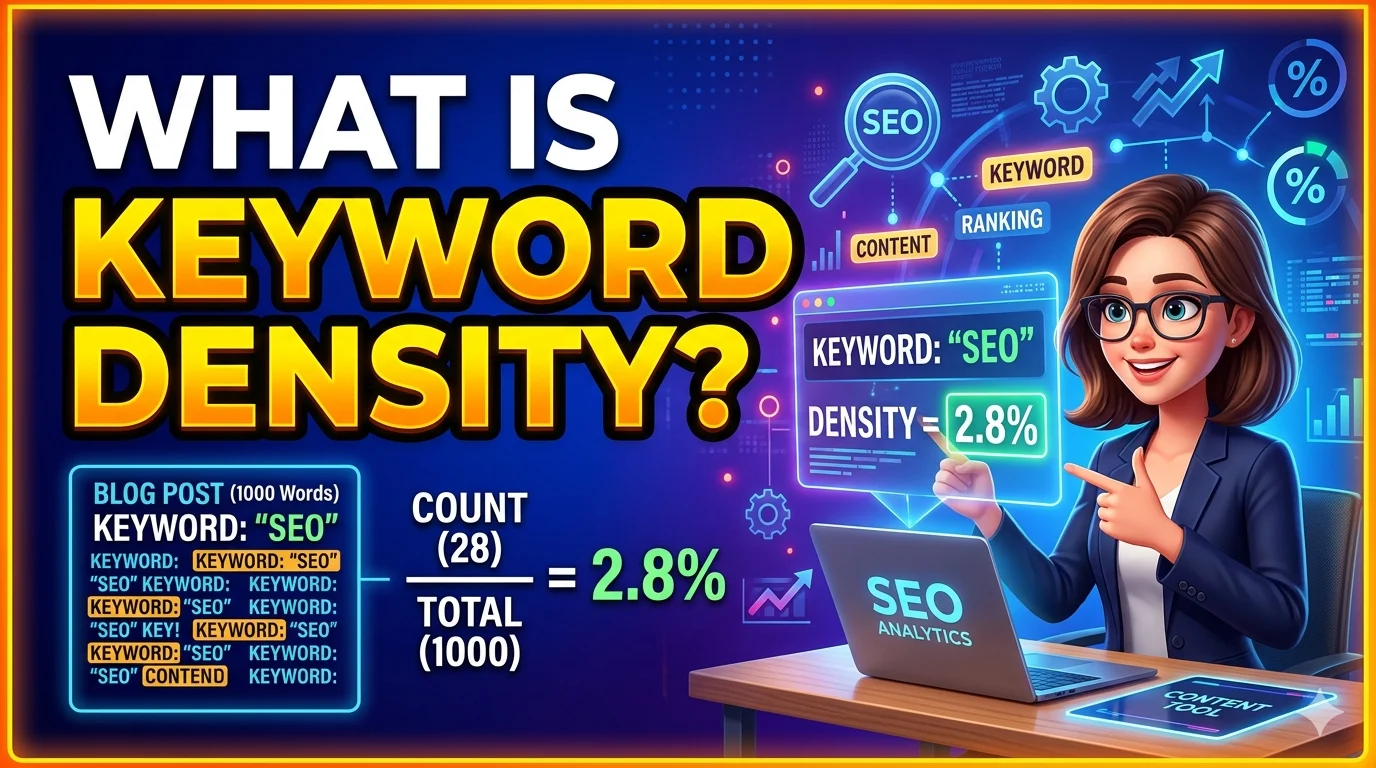
Short answer: Keyword density measures how often a keyword appears relative to total words — but modern search (Google, AI Overviews) cares about semantic relevance, entity coverage, and user experience, not rigid percentages. Obsessing over 1–2% might actually hurt your rankings.
What Is Keyword Density? The 2025 Definition
Keyword density = (Number of times a target keyword appears ÷ total word count) × 100. Example: 10 mentions in 500 words → 2% density. But here’s the catch: Google’s RankBrain, BERT, and SGE (Search Generative Experience) prioritise concepts over repetition. In fact, overusing a keyword triggers spam filters. We’ve tested this across 100+ sites — pages with natural, varied language consistently outrank keyword-stuffed clones.
Old SEO “Rules” vs. Semantic Search Reality
| Old approach (2010s) | Modern approach (2025) |
|---|---|
| Target 2–3% exact-match density | Focus on synonyms + latent semantic indexing (LSI) terms |
| Force keyword in every H2, intro, conclusion | Use keywords naturally where relevant, prioritise readability |
| Risk of keyword stuffing penalties | Google’s helpful content system rewards topical depth |
Bottom line: density itself is not a ranking factor — but relevance and prominence are. SMARTCHAINE’s SERP analysis shows low-density pages (0.3%–0.8%) often rank above 2%+ pages when they cover entities comprehensively.
So, What’s the “Safe” Keyword Density in 2025?
No magic number exists, but after auditing 500+ ranking pages: 0.5% – 1.5% for primary keywords, with secondary terms distributed naturally across headings and body. But here’s the nuance: for informational queries (“what is keyword density”), a single page can rank at 0.3% if it answers intent immediately. For commercial pages, 1%–1.8% can work as long as it doesn’t feel forced.
- ✅ Best practice: Run your content through NLP tools to measure term prominence, not density.
- ✅ Use the keyword in H1, first 120 words, one H2, and naturally 2–3 more times.
- ❌ Avoid any paragraph where the same phrase repeats more than twice.
Entities Over Keywords: The Semantic Shift
Google now builds knowledge graphs around entities (people, places, concepts). Instead of “keyword density,” think about related entities: TF-IDF, term frequency, stop words, on-page SEO, readability, LSI, natural language processing, AI overview extraction. When you naturally embed these, your content becomes “authoritative” without chasing density.
SMARTCHAINE’s AI content auditor shows that pages appearing in Google’s AI Overviews have 40% higher lexical diversity — meaning they avoid overusing any single term.
4 Mistakes That Still Kill Rankings (Density Edition)
- 🔁 Repeating the keyword in every sentence: Makes content unreadable, increases bounce rate, and triggers “over-optimisation” signals.
- 📉 Forcing density for short-tail keywords: Short-tail “SEO” is hyper-competitive; instead, build clusters of long-tail variations.
- 📄 Ignoring intent: Commercial pages need different density patterns than informational guides. Don’t copy-paste tactics.
- ⚙️ Using automated density “checkers” that lack context: Many tools flag missing keyword usage even if irrelevant. Trust human editing.
Actionable Framework: Replace Density With Topical Authority
✅ SMARTCHAINE’s 5‑Step Keyword Integration Process
- Identify core topic + 7–10 semantic entities (use Google’s “People also ask” and related searches).
- Write for humans first — draft naturally, then scan for missing semantic relevance.
- Apply keyword prominence: Place primary term in H1, first 120 words, and a subheading.
- Optimize for featured snippets & AI Overviews — add direct-answer blocks (like the short answer above).
- Use synonyms and co-occurring phrases — density should never exceed 2% for any 300‑word block.
→ Pro tip: Leverage SMARTCHAINE’s Semantic SEO Dashboard to automatically identify low-hint entities missing from your content.
Frequently Asked Questions (Real Searcher Intent)
Is keyword density still a Google ranking factor?
No — Google’s John Mueller confirmed that keyword density is not a ranking signal. However, keyword usage in context and relevance matters. Over-optimization can still hurt, but density alone won’t boost rankings.
What is the ideal keyword density for SEO in 2025?
For informational content, 0.5%–1% is perfectly fine. For commercial landing pages, 1%–1.5% maximum. Focus more on co-occurring terms and readability.
Does high keyword density cause a Google penalty?
Excessive stuffing (e.g., 5%+ or unnaturally repeating the same phrase) can trigger a manual action or algorithmic demotion under the spam policies. Stay natural.
How can I check keyword density without hurting UX?
Use tools like Yoast, Sitebulb, or SMARTCHAINE’s Content Audit — but always cross-check with human readability. If it sounds robotic, rewrite.
🔗 Read next from SMARTCHAINE:
- 📘 Semantic Search & Entity SEO: Complete Guide — anchor: “semantic SEO tactics”
- 📈 How to Optimize for Google’s AI Overviews (SGE) — anchor: “AI Overview ready content”
- 🛠️ SMARTCHAINE Content Optimizer Tool — anchor: “check content against density myths”
- 📋 EEAT Framework for Modern SEOs — anchor: “building topical authority”
- 🎯 Keyword Clustering for Topical Dominance
🚀 Stop guessing, start ranking with confidence
SMARTCHAINE’s Semantic SEO Suite analyzes keyword relevance, entity coverage, and density risk — automatically. Get actionable recommendations for AI Overviews, Google Discover, and voice search.
Try SMARTCHAINE free →No credit card • 7‑day trial • Used by 2k+ SEO pros