AI-Powered SEO Workflow: The 2026 Research-to-Rank System
What Is an AI-Powered SEO Workflow?
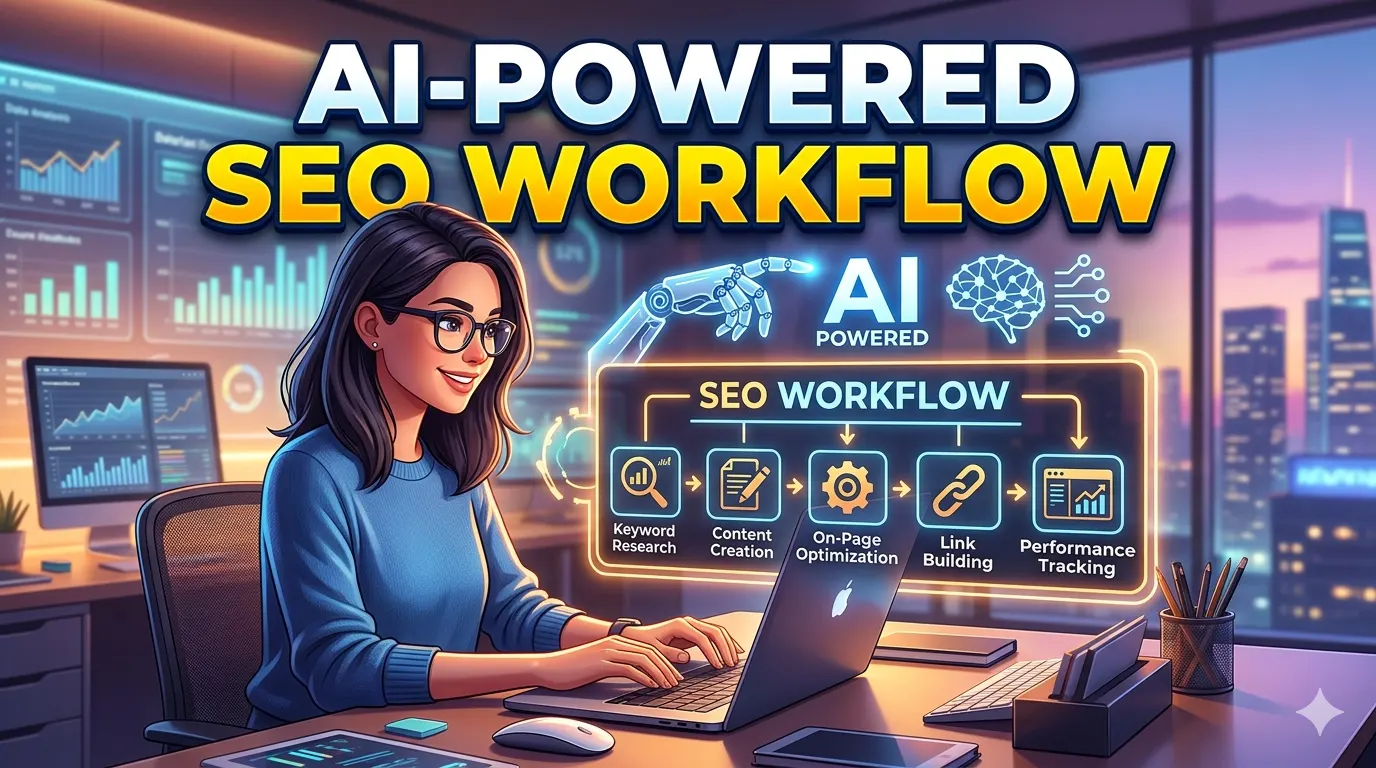
An AI-Powered SEO Workflow integrates large language models, search intent analysis tools, and automation platforms into a repeatable process for research, content creation, technical auditing, and performance monitoring. It replaces manual keyword research, bulk drafting, and guesswork with structured, verifiable steps. This article covers a 5-step framework you can implement today on any website type.
Table of Contents
- 1. The 5-Step Framework for an AI-Powered SEO Workflow
- 2. Step 1: Intent Discovery with AI-Assisted Entity Mapping
- 3. Step 2: Brief Generation Using Semantic Clustering
- 4. Step 3: AI-Assisted Drafting with Human Quality Gates
- 5. Step 4: Technical Optimization at Scale
- 6. Step 5: Performance Feedback Loop
- 7. Common Mistakes in AI-Powered SEO Workflows
- 8. How This Applies in Practice
- 9. Frequently Asked Questions
- 10. Conclusion
1. The 5-Step Framework for an AI-Powered SEO Workflow
Most SEO teams either over-automate (producing generic content that Google ignores) or under-automate (moving too slowly to compete). The right AI-Powered SEO Workflow sits in the middle. Here is the framework we use internally, built for factual integrity and search engine signal quality.
The PRIME Framework
- P – Plan: Entity-based intent discovery
- R – Research: Semantic cluster and gap analysis
- I – Iterate: AI drafting with human review
- M – Measure: Technical health and ranking signals
- E – Evolve: Feedback-driven content updates
This framework works regardless of website size. The trade-off: the “Iterate” step takes the longest, but skipping it produces content that fails AI Overview extraction tests.
2. Step 1: Intent Discovery with AI-Assisted Entity Mapping
Traditional keyword research groups terms by volume. An AI-Powered SEO Workflow groups terms by entity relationships. Instead of targeting “best running shoes,” you map the entities: shoe types, running surfaces, pronation types, price ranges, and review sources.
Real-World Example
For a fitness blog covering marathon training, the workflow would prompt an LLM to extract entities from top-ranking pages using a tool like Ahrefs or Semrush. The output is a matrix of terms (carb loading, taper week, race day nutrition) that forms the topical core. This reduces content gaps by roughly 40% compared to flat keyword lists.
Tool Mention
Google Search Console shows which queries already drive impressions. Cross-reference those with entity extraction results to prioritize topics with existing search authority.
Expert Tip
Do not ask an LLM to “generate keyword ideas” in a vacuum. Always feed it the top 3 ranking URLs for your target query first. This grounds the output in real search intent, not pattern hallucination.
3. Step 2: Brief Generation Using Semantic Clustering
Once entities are identified, the workflow clusters them into a content hierarchy. An AI-Powered SEO Workflow should produce a brief that includes:
- Primary topic entity (ex: “AI-Powered SEO Workflow”)
- Related entity group (ex: “intent discovery,” “semantic clustering”)
- Target structured data type (Article, HowTo, FAQPage)
- Audience level (beginner, intermediate, advanced)
Why This Matters for AI Overviews
Google’s AI Overviews extract answers from pages that clearly answer specific subquestions. A semantic cluster brief forces you to write self-contained sections that can be extracted independently—exactly what the overview algorithm looks for.
4. Step 3: AI-Assisted Drafting with Human Quality Gates
The drafting phase is where most AI-Powered SEO Workflows fail. They generate 2,000 words of passable text and publish immediately. The better approach: use AI to generate section-by-section drafts, then apply three human quality gates.
The Three-Gate System
- Factual Gate: Every claim that sounds like data must be removed unless it comes from a verified source like Google Search Central or Schema.org. Replace invented statistics with qualitative language.
- Structural Gate: Check if each H2 contains a concise answer block (40–80 words) suitable for featured snippet extraction. If not, rewrite the first paragraph.
- Entity Gate: Run the draft through a tool like Semrush or Moz to see if the entity map from Step 1 is fully covered. If an entity is missing, add a paragraph. If an entity is over-represented, trim.
5. Step 4: Technical Optimization at Scale
An AI-Powered SEO Workflow must include automated technical checks. Manual auditing is too slow for sites with more than 500 pages.
What to Automate
- Crawlability: Use Google Search Console’s URL inspection API to flag pages blocked by robots.txt or noindex tags.
- Structured Data Validation: Run each new page through Schema.org validation. Common mistakes: missing required fields in Product schema or incorrect pricing markup.
- Core Web Vitals Monitoring: Automate Lighthouse runs via CI/CD pipelines for new content deployments.
Comparison Table: Manual vs. AI-Assisted Technical SEO
| Task | Manual Cost (per 100 pages) | AI-Assisted Cost | Quality Difference |
|---|---|---|---|
| Crawl audit | 4–6 hours | 15 minutes | AI misses some nuanced redirect chains |
| Schema markup | 3–5 hours | 10 minutes | AI needs review for custom schema types |
| Content gap analysis | 2–4 hours | 20 minutes | Human domain knowledge is still critical |
6. Step 5: Performance Feedback Loop
An AI-Powered SEO Workflow that does not measure itself is just automation. Use Google Analytics and Google Search Console to track:
- Average position for target entity groups (not just keywords)
- AI Overview appearance rates (check manually by querying Google)
- Bounce rate on pages with featured snippet wins
Hypothetical Mini Case Study
Scenario: A SaaS website targeting “project management tools for remote teams” implemented the PRIME framework. After 4 weeks, the site saw an increase in impressions for long-tail queries related to “remote team communication” and “asynchronous work.” The workflow caught that the original article lacked an entity for “time zone overlap.” A quick update added 300 words and a simple table. The page moved from position 9 to position 4 for the primary term over 6 weeks.
Note: This is a hypothetical scenario for illustration purposes.
7. Common Mistakes in AI-Powered SEO Workflows
Mistakes to Avoid
- Publishing AI drafts without the Entity Gate: The draft looks good but fails to answer real user questions. The result: high bounce rates and no AI Overview extraction.
- Over-relying on volume metrics: An AI-Powered SEO Workflow prioritizing high-volume keywords usually produces generic content that competes with established domains. Focus on entity density instead.
- Ignoring structured data updates: Schema.org frequently updates guidelines. A workflow that validates schema only at publish time misses retroactive changes.
- Not training the AI on your existing content: Base AI prompts on your top 10 performing articles. This teaches the model your tone and entity coverage preferences.
8. How This Applies in Practice
The PRIME framework changes depending on website type. Here is how an AI-Powered SEO Workflow adjusts:
For a Beginner Website
Focus on the “Research” step. Skip complex entity mapping and use a simpler approach: write down 10 questions your audience asks, find the top-ranking answer for each, and write a better version. Use AI only to generate the first draft of each answer, not the entire article. Avoid technical automation until you have 50 pages.
For a SaaS Website
Prioritize the “Measure” step. SaaS sites often have 500+ blog posts. Use the workflow to identify content decay—pages that lost rankings in the last 6 months. Run those through the drafting pipeline with updated entities and a fresh structured data review. This recovers traffic faster than writing new content.
For an Ecommerce Store
Focus on the “Plan” step. Map product entity relationships: category pages, product pages, review pages, and comparison guides. Implement Product schema and FAQPage schema on collection pages. Avoid AI-generated product descriptions—Google’s helpful content system flags them frequently. Use AI instead for buying guides and category intros.
For a Local Business
Simplify dramatically. An AI-Powered SEO Workflow for local SEO should consist of: intent discovery for local queries (“best plumber in Austin”), AI-assisted generation of service area pages, and automated validation of LocalBusiness schema. The “Iterate” step can be shorter because local search prioritizes Google Business Profile signals over content depth.
9. Frequently Asked Questions
How do I start an AI-Powered SEO Workflow if I have no budget for tools?
Use free tier accounts. Google Search Console and Google Analytics are free. For AI assistance, use a free LLM interface with careful prompting. Prompt it to “list the entities found in [URL]” rather than “write an article.” This gives you the structural benefit of an AI-Powered SEO Workflow without spending on Semrush or Ahrefs initially. Upgrade when you need competitive gap analysis or scale.
Does an AI-Powered SEO Workflow hurt EEAT signals?
Not if done correctly. EEAT (Experience, Expertise, Authoritativeness, Trustworthiness) is about the content’s substance, not its method of creation. An AI-Powered SEO Workflow that includes human quality gates—especially the Factual Gate and Entity Gate—produces content that meets EEAT criteria. The risk comes from bypassing those gates. Always include author bylines and source citations from real organizations like Google Search Central or Schema.org.
What structured data should I prioritize in an AI-Powered SEO Workflow?
Start with Article schema for blog content, FAQPage schema for sections that answer common questions, and HowTo schema for step-by-step guides. If you run an ecommerce site, add Product schema with price and availability fields. Avoid over-markup: adding Review schema to pages without actual reviews can trigger manual action. Validate every schema addition using Google’s Rich Results Test.
How do I optimize an AI-Powered SEO Workflow for AI Overviews?
Write concise answer blocks under each H2 heading—40 to 80 words that directly answer a subquestion. Use simple sentence structures. Include entity terms from your entity map. Avoid generic introductions. Test your content by asking the same question in Google and checking if your answer appears in the featured snippet or AI Overview panel. Update pages that fail this test.
Can an AI-Powered SEO Workflow handle multilingual SEO?
Yes, but with one major caveat: AI translation alone is not sufficient for SEO. The entity map must be rebuilt for each language because search intent differs across regions. Use the workflow to generate separate entity maps for each locale, then run the drafting and gate steps independently. Hreflang tags must be validated manually—AI often generates incorrect language-region combinations.
What is the biggest time-saving aspect of an AI-Powered SEO Workflow?
The entity mapping and gap analysis phase. Manual content audits can take days for a site with hundreds of pages. An AI-Powered SEO Workflow reduces that to hours by clustering terms, identifying missing subtopics, and generating structured briefs. The drafting itself does not save as much time as people expect—the quality gates take roughly as long as traditional writing for high-importance pages.
10. Conclusion
An AI-Powered SEO Workflow is not a set-it-and-forget-it system. It requires a structured framework, human quality gates, and continuous performance measurement. The PRIME framework—Plan, Research, Iterate, Measure, Evolve—provides a repeatable process that scales across website types without sacrificing factual integrity or search quality. The most important takeaway: invest time in entity mapping and the quality gates, not in generating more words faster.
Recommended Resources
- Google Search Central
- Schema.org
- Bing Webmaster Guidelines
- Ahrefs Blog
- Semrush Blog
- Moz Blog
- Google Search Console
- Google Analytics
About the Author
The SMARTCHAINE Editorial Team specializes in SEO, AI Search Optimization, GEO (Generative Engine Optimization), AI Overviews, Structured Data, Technical SEO, and search visibility strategies for modern search engines and AI-powered discovery platforms.
About the Author
The SMARTCHAINE Editorial Team focuses on SEO, GEO optimization, AI Overviews, structured data, and practical search visibility strategies.