Category Page SEO: 7 Mistakes That Kill Rankings in 2026
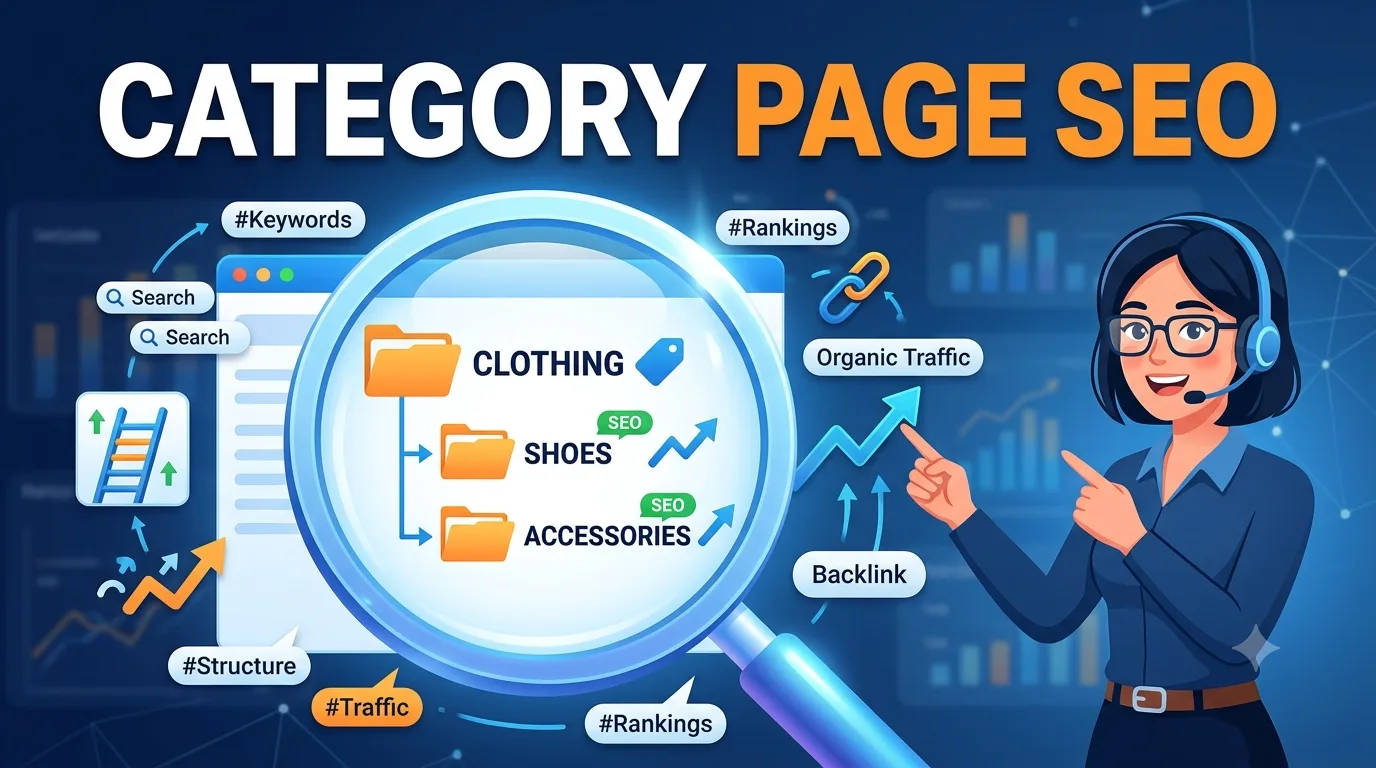
**Quick Answer:** Category Page SEO is the practice of optimizing taxonomy and archive pages (product, blog, or directory pages) to rank for broad, high-intent search queries. Unlike individual product or post pages, category pages serve as topical hubs. Success depends on clean URL structure, unique descriptive content, internal linking logic, and proper indexation signals. Done correctly, they capture commercial and navigational search volume that single pages cannot compete for.
**TL;DR:** Category pages are often neglected or duplicated, wasting crawl budget and confusing Google. In 2026, AI Overviews and semantic search reward category pages that function as authoritative topic summaries. Avoid the 7 mistakes below to turn your category pages from thin content liabilities into ranking assets.
**Key Takeaways**
- Category pages must have unique, useful content—never rely on thin product lists alone
- Indexation strategy matters: noindex thin or duplicate categories; index only value-adding hubs
- URL structure should be flat and descriptive, avoiding parameters and excessive depth
- Internal linking from categories to high-value subpages distributes topical authority
- Structured data (BreadcrumbList, ItemList, CollectionPage) helps Google understand page type
- AI Overviews favor category pages that answer a question comprehensively at the top
- Regular content audits prevent category bloat and cannibalization across similar themes
**Table of Contents**
1. Mistake 1: No Unique Content on Category Pages
2. Mistake 2: Poor Internal Linking Logic
3. Mistake 3: Indexing Every Thin Category
4. Mistake 4: Ignoring Structured Data
5. Mistake 5: Over-Optimizing Anchor Text
6. Mistake 6: Neglecting Mobile UX and Core Web Vitals
7. Mistake 7: No Refresh Cadence for Stale Categories
8. The SMARTCHAINE Category Priority Framework
9. How This Applies in Practice
10. FAQ
---
## Mistake 1: No Unique Content on Category Pages
A category page without descriptive text is essentially a list of links. Google’s algorithms in 2026 are far better at evaluating topical relevance through semantic context. If your category page has only product titles and prices, it provides insufficient signals for ranking broad queries. **The fix:** Add a short introductory paragraph (150–300 words) explaining what the category covers, who it is for, and how items relate. This is not the place for keyword stuffing. Write for a human reader who wants to know if this category matches their intent.
**Expert Insight:** A common mistake is copying this description from the manufacturer or another category. Google’s duplicate content detection applies here. Even if the text is unique across your site, make sure it adds genuine utility—such as a buying guide or FAQ snippet embedded at the top of the page.
**Example scenario:** An ecommerce store selling hiking gear has a category `/hiking-boots`. Instead of a blank list, the page includes a 200-word guide explaining the difference between trail runners, mid-height boots, and mountaineering boots. This satisfies both informational and commercial intent, and Google rewards it with featured snippet eligibility.
---
## Mistake 2: Poor Internal Linking Logic
Many sites treat category pages as dead ends. Users and search engines arrive, see a list, and click away. Internal linking from category pages to related guides, best-of articles, or subcategories improves topical depth and spreads link equity. **The fix:** On every category page, include links to 2–3 relevant blog posts, buying guides, or adjacent categories. Use descriptive anchor text (e.g., “Read our guide to waterproof hiking socks”) instead of “click here.” **When to avoid this:** If your category page already has 50+ product links, adding more may overwhelm users. Instead, embed a small accordion or “Related Guides” section at the bottom. --- ##Mistake 3: Indexing Every Thin Category
Not all category pages are created equal. Some are seasonal, some are too narrow, and some combine overlapping terms (e.g., “blue running shoes” and “blue shoes for running”). Indexing all of them can waste crawl budget and cause keyword cannibalization. **The fix:** Audit your category indexation using Google Search Console. For any category that has fewer than 3–5 items, no unique content, or minimal search volume, add a `noindex` tag or consolidate it into a parent category. **Hypothetical scenario:** A fashion retailer has `/women/dresses/summer` and `/women/summer-dresses`. Both pages contain identical product sets. The first page should redirect to the second, or one should be noindexed to avoid splitting signals. --- ##Mistake 4: Ignoring Structured Data
Schema markup helps search engines understand the purpose of a page. For category pages, the most relevant types include `BreadcrumbList`, `ItemList`, and `CollectionPage`. Without these, Google may misinterpret your category page as a simple list or duplicate. **The fix:** Implement `BreadcrumbList` schema on all category pages to clarify the path (e.g., Home > Sports > Running). Use `ItemList` to indicate that the page contains a list of items, and `CollectionPage` for curated editorial categories. Avoid `Product` schema on category-level pages—it is meant for individual product pages. **Decision rule:** Use `CollectionPage` when the category is editorial (e.g., “Best running shoes 2026”). Use `ItemList` when the category is purely navigational (e.g., “Men’s running shoes”). Check your markup with Google’s Rich Results Test. --- ##Mistake 5: Over-Optimizing Anchor Text
When linking to category pages from your homepage, navigation, or blog posts, many SEOs use exact-match anchor text like “hiking boots” for every link. This creates an unnatural link profile and can trigger algorithmic filters. **The fix:** Vary anchor text. Use branded anchors, generic phrases (“browse our collection”), or partial matches (“top-rated hiking boots for winter”). Aim for a natural distribution: 30% branded, 40% generic, 30% partial or exact. **Common mistake:** Building links to your category page using the same keyword across dozens of external sources. This is no longer effective and may look manipulative. Focus on relevance over repetition. --- ##Mistake 6: Neglecting Mobile UX and Core Web Vitals
Category pages are often the heaviest pages on a site due to multiple product images, filters, and JavaScript. Slow load times hurt both rankings and user experience, especially on mobile. **The fix:** Compress images, lazy-load below-the-fold content, and test your category page using Google’s PageSpeed Insights. Prioritize Largest Contentful Paint (LCP) and Cumulative Layout Shift (CLS) because category pages often have dynamic price filters or image sliders that shift layout. **Implementation note:** If your category page uses infinite scroll, ensure that pagination is still crawlable via `rel="next"` and `rel="prev"` tags or through static numbered URLs for deeper pages. Googlebot does not “scroll.” --- ##Mistake 7: No Refresh Cadence for Stale Categories
Category pages that were created once and never updated lose relevance over time. Products sell out, trends shift, and new subcategories emerge. A static category page signals low authority. **The fix:** Set a refresh schedule. For ecommerce, review top categories every quarter. For content categories (e.g., a blog archive), review every 6 months. When refreshing, update the introductory text, remove outdated product links, and add recent items or articles. **Author Insight:** Most SEOs focus on refreshing blog posts but forget that category pages are just as important. A category page with a “Last updated” tag (via schema) can earn trust signals for freshness algorithms. --- ##The SMARTCHAINE Category Priority Framework
**Purpose:** Decide which category pages to optimize first when resources are limited. This framework uses qualitative scoring rather than mathematical formulas. **Three scoring categories:** 1. **Traffic potential** – estimated organic search volume for the category’s primary keyword (use Ahrefs or Semrush to gauge this) 2. **Content readiness** – whether the page already has unique text, structured data, and internal links 3. **Business value** – margin, conversion rate, or strategic importance of the category Assign each a priority: **High**, **Medium**, or **Low**. | Category | Traffic Potential | Content Readiness | Business Value | Priority | |----------|-------------------|------------------|----------------|----------| | “Running Shoes” | High (10K searches/mo) | Low (no text, no schema) | High (40% margin) | High | | “Shoe Laces” | Low (200 searches/mo) | Medium (has text, no schema) | Low (low margin) | Low | | “Trail Running Shoes” | Medium (2K searches) | Low (thin content) | High (25% margin) | Medium | **Action:** Start with High-priority pages. Add unique content, fix structured data, and improve internal links. Move to Medium-priority after the first batch. For Low-priority, consider noindexing or merging. --- ##How This Applies in Practice
**Beginner website (small blog or niche store):** Focus on content creation first. Write 150 words for each category, use BreadcrumbList schema, and noindex any category with fewer than 3 items. Avoid complex internal linking until you have 10+ categories. **SaaS website:** Category pages might be “features,” “integrations,” or “use cases.” Add comparison tables and tool-specific descriptions. Use `CollectionPage` schema for editorially curated feature lists. Avoid noindexing; instead, merge thin integration pages into a single “All Integrations” page. **Ecommerce store:** Prioritize high-margin categories for content refresh. Add buying guides, FAQ sections, and user reviews aggregated at category level. Use `ItemList` schema and ensure pagination is crawlable. Avoid duplicate descriptions across similar categories like “women’s dresses” and “dresses for women.” **Local business:** Category pages may represent service areas or service types (e.g., “plumbing,” “emergency repairs”). Add location-specific content and use `LocalBusiness` schema on the parent service page, not on every subcategory. Noindex thin location pages that have no unique content. --- ##FAQ
**Article Summary**
Category Page SEO in 2026 requires more than keyword placement. The key success factors are unique content, proper indexation decisions, structured data (BreadcrumbList, ItemList, CollectionPage), and maintenance cadence. The SMARTCHAINE Category Priority Framework helps prioritize which pages need attention first. Avoid the 7 mistakes above, and your category pages will become strong topical hubs that satisfy user intent and qualify for AI Overviews.
---
**Recommended Resources**
- Google Search Central
- Schema.org
- Google Search Console
About the Author
The SMARTCHAINE Editorial Team specializes in SEO, AI Search Optimization, GEO (Generative Engine Optimization), AI Overviews, Structured Data, Technical SEO, and search visibility strategies for modern search engines and AI-powered discovery platforms.