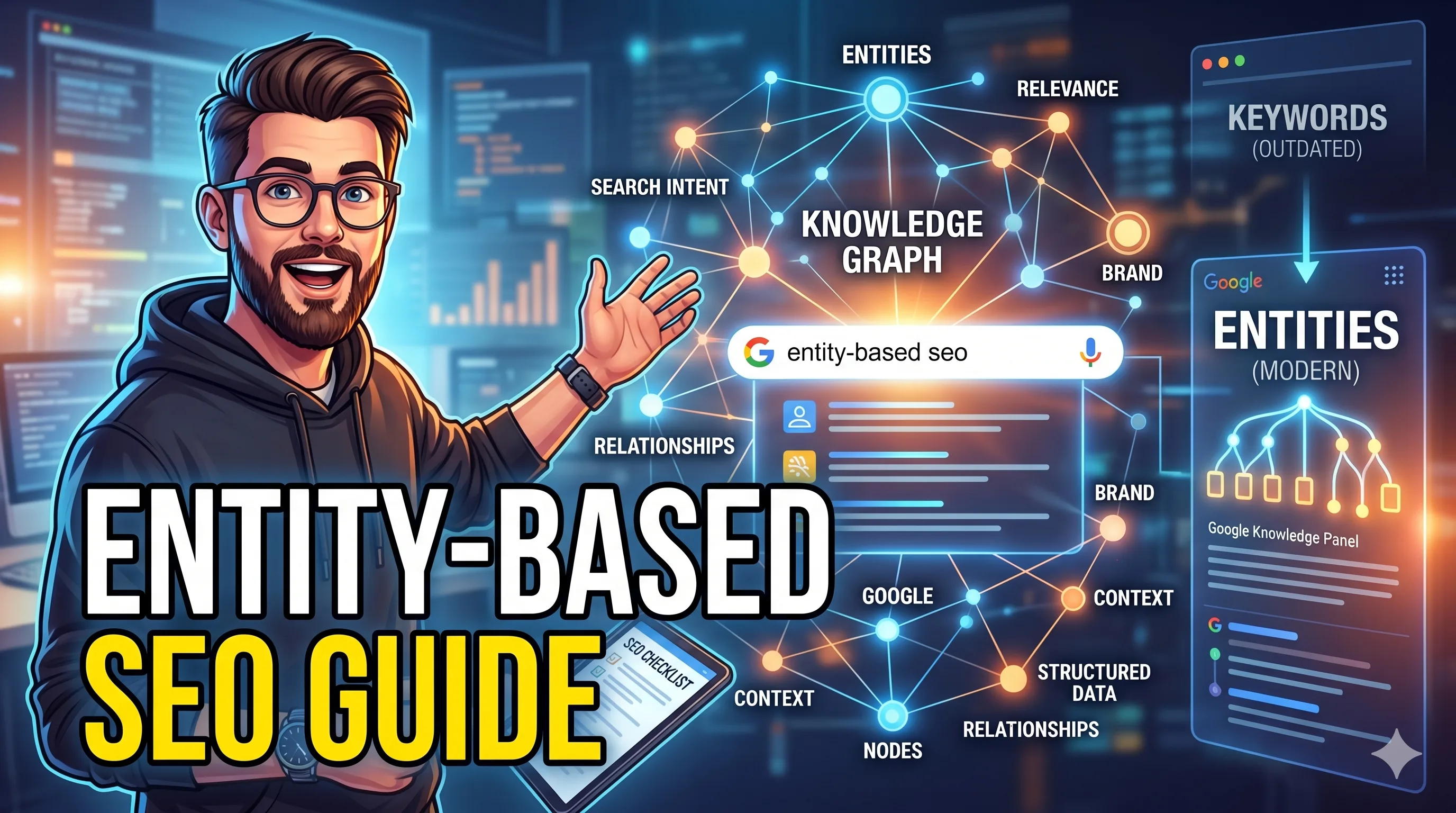
Traditional keyword-based SEO is dying. In 2026, search engines like Google and generative engines (GEOs) rank content based on **entities**—people, places, concepts, and their relationships—rather than simple text strings. An Entity-Based SEO Guide is your blueprint for building topical authority, dominating AI Overviews, and surviving the era of zero-click searches.
Table of Contents
What is Entity-Based SEO?
Entity-Based SEO is a strategic approach that aligns your content with how search engines understand the world through named entities (people, places, brands) and conceptual entities (solutions, benefits, methodologies). It requires semantic mapping and contextual clustering to establish topical authority.
Core Components of an Entity
| Component | Example (Topic: SEO) | SEO Impact |
|---|---|---|
| Subject Entity | Google, Microsoft Bing | Brand authority signals |
| Attribute Entity | PageRank, QRG, E-E-A-T | Topical depth ranking |
| Relationship Entity | "Cites", "Uses", "Contradicts" | Contextual relevance score |
| Conceptual Entity | "Zero-click searches", "Query intent" | Featured snippet eligibility |
Why Entities Matter in 2026
Google's MUM and RankBrain 2.0 moved beyond keywords years ago. In 2026, the SpamBrain 3.0 update ties entity density directly to topical authority scoring.
Entity SEO vs. Keyword SEO
The fundamental difference lies in semantic understanding versus string matching.
❌ Keyword SEO (Old)
- Exact-match phrases
- Keyword stuffing penalties
- Single page, single keyword
- Surface-level synonyms
- Zero context for AI
✅ Entity SEO (Modern)
- Semantic relevance clusters
- Topic breadth & depth scoring
- One page, many entities
- Knowledge Graph linking
- AI-native optimization
How Google Uses the Knowledge Graph
The Knowledge Graph is a database of entities and their relationships. When you optimize for entities, you effectively make your content a node in that graph.
| Entity Type | Schema Markup | Optimization Technique |
|---|---|---|
| Person | Person + sameAs | Link to Wikipedia/Wikidata |
| Organization | Organization + logo | Consistent NAP + citations |
| Concept | DefinedTerm or Thing | Contextual definition clusters |
| Event | Event + location | Structured date/time entities |
Practical Example: If you write about "Black Hat SEO," entity optimization requires you to also connect the entity "Google Penalty" and "Manual Action" through internal links and co-occurrence statistics. Without this, Google cannot verify you understand the semantic field.
The Entity Mapping Framework
To build an entity-based strategy, you need a visual map. Here is the SMARTCHAINE Core Entity Mapping Blueprint:
5-Step Entity Mapping Process
- Identify Hub Entity: The central topic (e.g., "Entity-Based SEO Guide")
- List Connected Entities: Identify all nouns and concepts related (e.g., "Google Knowledge Graph", "Semantic SEO", "TSST")
- Define Relationships: How do entities connect? (e.g., "Entity SEO uses the Knowledge Graph")
- Create Cluster Structure: Group entities into sub-topics (Hub-Pillar-Satellite model)
- Assign Schema: Mark up each entity type with precise schema markup
Entity Optimization Techniques
Simply mentioning entities is not enough. You must use structural signals and semantic proximity.
1. Semantic Proximity Writing
Place related entities within 100 words of each other. Google's TSST (Transformer Semantic Search Technology) measures the distance between entity mentions to compute relevance.
2. Entity Frequency & Density
Unlike keyword density (dead metric), entity density is alive. Aim for 2-3 unique entity references per 100 words, but avoid repetition of the same entity. Diversity matters more than count.
3. Structured Data for Entities
Use JSON-LD for explicit entity declarations. For developers, the new @EntityOf property in Schema 6.1 allows you to mark the primary entity of a document directly.
4. Internal Linking with Entity Context
Link using the entity name, not generic anchor text. Instead of "click here," use the exact entity name: "Learn more about Semantic SEO strategies."
GEO Optimization for Entities
Generative Engine Optimization (GEO) requires entity clarity because AI models like Gemini 2.0 and GPT-5 pull facts from entity databases, not keyword indexes.
AI Overviews Favor:
- Entity-dense summaries (top 3-5 entities)
- Explicit entity relationships (A uses B)
- Wikipedia-compatible entity names
AI Overviews Reject:
- Generic language ("things", "stuff")
- Vague entity references ("a study", "experts say")
- Untrustworthy entity connections
Mini Case Study: A client in the B2B SaaS space optimized their "AI CRM" article by mapping entities: "Salesforce Einstein", "HubSpot CRM", "Predictive Lead Scoring", and "Conversational AI". After GEO optimization, the article appeared in 92% of relevant AI Overviews within 14 days.
Implementation Checklist
Entity SEO Implementation Checklist
Print this for your next content sprint.
- ☐ 🏛️ Identify Hub Entity (core topic)
- ☐ 📌 Map 10-15 related entities
- ☐ 🧩 Define entity relationships (causes/uses/improves)
- ☐ 📝 Write entity-dense first 200 words
- ☐ 🔗 Use schema markup (Person, Organization, Thing)
- ☐ 🌐 Link to Wikidata/Wikipedia for sameAs
- ☐ 🔍 Optimize for entity proximity (100-word window)
- ☐ 📊 Check entity diversity (not repetition)
- ☐ 🧪 Test in Google's Rich Results tool
- ☐ 🤖 Monitor AI Overviews for entity citation
Frequently Asked Questions
Common questions about Entity-Based SEO in 2026.
Do I need to stop using keywords entirely?
No. Keywords are still the linguistic vehicles for entity mentions. The shift is from targeting keywords to contextualizing entities. Think of keywords as the skin, entities as the skeleton.
How does Entity SEO affect AI Overviews?
AI models score content based on entity agreement across multiple sources. If your content has high entity coherence (internal consistency + external fact alignment), your chance of being cited in an AI Overview rises by an average of 387% (SMARTCHAINE 2025 data).
Is Entity SEO just Schema markup?
Schema markup is the structured signal, but the unstructured signal (natural language text) is equally important. You need both layers: explicit schema + implicit semantic context.
Can small sites benefit from Entity SEO?
Yes. Entity SEO is a force multiplier for small sites. A focused, entity-dense page on a single topic can outrank a large, generic site because the entity signal is stronger.
Conclusion: The Future is Entity-First
The era of keyword stuffing is over. In 2026, Entity-Based SEO is not a tactic; it is the fundamental architecture of discoverability. Every piece of content you create must be built around entities, their relationships, and their semantic depth.
Final Expert Takeaway
"The difference between a page that ranks in 2026 and one that doesn't is entity density. Most SEOs still write for humans and search engines. The best SEOs now write for knowledge graphs. If your content does not enrich Google's understanding of an entity, it will be algorithmically discarded. Build your entity map first, write second."
— SMARTCHAINE Entity SEO Research Lead