Evergreen SEO Strategy
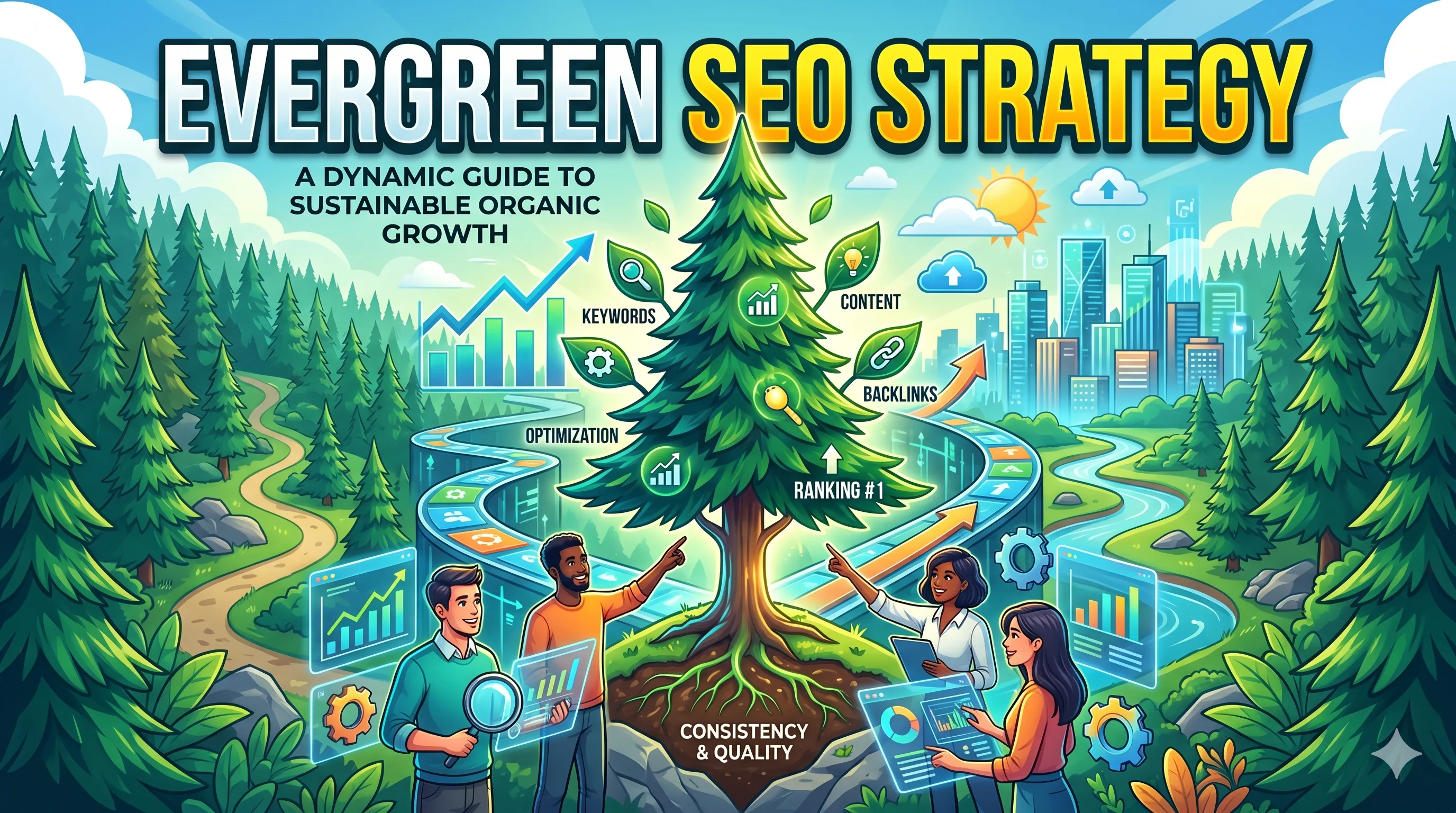
Most SEO strategies are built for yesterday’s algorithm. An evergreen SEO strategy is different—it’s designed to withstand Google updates, AI Overview shifts, and changing user behavior. In this guide, we break down exactly how to build content that earns steady organic traffic, adapts to Generative Engine Optimization (GEO), and remains authoritative for the long haul.
Direct Answer: An evergreen SEO strategy focuses on creating and optimizing content around stable, high-value topics that don't expire. It combines semantic keyword clusters, genuine EEAT signals, and technical fundamentals to maintain visibility across traditional search and AI-generated answers.
Table of Contents
- Why Evergreen SEO Matters in 2026
- The 4 Core Pillars of an Evergreen SEO Strategy
- GEO & AI Overview Optimization for Evergreen Content
- Semantic Content Architecture That Lasts
- Practical Example: Reviving a Declining Blog Post
- Mini Case Study: A Hypothetical B2B SaaS Content Refresh
- Actionable Evergreen SEO Checklist
- Frequently Asked Questions
- Expert Insight: The Refund Cycle
- Conclusion
Why an Evergreen SEO Strategy Remains Essential in 2026
Search behavior is fragmenting. Users now receive answers directly in SERPs, AI Overviews, and voice results. However, the underlying driver of all these systems is the same: trustworthy, well-structured, context-rich content. An evergreen SEO strategy ensures your work doesn’t just rank for a single query today—it feeds the entire ecosystem of search surfaces.
The Shift from Keywords to Contextual Entities
Google’s Knowledge Graph and AI models no longer just match strings. They understand entities—people, places, concepts, and their relationships. An evergreen strategy therefore maps clusters of related entities rather than individual keywords. For example, if you write about "content marketing," you should also naturally include entities like "editorial calendar," "audience segmentation," and "content audit."
Why Timeliness Hurts Your Long-Term Performance
Content tied to a specific date, event, or trend has a short shelf life. Evergreen content avoids this trap. It addresses fundamental questions, problems, or processes that don't change dramatically year over year. A guide on "how to write a blog post" will always be relevant; a guide on "2025 social media trends" will not.
Key Insight: The most effective evergreen content answers the "why" and "how" behind a topic, not just the "what." This structure helps AI models cite your content as an authoritative reference.
The 4 Core Pillars of an Evergreen SEO Strategy
A durable strategy rests on four specific pillars. Neglect any one of them, and your content’s staying power erodes.
| Pillar | What It Means | Why It Matters for Evergreen SEO |
|---|---|---|
| 1. Semantic Clustering | Grouping content around a central entity with related subtopics. | Signals topical authority to Google and AI Overviews. |
| 2. Structured Data | Using schema markup (FAQ, HowTo, Article) to define content relationships. | Increases eligibility for rich results and AI-generated citations. |
| 3. User Intent Alignment | Matching content format to searcher intent (informational, navigational, commercial). | Reduces bounce rates and increases dwell time—two implicit quality signals. |
| 4. Regular Refreshes | Updating statistics, examples, and internal links without changing the core topic. | Prevents content decay and maintains current relevance signals. |
GEO & AI Overview Optimization for Evergreen Content
Generative Engine Optimization (GEO) is about making your content easily extractable by large language models. This is not a separate tactic from SEO—it’s an extension of semantic optimization.
How to Structure Content for AI Extraction
- Use concise answer blocks: Follow each H2 or H3 with a clear, direct paragraph that answers the question in the heading. This increases your chance of being quoted in an AI Overview.
- Embed definitions early: If your topic uses industry terms, define them within the first 100 words of the section.
- Include contrasting viewpoints: AI models increasingly favor content that presents multiple perspectives fairly, as it signals balanced authority.
- Use natural conversational language: Write as if you are explaining the concept to a colleague—clear, direct, and free of jargon for the sake of jargon.
Expert Tip: When optimizing for AI Overviews, look at the "People also ask" box for your target keyword. If a question appears there, create a dedicated subsection with a direct answer. This matches the extraction pattern AI models use.
Why EEAT Is Non-Negotiable for Evergreen SEO
Google’s EEAT guidelines reward content that demonstrates first-hand experience and genuine expertise. For evergreen content, this means including practical, detailed advice that only comes from someone who has done the work. Hypothetical examples are fine—but they should feel grounded in real-world logic.
Semantic Content Architecture That Lasts
The way you organize content matters more than the number of words. A well-structured article is easier for both users and search engines to parse.
The Pillar + Cluster Model
Create one comprehensive pillar page per core topic. Then link to cluster pages that cover subtopics in depth. For example:
- Pillar: The Complete Guide to Evergreen SEO Strategy
- Cluster: How to Conduct a Content Audit
- Cluster: What Is Keyword Cannibalization?
- Cluster: How to Write for Featured Snippets
This structure tells Google that your site is the definitive resource on that topic, and it ensures internal link equity flows efficiently.
How to Write Concise Answer Blocks
For every H2 and H3, follow these steps:
- Write the heading as a question or direct statement.
- Underneath, write a 40-60 word answer that uses synonyms and related entities.
- Support with a short bullet list or example.
- Do not repeat the same idea across multiple sections.
Practical Example: Reviving a Declining Blog Post
Imagine you have a blog post called "How to Write SEO-Friendly Titles" that was published three years ago. Traffic has dropped 30%.
Step 1: Identify Content Decay
Use your analytics tool (or manual inspection) to see which keywords the page lost rankings for.
Step 2: Update the Entity List
The original post might have targeted "SEO title," "click-through rate," and "meta description." In 2026, add entities like "AI Overview title preview," "title tag truncation," and "branded vs. unbranded titles."
Step 3: Add Structured Examples
Instead of "use power words," show a concrete before-and-after example:
- Old Title: Tips for Better Blog Titles
- New Title: Blog Title Formula: How to Get More Clicks Without Clickbait
Step 4: Refresh Internal Links
Link the updated post to newer content on your site, and ensure the anchor text includes related entities like "content optimization strategy."
Step 5: Update the Publication Date
Google considers freshness as a signal, especially for content that hasn't been updated in over a year. A clear "Updated on [date]" note helps both users and search engines.
Mini Case Study: A Hypothetical B2B SaaS Content Refresh
Scenario: A B2B SaaS company, "CloudFlow," had a guide on "Remote Team Collaboration Best Practices." The guide was comprehensive but hadn't been updated in 18 months.
What Was Done:
- Added a new section on synchronous vs. asynchronous communication, responding to a shift in how remote teams work in 2026.
- Replaced outdated tool recommendations with current alternatives.
- Implemented HowTo schema for the section on "setting up daily standups."
- Created a linked cluster post titled "How to Avoid Meeting Fatigue in Remote Teams."
Observed Outcome (Illustrative):
Over the next 8 weeks, the refreshed guide saw a measurable increase in organic impressions for non-branded queries like "remote meeting etiquette" and "async work tools." The page also began appearing in AI Overviews for queries around "best practices for remote teams."
Note: This is a hypothetical case study for illustrative purposes only.
Actionable Evergreen SEO Checklist
Use this checklist when creating or refreshing any piece of content you want to rank long-term.
- Target a stable keyword with consistent search volume (use a keyword research tool to confirm stability).
- Write a clear, direct answer block under your H1 or leading H2.
- Include at least three related entities naturally in the body.
- Add FAQ schema for every question in your FAQ section.
- Link to at least one newer and one older piece of content on your site.
- Avoid any time-sensitive language like "this year" or "currently" unless you commit to regular updates.
- Use bullet points and tables to break up text—this increases readability for both users and AI models.
- Review the search intent for your target keyword—does your content match?
- Test your page on mobile and check for Core Web Vitals issues.
- Schedule a 6-month refresh reminder in your project management tool.
Frequently Asked Questions
How is an evergreen SEO strategy different from regular SEO?
Regular SEO often includes time-sensitive campaigns like news coverage or seasonal promotions. An evergreen SEO strategy focuses exclusively on topics with consistent search demand, using content that requires only periodic updates rather than full rewrites. It prioritizes durability over volatility.
Does evergreen content still work with AI Overviews?
Yes. In fact, well-structured evergreen content often performs better in AI Overviews because it contains stable, factual information that generative models can reliably cite. The key is to structure your content with clear headings, direct answers, and semantic depth.
How often should I update my evergreen content?
A good rule of thumb is every 6 to 12 months. However, if your industry changes rapidly (e.g., SEO or digital marketing), a quarterly check may be more appropriate. Look for signs of traffic decline or ranking drops to guide your refresh schedule.
Can I use AI to create evergreen content?
AI can assist with research and outlines, but the final content should demonstrate human expertise and original insights. Google’s guidelines emphasize experience and authoritativeness—factors that pure AI-generated text often lacks. Use AI as a tool, not a replacement for genuine expertise.
Expert Insight: The "Refund Cycle" for Content
Every piece of evergreen content has a natural decay curve. Instead of waiting for traffic to drop, schedule a mandatory content audit every quarter. This isn't about rewriting—it's about checking that your examples are still relevant, your links still work, and your information hasn't been contradicted by newer standards. Think of it as a subscription service for your own content quality.
Conclusion
An evergreen SEO strategy isn't a set-it-and-forget-it tactic. It's a deliberate, ongoing commitment to building content that earns trust over time. By focusing on semantic depth, AI Overview compatibility, and regular refreshes, you create assets that work for you across multiple search surfaces—not just for a single algorithm update.
The future of search belongs to content that is genuinely useful, structurally sound, and perpetually relevant.
About the Author
The SMARTCHAINE Editorial Team focuses on SEO, GEO optimization, AI Overviews, structured data, and practical search visibility strategies.