Human Writing vs AI Content SEO: What Actually Ranks in 2026?
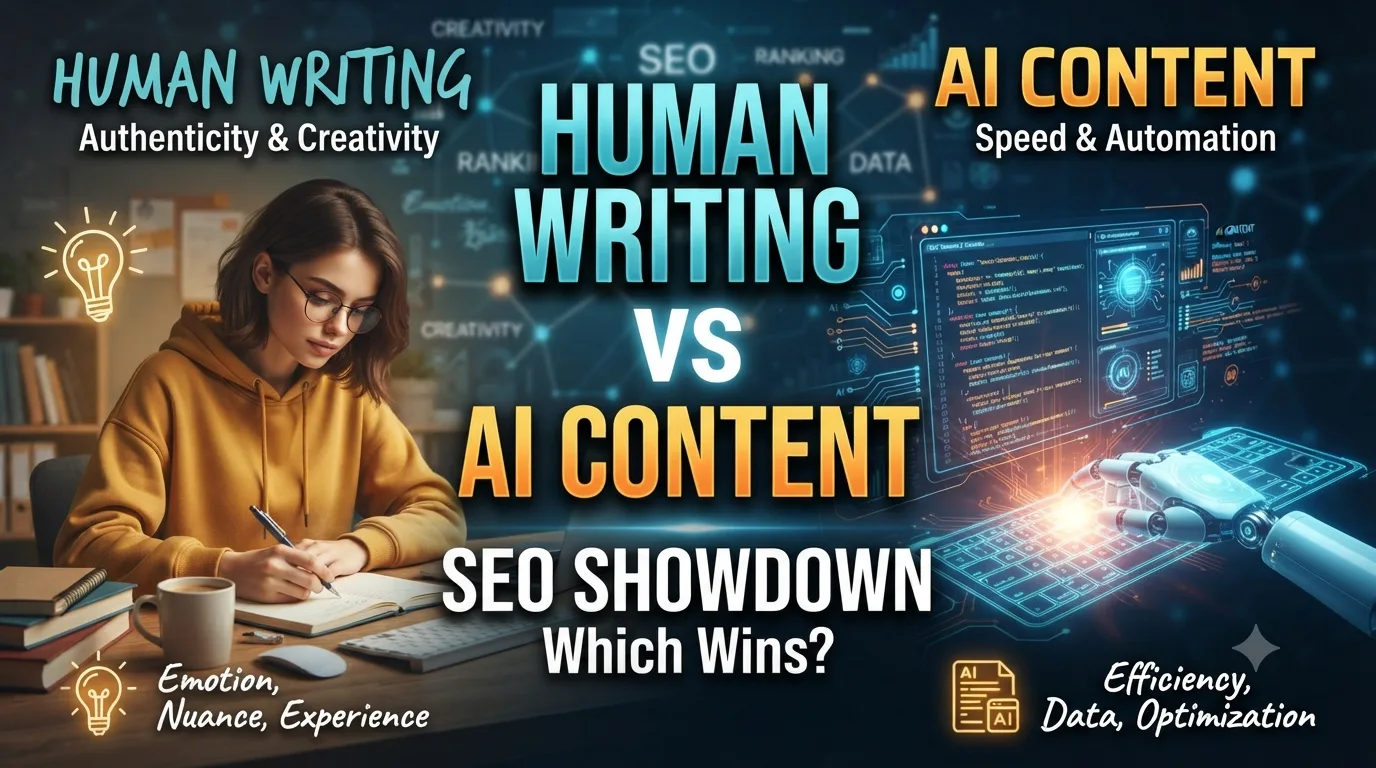
If you’ve spent any time reading SEO discussions over the past two years, you’ve heard the same polarised arguments: human writing is dying, AI content will dominate, or AI is filling search results with mediocrity. The more useful question isn’t which side wins — it’s how Google evaluates both kinds of content today, and how you can build a workflow that protects rankings while making content production manageable.
- AI content is not penalised by Google simply because it’s machine-generated — Google focuses on helpful, reliable, people-first content.
- Fully automated AI text frequently struggles with originality, factual depth, and EEAT signals, especially for topics that require real-world experience.
- A hybrid workflow — AI writing paired with human editing, subject-matter review, and brand-specific refinement — outperforms either approach alone in most content programmes.
- This article gives you a qualitative decision framework to choose between human-only, AI-assisted, and AI-only content based on the page type, risk, and purpose.
- Google ranks content based on quality, usefulness, and trustworthiness, not on whether a human or an AI wrote it, per Google Search Central’s guidance on AI-generated content.
- Pure AI content often lacks original examples, unique data, and a consistent editorial voice, which limits its ability to build topical authority over time.
- Hybrid workflows — AI drafting plus expert human editing — typically produce higher-quality output than fully manual or fully automated processes for the majority of content types.
- For YMYL (Your Money or Your Life) topics, human expertise and rigorous editorial review are not optional; they are essential for maintaining trust and satisfying EEAT expectations.
- AI-generated content carries a higher risk of factual inaccuracies and can misinterpret nuanced search intent, especially for complex, multi-layered queries.
- Over-reliance on AI without a content quality review process can lead to large volumes of thin pages that weaken a site’s overall authority in the eyes of users and search engines.
- Why SEO Isn’t About ‘Human vs. AI’ — It’s About Quality Signals
- How Google Evaluates Content Quality (No Matter Who Writes It)
- Strengths of Human Writing That AI Still Can’t Replicate
- Strengths of AI Content That Speed Up SEO Workflows
- Human Writing vs AI Content: SEO Comparison
- The Hybrid Workflow: Combining AI Drafting with Human Editorial Oversight
- When to Avoid Fully Automated AI Content — And Why
- Common Mistakes When Mixing Human and AI Content
- A Practical Framework for Content Decisions
- How This Applies in Practice
- FAQ: Human Writing vs AI Content SEO
- Article Summary
Why SEO Isn’t About ‘Human vs. AI’ — It’s About Quality Signals
The framing of “human writing versus AI content” misses the point of how modern search ranking works. Google does not classify a page by the tool that created its text. Instead, its systems look for signals of experience, expertise, authoritativeness, and trust — collectively known as EEAT. Whether words come from a person or a large language model matters far less than whether the content demonstrates first-hand knowledge, supports claims with credible sources, and actually helps the searcher.
How Google Evaluates Content Quality (No Matter Who Writes It)
Google’s ranking systems — and the human search quality raters who inform them — evaluate content along several dimensions that apply equally to human-written and AI-generated text. The Search Quality Rater Guidelines emphasise page purpose, expertise, authoritativeness, trustworthiness, and the amount of effort and originality invested in the content. If a page feels mass-produced, contains factual errors, or lacks genuine insight, it may underperform regardless of whether a person or a machine produced it.
Google Search Central has explicitly stated that AI-generated content is not against its guidelines as long as it is created with the goal of helping people, not manipulating rankings. This means the same scrutiny applies: thin, duplicate, or untrustworthy content is a problem, while well-researched, original, and user-focused content has a chance to rank — irrespective of its origin.
To assess quality consistently, SEO teams often monitor the same core signals they would for any page: organic click-through rate, dwell time, internal link equity, and whether the page earns backlinks or engagement. Tools like Google Search Console and Ahrefs can reveal impressions and clicks, but they won’t tell you whether the content is genuinely trustworthy — that judgement still requires human review.
Strengths of Human Writing That AI Still Can’t Replicate
Human writers bring lived experience, nuanced industry insight, and the ability to connect ideas in unexpected ways that feel fresh to a reader. In SEO, these traits help a page stand out when many competitors publish similar information. A human-written article can incorporate real anecdotes, proprietary data, and context that comes from actual client work, product development, or physical-world observation — things a language model cannot access.
Another advantage is editorial consistency. A skilled writer can maintain a distinct brand voice across hundreds of pages, building a recognisable identity that fosters trust and repeat visits. While AI tools can be prompted to mimic a tone, they often drift into generic phrasing or lose coherence across long-form content without heavy editing. For topics that require cultural nuance, legal interpretation, or sensitive health advice, relying solely on human expertise remains the safest path.
Strengths of AI Content That Speed Up SEO Workflows
AI content generation excels at two things that matter enormously in SEO: speed and structuring information. Large language models can quickly produce article outlines, meta description drafts, FAQ responses, and even full first drafts based on a topic and a set of target keywords. For content hubs that need dozens of supporting articles, this scalability reduces the time spent on research and formatting.
AI is also strong at summarising existing knowledge, suggesting semantically related sub-topics, and helping teams break complex subjects into digestible sections. When used thoughtfully, AI-assisted drafting lets SEO teams focus energy on higher-value activities — like conducting original research, building expert quotes, and refining the arguments that differentiate content from competitors.
Human Writing vs AI Content: SEO Comparison
| Factor | Human Writing | AI-Generated Content | Hybrid (Human + AI) |
|---|---|---|---|
| Originality & Unique Insight | High — access to personal experience and niche expertise | Low without human review — tends to recycle common knowledge | Moderate to high — human editing adds uniqueness to AI drafts |
| Scalability | Limited by writer capacity and budget | Very high — can generate multiple drafts quickly | Good — AI accelerates drafting, human review controls quality |
| Factual Accuracy (Without Review) | Variable — depends on writer’s knowledge and research | Risky — can confidently produce errors or outdated information | Strongest — human fact-checking catches AI hallucinations |
| EEAT Signal Strength | Strong when author credentials are present | Weak unless heavily edited and attributed to real experts | Can be strong if human expert is credited and review is evident |
| Cost Efficiency | Higher per-page cost at scale | Low initial cost but may require expensive rewrites later | Balanced — reduces drafting time while maintaining quality |
| Brand Voice Consistency | Easy to control with style guides and experienced writers | Difficult — often slips into generic or overly formal tone | Consistent when editors enforce brand guidelines on AI output |
The Hybrid Workflow: Combining AI Drafting with Human Editorial Oversight
A hybrid content creation process doesn’t mean simply generating AI text and hitting publish. The strongest SEO results come from a structured workflow where AI handles the heavy lifting of research aggregation and structural scaffolding, while human editors refine, verify, and enhance the content. This approach lets teams publish more without sacrificing quality — but only if the review step is thorough and consistent.
In a typical hybrid workflow, you might use an LLM to produce a detailed outline and a full first draft based on a target keyword cluster and a list of on-page SEO requirements. Then a subject-matter expert (or a senior editor) checks for factual correctness, adds real-world examples, improves transitions, and ensures the page matches the search intent. The final step is an on-page SEO check that covers internal linking, heading hierarchy, and schema markup such as Article or FAQPage where appropriate.
A travel blog with 300+ destination guides moved from a fully manual process to an AI-assisted model. The editor provided detailed prompts with target keywords, tone requirements, and specific local insights. The AI generated first drafts; a team of two travel editors then fact-checked opening hours, added personal anecdotes from their trips, and replaced generic descriptions with specific sensory details. Publication speed increased, but the time spent on editing grew proportionally. The biggest lesson: AI accelerated the structural work, but the content only earned links and social shares when the editorial layer was strong enough to make each guide feel authentically human.
- Cross-check all factual claims, statistics, and dates against reputable external sources.
- Verify that examples, names, case details, and numbers are not AI hallucinations.
- Review the article against the target search intent: does the page genuinely answer the question or solve the problem?
- Adjust tone, vocabulary, and sentence rhythm to match brand guidelines — remove generic phrases.
- Add internal links to related cluster content and authority pages on your site.
- Optimise headings, meta title, and meta description for CTR without keyword stuffing.
- Check for redundant paragraphs or sections that repeat the same point in slightly different words.
When to Avoid Fully Automated AI Content — And Why
Fully automated AI content — where a draft is generated and published with no editorial review — is risky for any page you expect to drive meaningful organic traffic. The risks compound for YMYL topics such as health, finance, legal advice, or safety information, where factual errors can cause real-world harm and Google applies stricter quality standards. Even on non-YMYL sites, publishing AI content without review can lead to indexing of near-duplicate or contradictory information that confuses users and dilutes site authority.
Automation is also a poor choice for pages that require original data, proprietary research, or strong opinion pieces. Search engines reward content that adds something new to the conversation, and unedited AI content tends to regurgitate existing web knowledge without contributing fresh insight. If a page cannot pass a basic “who would cite this as a source” test, it’s not ready to publish.
Common Mistakes When Mixing Human and AI Content
Even experienced content teams make missteps when blending AI and human writing. The most frequent mistakes are not about the tool itself, but about process gaps.
- Treating AI output as final copy. Assuming the draft is publication-ready leads to factual errors, bland phrasing, and missed opportunities to add unique examples.
- Ignoring author identity and transparency. Publishing AI-heavy content without a clear author bio or expert attribution weakens EEAT signals, especially for topics where credentials matter.
- Over-optimising for keywords instead of intent. AI tools can easily be prompted to include keywords at a target density, but this often results in unnatural language that frustrates readers and underperforms in search.
- Skipping the internal linking strategy. AI drafts often fail to link to other relevant pages on the site, missing an opportunity to distribute PageRank and reinforce topical clusters.
- Creating too much content too fast without quality gates. A sudden spike in low-value indexed pages can trigger a site-wide quality reassessment, especially on smaller or newer domains.
- Not differentiating between content types. Using the same hybrid workflow for a privacy policy page, a thought-leadership article, and a product description without tailoring the review depth per page type leads to inconsistent quality.
A Practical Framework for Content Decisions
Instead of approaching every page with the same workflow, use a qualitative decision matrix that considers the content’s purpose, the level of expertise required, the risk of inaccuracy, and how much trust the reader needs. This framework helps you choose between human-only, AI-assisted, and AI-only creation on a page-by-page basis.
Rate each content piece on the following criteria using a simple scale: 1 = Low, 2 = Moderate, 3 = High. Then decide the appropriate creation method based on the total score and the nature of the page.
| Criterion | Score 1 (Low) | Score 2 (Moderate) | Score 3 (High) |
|---|---|---|---|
| Need for original insight or unique data | Can be based on widely known facts | Requires some analysis or industry interpretation | Requires proprietary research, case studies, or expert opinion |
| Subject-matter expertise required | General knowledge is sufficient | Specialist knowledge improves quality | Formal credentials or first-hand experience is essential |
| Factual accuracy risk | Low — minor errors have little impact | Moderate — errors could mislead readers | High — errors could cause harm or legal risk |
| Reader trust level needed | Low — informational content with no high-stakes decisions | Medium — content influences product choices or opinions | High — YMYL, financial, medical, or legal content |
Decision guide:
- Total 4–5: AI-only with light human review. Suitable for simple definitions, internal keyword glossaries, or low-risk listicles where uniqueness is not a priority.
- Total 6–8: AI-assisted hybrid workflow. AI drafts the structure and body, human editor adds examples, refines voice, and fact-checks. Works well for most blog posts, how-to guides, and category descriptions.
- Total 9–12: Human-led creation. Assign to a subject-matter expert or experienced writer. AI can still assist with research aggregation and SEO outlines, but the final output must be heavily human-authored and reviewed.
For any page with a score of 3 in the “Factual accuracy risk” or “Reader trust level needed” criteria, always default to human-led creation, regardless of the total score.
Use this matrix during content planning, not after writing. It prevents the common mistake of treating high-stakes pages the same way as low-risk supporting content.
How This Applies in Practice
The same hybrid workflow and decision matrix look different depending on your site type. Here’s how the concepts translate into everyday operations for four common scenarios.
Beginner website (blog, hobby site)
At this stage, resources are limited and the primary goal is building initial topical coverage. An AI-assisted approach makes sense for most posts, but the site owner should still manually review each draft for accuracy and add personal perspective. A beginner site benefits from slower publishing with higher editorial care — publishing 10 high-quality hybrid articles can outweigh 50 AI-only posts that lack personality. Over time, as the author gains subject-matter expertise, more human-written content can strengthen EEAT signals.
SaaS website
SaaS content often requires deep product knowledge, technical accuracy, and the ability to address pain points from real user conversations. Use AI for help with competitive comparison tables, feature list drafts, and SEO meta data, but keep product demos, case studies, and thought-leadership pieces human-led. The decision matrix typically places SaaS landing pages and comparison posts in the hybrid or human-led category because factual errors directly impact purchasing decisions. Author bios with real team member names and credentials become essential.
Ecommerce store
Product descriptions at scale are a natural fit for AI-assisted generation, but the editorial layer must add unique details that a language model cannot know — material feel, size nuances, customer-favourite use cases. Category pages and buying guides often score moderate on the matrix and work well with hybrid creation. For any page that discusses product safety, dietary information, or warranties, treat it as high-risk and use human-led creation with strict fact-checking.
Local business
Local SEO pages — service descriptions, city landing pages, and FAQ sections — can benefit from AI drafting to avoid thin content, but must be carefully customised with real location-specific information (address, staff names, local regulations, and project photos). Google’s local ranking factors reward authenticity and relevance. An AI-generated “About Us” page that sounds generic will not build trust with users or search engines. Here, the hybrid workflow should always end with a local expert review.
FAQ: Human Writing vs AI Content SEO
Does Google penalize AI-generated content?
No, Google does not automatically penalize content because it was generated by AI. Google’s position, published on Google Search Central, is that the focus should be on content quality, helpfulness, and trustworthiness — not the production method. However, if AI-generated content is used to create low-value, duplicate, or misleading pages at scale, it can violate Google’s spam policies and trigger manual or algorithmic actions. The risk is not the AI itself, but the intent behind the content. When using AI, treat it like any other content source: review carefully, add unique value, and ensure it genuinely serves the user’s query.
Can AI content rank on the first page of Google?
Yes, AI-generated content can rank on the first page, sometimes in competitive niches, when it meets the same criteria as human-written pages: thorough topic coverage, correct information, good user experience, and strong EEAT signals. That said, purely unedited AI content often underperforms over time because it lacks the distinctive insight and freshness that keep a page authoritative. The content that consistently appears on page one tends to have human oversight — editors who verify facts, improve readability, and inject industry-specific context. If you treat AI as a first draft tool rather than a final publisher, your chances of earning and keeping first-page rankings increase substantially.
How can I tell if content is AI-generated?
There is no completely reliable automated detector, and Google has acknowledged the limitations of AI detection tools. Instead, human reviewers look for patterns: repetitive sentence structures, unnatural transitions, lack of specific examples, and content that reads like a generic encyclopaedia entry without original perspective. Often, AI content struggles with deep nuance, contradictory statements within the same article, or overly confident factual claims that lack citations. While these patterns can hint at AI involvement, they are not definitive proof. A better approach is to assess quality regardless of origin: if a page reads like it was written without genuine first-hand knowledge or editorial care, its ranking potential will likely suffer no matter who or what wrote it.
Should I disclose the use of AI for content creation?
There is no SEO-specific requirement from Google to disclose AI usage, but transparency can benefit EEAT. For some industries, particularly news, health, or finance, disclosing AI assistance and naming the human editor responsible for review helps build trust with readers. A simple note such as “This article was drafted with AI assistance and reviewed by [name], [credentials]” can reassure users that an expert has verified the information. For lower-stakes content, disclosure is optional but may still strengthen your brand’s commitment to honesty. Whatever you choose, ensure that any disclosure is genuine — don’t claim human oversight that didn’t happen, as that backfires when quality issues emerge.
Is human-written content always better for SEO?
Not automatically. A poorly researched or badly structured human-written article can perform worse than a carefully edited AI-assisted article. Human writing isn’t a SEO shortcut; the same quality filters apply. What human writers can do better — when given enough time and expertise — is bring authentic voice, original anecdotes, and the ability to interpret complex or ambiguous topics in a way that resonates with readers. But many human-produced pages fail because they’re rushed, neglect search intent, or ignore on-page SEO best practices. Content quality is a multi-factor outcome, not a simple binary of human versus machine.
How do AI Overviews affect AI content rankings?
AI Overviews (formerly called SGE) synthesise answers from multiple sources and present them at the top of search results. This changes the traffic potential for some informational queries, regardless of whether the source content is human or AI-generated. Pages that directly, concisely, and accurately answer a query — with structured data such as FAQPage schema or clear definition-style formatting — have a better chance of being sourced in AI Overviews. Purely AI-generated pages that are vague or redundant are unlikely to be selected as a source. To increase visibility in an AI-driven SERP, focus on creating entity-rich, well-structured, and reliably cited content that clearly solves the user’s problem in one place. Human editorial oversight is critical to ensure that level of clarity and trustworthiness.
This article examined how human writing and AI-generated content perform in search, emphasising that Google evaluates quality, trust, and usefulness — not the identity of the writer. You learned that both methods can succeed, but raw AI content often lacks the originality and authority needed to sustain rankings, while human-only workflows can become unscalable. The core recommendation is a structured hybrid workflow: AI handles drafting and research aggregation, while human editors inject unique insight, enforce brand voice, and verify accuracy. The Content Quality Decision Matrix gives you a practical, page-level tool to decide when to use AI-only, hybrid, or human-led creation based on insight demands, expertise requirements, factual risk, and reader trust.
Conclusion
The human writing vs AI content SEO debate distracts from what actually matters — building content that earns trust while remaining manageable to produce. In 2026, the teams that succeed aren’t picking a side; they’re designing review processes, editorial checklists, and decision frameworks that extract the efficiency of AI while protecting the authenticity that users and search engines demand. A thoughtful mix of both, calibrated by content risk and purpose, is the strategy that most often leads to consistent, long-term organic performance.
Recommended Resources
- Google Search Central — official guidance on AI content, ranking, and webmaster guidelines.
- Schema.org — structured data types including Article, FAQPage, and HowTo.
- Ahrefs Blog — SEO research, content strategy, and ranking factor analysis.
- Semrush Blog — content marketing, SEO workflows, and competitive research.
- Moz Blog — industry commentary and practical SEO education.
- Google Search Console — monitor indexing, clicks, and impressions for your content.
About the Author
The SMARTCHAINE Editorial Team specializes in SEO, AI Search Optimization, GEO (Generative Engine Optimization), AI Overviews, Structured Data, Technical SEO, and search visibility strategies for modern search engines and AI-powered discovery platforms.