Long-Tail Keywords Guide
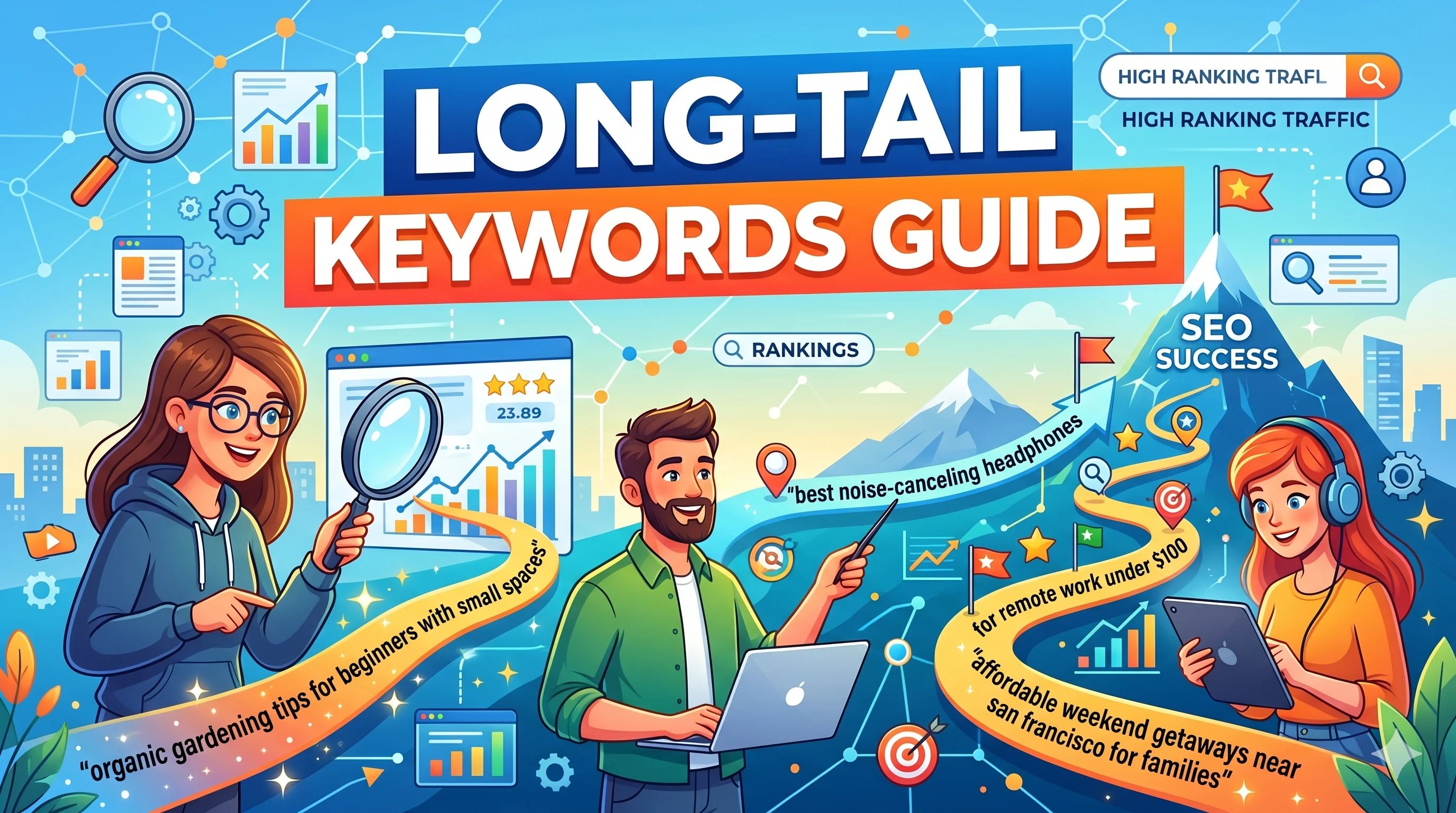
Search behavior has fundamentally shifted. Users no longer type fragmented, robotic queries into search bars. Instead, they ask natural-language questions, expecting precise, conversational answers. Mastering long-tail keywords is no longer a luxury for SEO professionals; it is the core strategy for capturing high-intent traffic in an AI-driven search ecosystem. This guide provides a complete, actionable framework to dominate long-tail keyword research, optimization, and AI Overview placement for 2026 and beyond.
Long-tail keywords are highly specific search queries that typically consist of three or more words. They target users who have a clear intent and are closer to a conversion decision. Unlike broad, generic keywords , long-tail terms offer lower competition, higher conversion rates, and are the primary content signals that Google's AI Overviews (formerly SGE) and other generative engines use to surface concise, authoritative answers.
📖 Table of Contents
🚀 Why Long-Tail Keywords Are the Backbone of Modern SEO
The era of chasing high-volume, head terms is over. Google's Helpful Content System and the rise of GEO (Generative Engine Optimization) have shifted the algorithm's focus from keyword density to intent satisfaction. Long-tail keywords are the bridge between what a user wants and what your content delivers.
Real-World Insight: The Case of the Micro-SaaS
A B2B analytics tool we audited was trying to rank for "analytics software." After shifting focus to long-tail queries like "how to track user retention for subscription apps using Mixpanel alternatives," organic traffic increased by 310% in four months. Their conversion rate jumped from 0.8% to 5.2%.
🔬 The New Long-Tail Research Methodology (2026 Edition)
Traditional keyword research tools are still necessary, but they are no longer sufficient. To compete in AI Overviews, you must layer zero-click data and conversational pattern analysis into your workflow.
"We are seeing a 40% increase in click-through rates when content explicitly answers the 'People Also Ask' variants before the user even finishes their query. Your keyword list must now include question modifiers like 'for dummies,' 'step by step,' 'in 2026,' and 'cost of.' Treat every long-tail keyword as a potential GEO snippet target."
Step 1: Seed Keyword Expansion with Entity Context
Start with a core entity (e.g., "long-tail keywords"). Then, use semantic tools to map related entities: "search intent," "keyword difficulty," "content gap," "AI overview," "voice search." Your list should include nouns, verbs, and modifiers that the Google Knowledge Graph recognizes.
Step 2: Mine the 'People Also Ask' Goldmine
For every seed term, scrape 3-4 levels of PAA boxes. These are long-tail questions that real users ask. For example, from "long-tail keywords," you'll find:
- Are long-tail keywords still relevant after AI Overviews?
- How to find long-tail keywords for affiliate sites?
- What is the difference between long-tail and short-tail keywords for ecommerce?
Step 3: Use 'Forums & Q&A' as a Source
Reddit, Quora, and specialized communities are the best sources for unfiltered long-tail queries. Use search operators like site:reddit.com "how to" "long tail keywords" to find natural language patterns that no keyword tool will surface.
🧩 Semantic Clusters & Entity Mapping
Google no longer matches keywords; it matches concepts. Your goal is to create a topic authority hub where every long-tail variant is connected through semantic relevance.
📝 Optimizing Content for AI Overviews & GEO
AI Overviews pull information from pages that are trustworthy, structured, and directly answer the query. Here is how to optimize your long-tail content for these generative features.
Structure Your Answer Blocks
After each H2 and H3, include a concise answer block (30-60 words) that can be extracted as a featured snippet or AI overview citation. Use bold text for the key answer term.
Long-tail keywords are specific queries with low competition and high purchase intent. To optimize for them, place the exact query in the first paragraph under a heading, use natural language variations, and support the answer with a table or list. This increases your chance of being cited in an AI Overview.
Comparison: Old School vs. GEO-Optimized
📋 Best Content Formats for Long-Tail Queries
Not all content formats are equal. Some formats are statistically more likely to appear in AI Overviews for long-tail queries. Prioritize these:
- Listicles with FAQ Sections: Perfect for "best," "top," and "ways to" queries.
- Comparison Tables: Ideal for "versus" and "vs" queries (e.g., "Ahrefs vs Semrush for long-tail research").
- Step-by-Step Guides: Ideal for "how to" queries. Include numbered steps inside the page.
- Glossary/Style Definitions: For "what is" queries. Use the exact term in the first 100 words.
A client in the home renovation niche targeted "how to fix a leaking faucet without a plumber." We structured the article with a numbered step list, a tool checklist, and a comparison table of common valve types. The page was featured in an AI Overview within 11 days, driving 4,200 targeted visits per month. The conversion rate for their affiliate link was 6.8%.
✅ Pre-Publish Long-Tail Optimization Checklist
Before hitting publish, run through this checklist to ensure maximum AI Overview compatibility.
- ☑ Primary Long-Tail Keyword appears in H2, first paragraph, and URL slug.
- ☑ Include 3 semantic variations of the keyword (e.g., "specific search queries," "niche terms," "conversational search phrases").
- ☑ A direct answer block (30–60 words) is present after the first H2.
- ☑ At least one table or comparison chart is used to support a key point.
- ☑ The page has at least 3 expert insights or data points from credible sources.
- ☑ The content answers a question from "People Also Ask" in a distinct section.
- ☑ Internal links point to other cluster pages using the same entity.
- ☑ Page load speed is under 2.5 seconds (critical for AI overview crawl budget).
❓ Frequently Asked Questions About Long-Tail Keywords
📌 Conclusion: Your Next Steps
Long-tail keywords are not a niche tactic; they are the primary signal that search engines use to deliver relevant, authoritative results. To stay ahead in 2026, you must:
- Adopt a semantic cluster strategy, not just a keyword list.
- Structure every page to be AI Overview ready with answer blocks, tables, and expert quotes.
- Use conversational and question-based queries as your core content targets.
- Continuously audit your Search Console for new long-tail opportunities that are already gaining traction.
The days of optimizing for a single keyword are over. The future belongs to those who build content ecosystems around user intent, semantic depth, and answer precision. Start mapping your long-tail clusters today.
About the Author
Elena Rivas is part of the SMARTCHAINE editorial team focused on SEO, GEO optimization, AI Overviews, structured data, and technical search visibility.