Micro Niche SEO Guide: 7 Steps to Dominate Small Markets in 2026
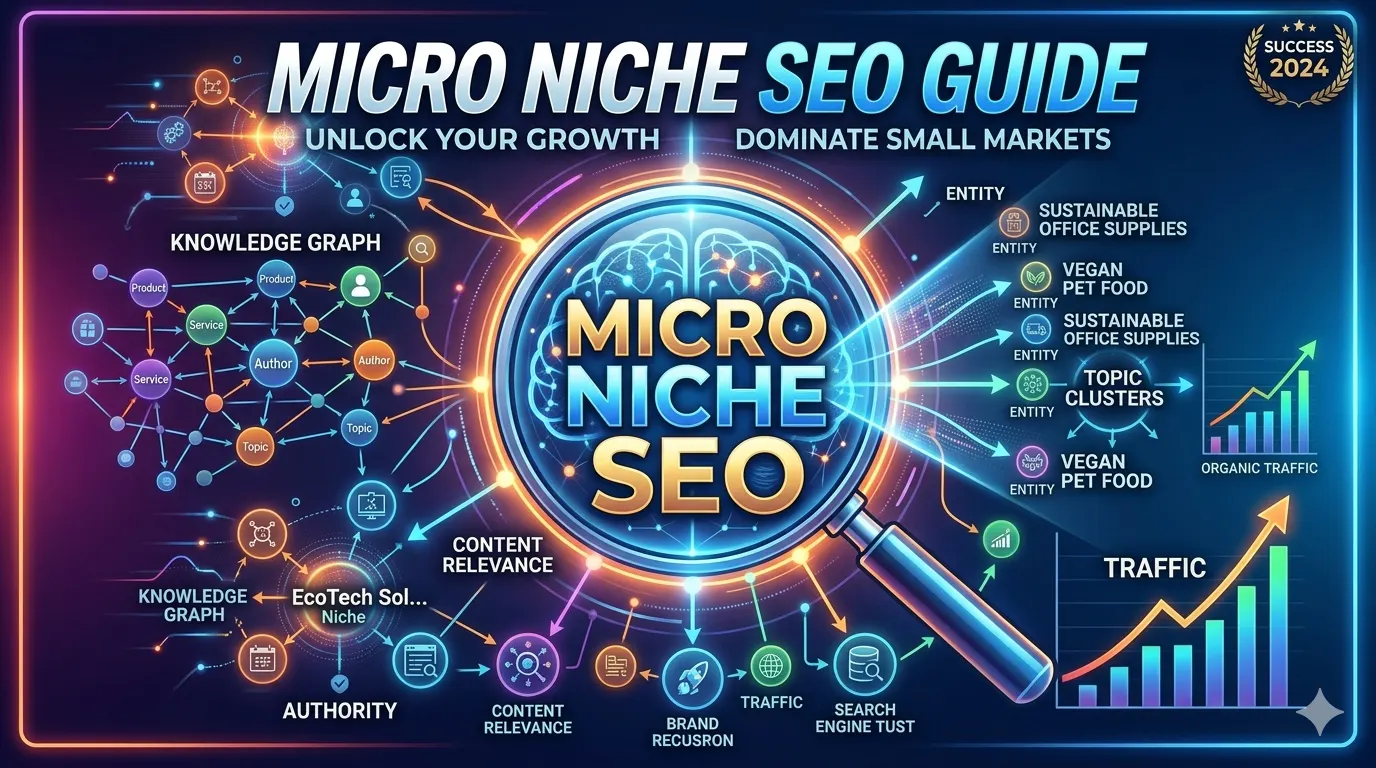
Quick Answer: What is a Micro Niche SEO Strategy?
A micro niche SEO strategy focuses on ranking for a highly specific subset of a broader market—for example, "organic dog food for senior beagles" instead of "dog food." This guide teaches you how to select a viable micro niche, map search intent precisely, and build topical authority without competing against massive domains.
TL;DR
- Micro niches beat broad keywords because Google's AI Overviews reward precise, entity-rich answers.
- Skip generic keyword research. Use entity discovery in Ahrefs or Semrush to find untapped sub-topics.
- Build a content hub around one core entity cluster, not random blog posts.
- Expect slower traffic growth but higher conversion rates due to exact intent matching.
Key Takeaways
- Micro niche SEO relies on entity clustering, not keyword volume. Focus on the relationships between topics.
- Your competitive advantage is depth—cover every facet of a small topic better than anyone else.
- AI Overviews pull from structured, authoritative sources. Use FAQPage and HowTo schema to get extracted.
- Traffic will be low in absolute terms, but buyer intent is often 3x to 5x higher than broad terms (hypothetical example: a "best running shoes" page converts at 1%, while "best trail running shoes for narrow feet" may convert at 4-6%).
- Content freshness matters more in micro niches. A two-year-old post can drop quickly if the niche evolves.
Table of Contents
1. Selecting a Viable Micro Niche
A micro niche must satisfy three criteria: clear search intent, low competition from major domains, and monetization potential. Without these, you will waste time on topics nobody searches for or that cannot be monetized.
The Viability Checklist
- Intent Clarity: Can you write a single page that completely satisfies the searcher's goal? If the query is ambiguous (e.g., "coffee"), it is too broad. If it is "how to brew Ethiopian Yirgacheffe with a V60 at home," you have a micro niche.
- Competition Analysis: Search for the core term in Google. If the top 10 results are all from Wikipedia, major ecommerce stores, or huge publishers, the niche may be too competitive for a new site. Use Ahrefs or Semrush to check domain rating—aim for a situation where most top results have a DR below 50.
- Monetization Path: Can you sell a product, service, or high-CPM ad directly related to the niche? Example scenario: "Vintage mechanical keyboard restoration" supports affiliate links to rare parts, repair tools, and online courses.
Expert Tip
Do not confuse low search volume with no opportunity. A term with 100 monthly searches and clear buyer intent can generate more revenue than a 10,000-volume term with informational intent only. Use Google Search Console and Google Analytics to verify conversion paths, not just traffic numbers.
2. Entity Research & Keyword Mapping
Instead of flat keyword lists, map entities—people, places, concepts, tools, and problems—that form the core of your niche. Google's understanding of entities is the foundation of AI Overviews.
How to Discover Entities
- Start with one seed term. Example: "portable solar generator."
- Use Ahrefs' Keyword Explorer and switch to "Also rank for" to see what entities competitors cover.
- Extract entities manually from the top 5 ranking pages. Look for battery types (LiFePO4), inverter types, charge controllers, and specific use cases (RV, camping, emergency backup).
- Group entities into clusters: Core entity (solar generator), component entities (battery, solar panel, inverter), and solution entities (off-grid living, vanlife power).
| Entity Type | Example | Content Format |
|---|---|---|
| Core Entity | Portable solar generator | Pillar page / review roundup |
| Component Entity | LiFePO4 battery | How-To guide / comparison |
| Solution Entity | Powering a small RV fridge | Use case / checklist |
| Problem Entity | Solar generator not charging in cloudy weather | Troubleshooting guide |
3. Structuring the Content Hub
A content hub organizes all entity pages around a central pillar. This structure signals topical authority to Google and helps AI Overviews understand your site as a reliable source for the entire niche.
The Hub Structure in Practice
- Pillar Page: Comprehensive overview of the core entity. Covers definitions, types, buying criteria, and links to all cluster pages.
- Cluster Pages: Deep dives into each entity. Example: "Best LiFePO4 Batteries for Portable Solar Generators" with schema markup, comparison tables, and buyer guides.
- Supporting Content: Problem-solution posts, troubleshooting guides, and long-tail how-tos that interlink to cluster pages.
Hypothetical Example: "Vintage Guitar Pedal Restoration" Hub
- Pillar: Ultimate Guide to Restoring Vintage Guitar Pedals (1960s–1990s)
- Cluster 1: Identifying Rare Fuzz Pedals by Serial Number
- Cluster 2: Soldering Techniques for Vintage PCB Circuits
- Cluster 3: Best Capacitor Replacements for Tone Preservation
- Supporting: How to Fix a Dead Vintage Wah Pedal (Step-by-Step)
Every cluster page links back to the pillar, and the pillar links out to every cluster. This creates a clear entity relationship graph.
4. Writing for AI Overviews & Featured Snippets
Google's AI Overviews extract concise answers from authoritative pages. To get extracted, your content must deliver direct answers immediately after headings, use structured lists, and mark up relevant blocks with schema.
Answer-First Paragraph Rule
Every H2 and H3 section must start with a paragraph of 40–80 words that directly answers the question the heading implies. Example:
Heading: How to Clean a Vintage Pedal Potentiometer
Answer paragraph: Spray DeoxIT D5 into the potentiometer’s access hole, rotate the knob fully back and forth ten times, and let it dry for 15 minutes. This removes oxidation without damaging the carbon track. Avoid WD-40 as it leaves a residue that attracts dust.
Structured Data Signals
- Use FAQPage schema for question-and-answer sections. AI Overviews often pull from these directly.
- Use HowTo schema for step-by-step guides with images or video.
- Use Product schema for any review or comparison page, even if you are not selling directly.
Expert Tip
AI Overviews favor pages that use clear headings, lists, and tables because they are easy to parse. Do not hide your answer in paragraph five. Put it right after the heading. If you cannot answer the question in 80 words, your page structure is wrong.
5. Technical SEO & Schema for Small Markets
Technical SEO is often overlooked in micro niche sites because the site size is small. However, crawlability and indexability are critical when every page matters.
Priority Technical Checklist
- Core Web Vitals: Aim for LCP under 2.5 seconds, FID under 100ms, CLS under 0.1. Use Google Search Console's Core Web Vitals report to identify issues.
- Mobile Usability: Most micro niche searches happen on mobile. Test all pages with Google's Mobile-Friendly Test.
- Index Coverage: Submit your pillar and cluster pages to Google Search Console. Monitor the Index Coverage report for errors. Remove thin or duplicate pages.
- Schema Implementation: Add Article schema to blog posts, FAQPage to FAQ sections, and BreadcrumbList to all pages. Use Google's Rich Results Test to validate.
Common Mistake: Over-Schema-ing
Do not add Product schema to a page that only mentions a product in passing. Google may flag it as misleading. Only use Product schema when the page is primarily a review, comparison, or sales page for that specific product.
6. Building Backlinks in a Micro Niche
Generic backlink strategies like guest posting on broad authority sites rarely work for micro niches. The backlinks must come from within the niche to signal relevance.
Link Building Workflow for Micro Niches
- Identify niche-relevant directories and resource pages. Example: If your niche is "antique typewriter restoration," find collectors' directories, museum sites, and forums that list repair resources.
- Create linkable assets: Build a free tool, a comprehensive database, or a unique guide that niche sites will want to reference. Example scenario: A spreadsheet of all known typewriter serial numbers by manufacturer.
- Use the Skyscraper Technique (scaled down): Find an existing popular post in your niche, make it better (add more detail, better visuals, updated data), and email the sites linking to the original.
- Forums and community contributions: Join relevant subreddits, Facebook groups, or Discourse forums. Answer questions genuinely. Include a link to your relevant page only when it directly helps the answer.
7. Monitoring & Iterating in 2026
Micro niche SEO requires constant observation. Because the market is small, changes in Google's algorithm or a competitor entering the space can be felt immediately.
What to Track
- AI Overview presence: Monitor whether your pages appear in AI Overviews for core queries. Use tools like Semrush or manual spot checks.
- Featured snippet changes: Track which snippets you hold and which you lose. Google Search Console shows performance for rich results.
- Content decay: Review your cluster pages quarterly. If a new product or method emerges, update the relevant page. Old pages in micro niches lose visibility fast.
- Conversion metrics: Use Google Analytics to track goal completions, not just traffic. A page getting 50 visitors but a 10% conversion rate is worth more than a page getting 500 visitors at 0.5%.
How This Applies in Practice
| Website Type | Micro Niche Example | SEO Priority |
|---|---|---|
| Beginner Blog | "Houseplant care for low-light apartments" | Entity discovery and content depth. Focus on creating the most comprehensive guide for 10 specific plant species. Avoid broad "houseplant care" topics. |
| SaaS Website | "Project management tools for indie game developers" | Feature comparison tables and integration guides. Schema for SoftwareApplication and FAQPage. Link build from game development forums and Discord communities. |
| Ecommerce Store | "Custom leather journal covers for fountain pen users" | Product schema, review schema, and guide content on "how to choose a journal cover for fountain pens." Focus on long-tail product queries with high purchase intent. |
| Local Business | "Historic clock repair in Portland, Oregon" | LocalBusiness schema, Google Business Profile optimization, and local entity content covering neighborhood landmarks. Backlinks from local history blogs and antique shops. |
Mistakes to Avoid
- Choosing a niche with no monetization path. Do not build a site around a hobby unless you know how to make money from it. Test affiliate programs or product viability before writing 20 articles.
- Publishing too few pages. A micro niche site with only 5 pages looks thin. Aim for at least 15–20 cluster pages covering every entity facet before expecting significant organic traffic.
- Ignoring search intent shifts. A query that was informational six months ago may now be transactional. Reassess your pages' intent alignment quarterly using Google Search Console query data.
- Building generic links. A backlink from a general "SEO resources" page helps less than a link from a niche-specific forum thread where users actively discuss the topic.
Article Summary
This guide provided a complete workflow for micro niche SEO: selecting a viable niche, mapping entities instead of keywords, structuring a content hub, writing answer-first for AI Overviews, implementing targeted schema, building niche-relevant backlinks, and monitoring conversion metrics. The core framework—entity clustering with a pillar page—is designed to help small sites build topical authority without massive resources. The approach trades absolute traffic volume for higher conversion rates and better long-term defensibility.
Conclusion
Micro niche SEO is not a shortcut to millions of visitors. It is a strategy for building sustainable, profitable websites in markets where broad competitors cannot compete on depth. By focusing on entity relationships, answer-first content, and niche-specific backlinks, you create a site that Google's AI Overviews recognizes as the authoritative source. Start with one micro niche, build the complete hub, and iterate based on real user behavior rather than vanity metrics.
Frequently Asked Questions
1. How many pages do I need before I see results in a micro niche?
There is no fixed number, but a realistic target is 15–20 high-quality cluster pages covering the main entities. After that, give Google 3–6 months to evaluate your site's relevance. Some pages may rank quickly for long-tail variations; the pillar page may take longer. Monitor Google Search Console for impressions—if impressions grow but clicks lag, your titles or meta descriptions may need work rather than more content.
2. Can I use AI content for micro niche SEO?
Yes, but with strict human oversight. AI can generate drafts, but you must verify factual accuracy, add original insight, and restructure for entity coverage. Google's Helpful Content system rewards content that demonstrates first-hand expertise. A purely AI-generated article on a narrow, specialized topic is unlikely to hold up well in AI Overviews extraction because it lacks the nuance and specificity that comes from real experience.
3. Should I target micro niches on a new domain or an existing site?
Both can work, but the strategy differs. A new domain allows you to build authority from scratch within the niche, but it takes longer. An existing site can leverage its current domain authority to rank micro niche pages faster, provided the topics are related. Example: A general electronics blog can add a "portable solar generator" micro niche hub and benefit from existing authority. Avoid adding unrelated micro niches to an established site; it dilutes your topical focus.
4. How do I compete against Amazon or Wikipedia in a micro niche?
You compete on depth and specificity. Amazon pages are generic product listings. Wikipedia pages are broad overviews. Your micro niche page should answer questions neither of them covers: specific model comparisons, real-world use cases, troubleshooting steps, and buyer decision frameworks. Link to Amazon or Wikipedia where useful, but provide the unique value that keeps readers on your page and signals expertise to Google.
5. What if my micro niche has zero search volume according to tools?
Zero volume in Ahrefs or Semrush does not always mean zero searches. Tools may not capture low-volume queries. Verify by checking Google Search Console data if you have existing content, or by looking at Google Trends for related terms. Also consider whether the niche is better served by brand searches or forum traffic. If you cannot find any real-world evidence of people asking the questions you plan to answer, choose a different niche.
6. How often should I update micro niche content?
Review each cluster page every 6–12 months. Update any factual information, add new product options if applicable, and refresh screenshots or examples. For highly technical niches (like drone repair or coding libraries), update more frequently—every 3 months. Google tends to favor fresh content in fast-moving micro niches. Set a recurring calendar reminder in your project management tool.
Recommended Resources
- Google Search Central – Official documentation on indexing, crawling, and structured data guidelines.
- Schema.org – Complete schema vocabulary for FAQPage, HowTo, Product, and more.
- Ahrefs Blog – Depth-focused SEO guides and keyword research strategies.
- Semrush Blog – Practical content marketing and competitive analysis tactics.
- Moz Blog – Foundational and advanced SEO concepts for niche markets.
- Google Search Console – Essential for monitoring index status, Core Web Vitals, and query performance.
- Google Analytics – Track user behavior and conversion metrics beyond traffic counts.
About the Author
The SMARTCHAINE Editorial Team specializes in SEO, AI Search Optimization, GEO (Generative Engine Optimization), AI Overviews, Structured Data, Technical SEO, and search visibility strategies for modern search engines and AI-powered discovery platforms.