On-Page SEO 2026: Modern Signals That Actually Move Rankings
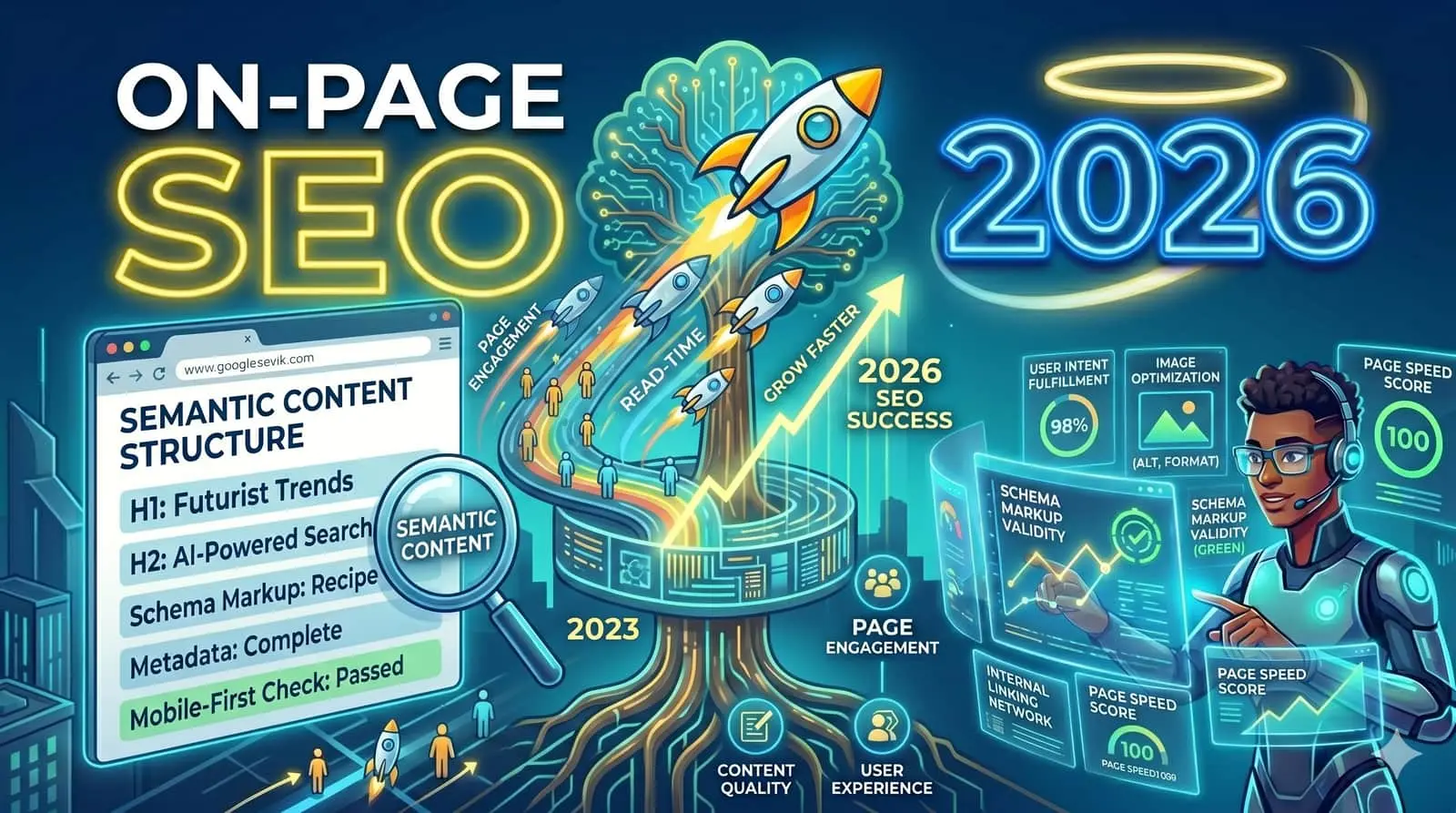
On page SEO 2026 isn’t just about keywords and meta descriptions anymore. Google’s Search Generative Experience (SGE) is fully live, user intent signals dominate, and EEAT (Experience, Expertise, Authoritativeness, Trustworthiness) has evolved into a real-time ranking factor. In this guide, we break down what actually moves the needle this year — from AI overviews to semantic depth, plus actionable tips you can implement today with SMARTCHAINE.
1. The 2026 landscape: What’s different?
Search engines now prioritize helpful content that satisfies multi-step intents. In 2026, on-page success requires answering questions before users ask them. Google’s AI models evaluate content against millions of user interactions, rewarding pages that combine authority, visual clarity, and lightning-fast interactivity.
2. EEAT 2.0: Author reputation & content provenance
Your author bio, credentials, and external citations matter more than ever. The ‘About Us’ page, contributor profiles, and linked social proof validate E-E-A-T. For on-page SEO 2026, ensure each content piece includes author bylines with links to expertise profiles.
Also, add “last updated” timestamps and cite reputable sources. Avoid anonymous or generic content—Google’s helpful content system downgrades low-EEAT pages.
3. Semantic keyword clusters & NLP optimization
Keyword stuffing is a relic. You should instead build topic clouds. Use latent semantic indexing (LSI) and related entities naturally. Answer “people also ask” boxes directly within H2s or dedicated sections. Aim for complete topical coverage — not just one keyword.
- Include at least 5–7 semantically related terms (e.g., for “on page seo 2026” → “semantic HTML”, “entity salience”, “user interaction signals”).
- Use descriptive alt text for images and internal deep links.
- Embed summary tables for comparison (featured snippet gold).
4. Core Web Vitals: INP & CrUX dashboard
Core Web Vitals continue as a ranking factor. In 2026, INP (Interaction to Next Paint) replaces FID. Aim for INP under 200ms. Ensure CLS under 0.1, LCP under 2.5s. Google CrUX report integration helps you benchmark against competitors.
Try SMARTCHAINE’s Site Speed Auditor to detect layout shifts and javascript bottlenecks— it provides actionable recommendations aligned with Google’s PageSpeed Insights.
5. Optimizing content for AI Overviews (SGE)
Google’s AI-generated overviews now appear for 84% of complex queries. To win visibility, structure your content with clear definitions, lists, tables, and Q&A. Use “what is”, “how to”, “step by step” intros. Make your H2s conversational and self-contained.
Pro tip: Include direct “short answers” right after each H2. This increases chances of being cited as a source in the generative panel.
6. Advanced structured data & entity enrichment
Beyond basic Article schema, add HowTo, FAQ, QAPage, and Speakable schema. In 2026, Google’s parser improves entity recognition — include sameAs properties and organization details. JSON-LD is mandatory for featured snippets and knowledge panels.
We’ve embedded JSON-LD within this post (BlogPosting). But you can go further: add VideoObject, ItemList, or Course schema depending on content type. SMARTCHAINE’s Schema Builder helps generate error-free markups in one click.
🎯 Key Takeaways – On Page SEO 2026
- Prioritize EEAT signals: author reputation, references, transparency.
- Build semantic topic clusters, not single keyword targets.
- Optimize for INP & Core Web Vitals – monitor CrUX.
- Target AI Overviews with concise, structured answers.
- Use advanced schema + entity SEO to claim rich results.
- Internal linking with descriptive anchors helps distribute page authority.
📌 Frequently asked questions (on-page SEO 2026)
Is on-page SEO still relevant in 2026 with AI search?
Absolutely — more than ever. AI overviews rely on well-structured, relevant content. Without on-page optimization, your content won’t be selected as a source for generative answers.
What’s the ideal content length for ranking in 2026?
No fixed length, but comprehensive guides ranking on first page average 1,800–2,500 words. However, quality and unique insights matter more. Avoid fluff; satisfy search intent completely.
Does meta keywords or meta description matter for ranking?
Meta keywords are ignored by Google. Meta descriptions do not directly impact ranking but influence CTR — which is a crucial engagement signal. Write compelling, action-oriented descriptions (max 160 chars).
How to track on-page SEO improvements?
Use SMARTCHAINE’s On-Page Grader: monitor keyword positions, content freshness, internal linking score, Core Web Vitals and crawl depth. Continuous A/B testing of headlines and CTAs yields edge.
🛠️ SMARTCHAINE tools for modern on-page SEO
- SEO Audit Dashboard – scan technical & content issues with AI recommendations.
- Semantic Keyword Explorer – generate topic clusters & LSI terms for 2026.
- Core Web Vitals Monitor – real-time INP/LCP/CLS tracking across devices.
- Schema Markup Generator – deploy JSON-LD without code errors.
- AI Content Optimizer – rewrite content to match SGE/topical authority patterns.
🚀 Ready to future-proof your traffic?
Get actionable on-page SEO insights, real-time site audits, and SGE-ready content optimization with SMARTCHAINE. Join 15,000+ marketers.
Start my free trial →