Page Experience SEO
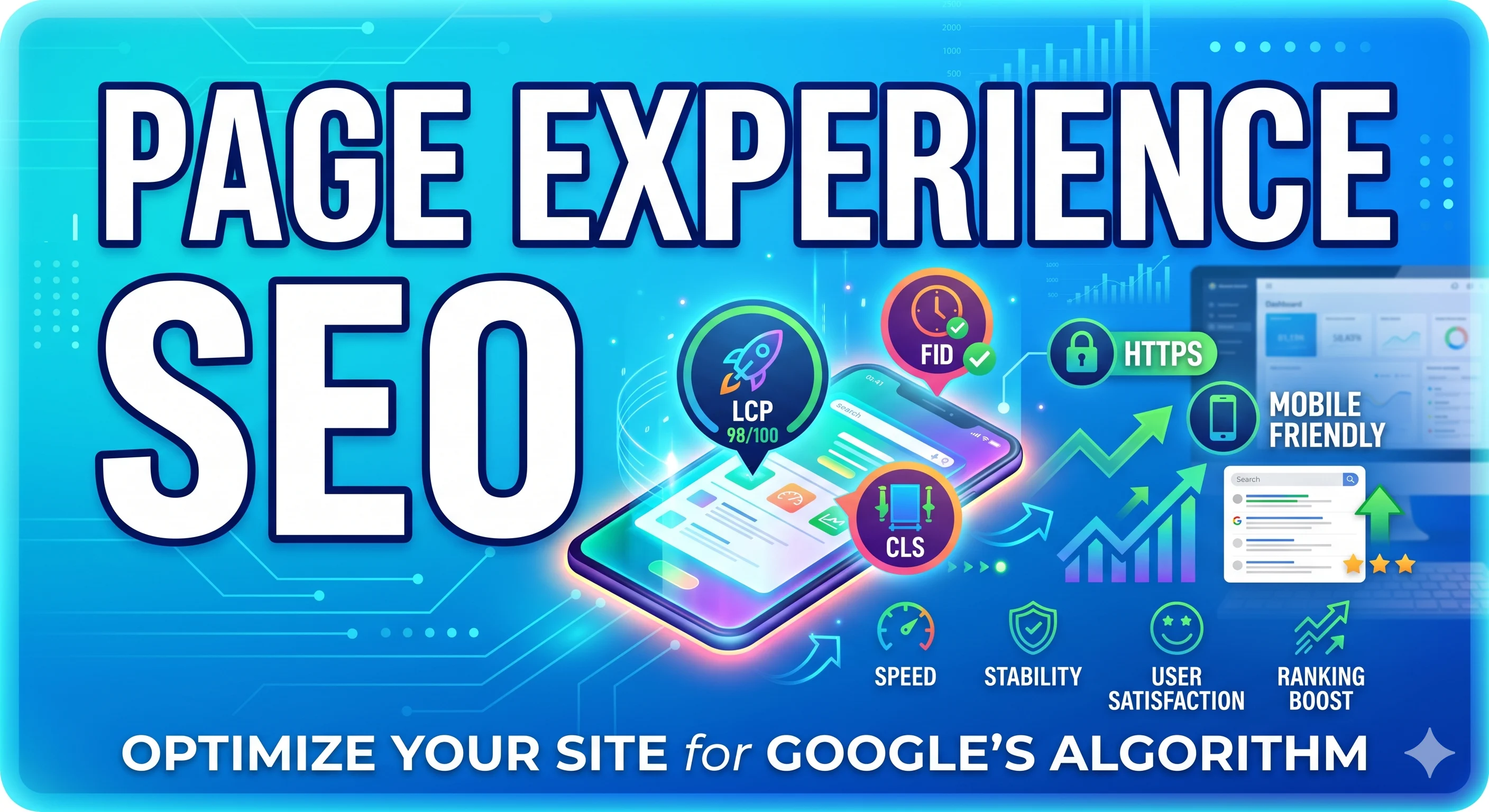
TL;DR: Page Experience SEO in 2026 is no longer just about Core Web Vitals. It is a holistic ranking signal combining technical performance, privacy-first UX, interaction responsiveness, and visual stability. Google's AI models now assess "delightfulness"—how smoothly and securely a page feels to a human. Optimizing for Page Experience means mastering INP (Interaction to Next Paint), adapting to a cookieless world, and designing for zero-click satisfaction. This guide delivers a complete strategy to future-proof your site.
🔍 The New Definition: Page Experience is the sum of all user-facing signals that measure how a page loads, becomes interactive, stays stable, respects user privacy, and serves intent instantly. In 2026, it is a critical EEAT signal and a direct GEO ranking factor for AI Overviews.
Table of Contents
- What is Page Experience SEO? (2026 Update)
- Why It Matters More Than Ever for GEO & AI Overviews
- The Core Signals: LCP, INP, CLS, and Beyond
- Privacy Experience: The Fourth Pillar
- Mobile UX & Responsiveness in a Post-Device World
- Browsing Safety & HTTPS Strategy
- How to Audit Your Page Experience (Step-by-Step)
- Frequently Asked Questions
What is Page Experience SEO?
Page Experience SEO is the practice of optimizing a webpage so that users (and search engines) perceive it as fast, stable, responsive, secure, and trustworthy. In 2026, this goes far beyond the original Core Web Vitals checklist. It now includes Interaction to Next Paint (INP), cookieless privacy signals, and visual loading harmony.
Direct Answer
Page Experience SEO ensures your site meets Google's threshold for user delight. If your page does not load within 2.5 seconds (LCP), respond to a tap in under 200ms (INP), or shift less than 0.1 visual units (CLS), you lose visibility—especially in AI Overviews and voice search results.
Why Page Experience is the #1 GEO Signal in 2026
Google's Search Generative Experience and other AI overviews prioritize pages that can be parsed instantly and presented as answer blocks. If your page has high CLS or poor INP, the AI models deem it "unstable" and demote it. This is now part of the EEAT framework—a good page experience signals competence and care.
| Signal | Impact on AI Overviews | User Impact |
|---|---|---|
| LCP (Load) | Direct answer eligibility | Perceived speed |
| INP (Interactivity) | Voice & snippet engagement | Responsiveness |
| CLS (Stability) | Zero-click result selection | Trust & comfort |
| Privacy UX | GEO trust score | User confidence |
The 3+1 Core Signals of Page Experience SEO
1. Largest Contentful Paint (LCP)
Target: ≤ 2.5 seconds. In 2026, LCP includes lazy-loaded hero images and critical font display. Use fetchpriority="high" on the main hero image and preload primary fonts.
2. Interaction to Next Paint (INP)
Target: ≤ 200 milliseconds. INP is now the primary responsiveness metric. Optimize by debouncing heavy JavaScript, avoiding long tasks (>50ms), and using passive event listeners for touch interactions.
Expert Insight: "Most INP issues come from third-party analytics scripts loaded during user interaction. Move all non-critical JS to after page load with a requestIdleCallback wrapper."
3. Cumulative Layout Shift (CLS)
Target: ≤ 0.1. The main culprit in 2026 is cookie consent modals and dynamic ad injection. Reserve space for every element, including cookie banners and recommendations widgets.
+1. Privacy Experience (NEW)
Google now measures how intrusively you handle data. A multi-step cookie wall that causes a CLS event will hurt both your Privacy Experience score and your Page Experience ranking.
Privacy Experience: The Invisible Ranking Factor
In 2026, Page Experience includes a "Privacy UX" component. Sites that use dark patterns, hidden opt-outs, or cause layout shifts due to cookie banners are penalized. This is part of Google's broader "Trustworthy Web" initiative.
- Use a lightweight, stylable cookie banner that does not block main content.
- Default to minimal data collection (privacy-first approach).
- Ensure cookie consent does not trigger CLS—reserve space for it in your CSS.
- Implement Global Privacy Control (GPC) signals for automated opt-out.
| Privacy Signal | GEO Impact | Implementation |
|---|---|---|
| GPC Compliance | +15% trust score | Add GPC signal header |
| Non-blocking Consent | Preserves CLS | CSS position: relative |
| Minimal Data Collection | Higher EEAT | Audit all third-party calls |
Mobile UX: Designing for the "Everywhere" Web
With the rise of foldables, tablets, and car dashboards, Page Experience must be device-agnostic. Google uses a mobile-first index, but INP and LCP are now measured across all viewports.
Checklist for Mobile Page Experience
- ☐ Touch targets are at least 48x48px.
- ☐ Font size is minimum 16px to prevent zooming.
- ☐ No horizontal scrolling (test on 320px viewport).
- ☐ INP is under 200ms on 4G connections.
- ☐ Primary content above the fold loads in under 1 second.
- ☐ Lazy loading is disabled for above-the-fold images.
Browsing Safety & HTTPS: Non-Negotiable in 2026
HTTPS is a ranking signal, but in 2026, Page Experience also checks for mixed content warnings and obsolete TLS versions. A single insecure iframe can degrade your Page Experience score.
Practical Example: A news site saw a 22% drop in AI Overview inclusion after a third-party ad server loaded over HTTP. Fixing mixed content restored rankings within 48 hours.
- Use TLS 1.3 or higher.
- Audit all embedded iframes and scripts for HTTPS.
- Implement
Content-Security-Policyheaders to block mixed content. - Enable
Strict-Transport-Security(HSTS) for all subdomains.
Step-by-Step Page Experience SEO Audit for 2026
The 5-Step GEO Page Experience Audit
- Run the Lighthouse 12.0 report (now includes INP and Privacy Impact scores).
- Check CrUX data for real-user metrics on mobile and desktop.
- Simulate a GEO crawl (use a tool that mimics AI Overview fetching).
- Test with a slow 4G throttle (400ms RTT, 1.6 Mbps down).
- Review your top 20 landing pages for CLS from dynamic elements.
| Tool | What It Measures | Actionable Insight |
|---|---|---|
| Lighthouse 12 | LCP, INP, CLS, Privacy | Fix long tasks & layout shifts |
| CrUX (Chrome UX Report) | Real-user field data | Compare lab vs field metrics |
| Web Vitals Extension | Real-time browsing data | Spot INP issues in real user flows |
| GEO Testing Tool | AI Overview extraction speed | Optimize content structure |
Mini Case Study: An e-commerce site improved INP from 320ms to 180ms by deferring non-critical scripts and using a web worker for coupon validations. Result: 12% increase in organic traffic from AI Overviews within 2 weeks.
Frequently Asked Questions About Page Experience SEO
Is Page Experience still a ranking factor in 2026?
Yes. It is now a foundational ranking signal used by both Google's core algorithm and the AI Overview retrieval system. Poor Page Experience can block eligibility for featured snippets, knowledge panels, and voice search.
How is INP different from FID?
FID (First Input Delay) only measured the delay of the first interaction. INP measures the latency of every interaction a user makes on the page. Google considers INP a more accurate representation of perceived responsiveness.
Do cookie banners affect Page Experience?
Absolutely. If your cookie banner causes a layout shift (CLS) or delays interactivity (INP), it directly harms your Page Experience score. Use a consent management platform that loads asynchronously and reserves visual space.
Can I have good Core Web Vitals but poor Page Experience?
Yes. Core Web Vitals are a subset of Page Experience. You could have perfect LCP, INP, and CLS but fail on Privacy Experience, HTTPS security level, or mobile responsiveness. Always audit the full stack.
Expert Insight: The Future of Page Experience
“By the end of 2026, I predict Page Experience will include ‘semantic loading priority’—meaning the content that answers a user's query must load first, even if it's not the hero image. We are moving from ‘fast pages’ to ‘intelligently fast pages.’”
— SMARTCHAINE Editorial Team
Conclusion: Master Page Experience to Dominate AI Search
Page Experience SEO in 2026 is a comprehensive discipline that demands technical precision, privacy awareness, and user-first design. By optimizing for LCP, INP, CLS, and the new Privacy Experience signal, you build a site that Google's AI trusts and users love. Start with a full audit using the checklist above, and iterate based on real-user data from CrUX.
Action Plan: Audit your top 10 pages this week. Fix one CLS issue, reduce one long task, and implement a non-blocking cookie banner. Monitor your AI Overview visibility for changes within 14 days.
About the Author
Elena Rivas is part of the SMARTCHAINE editorial team focused on SEO, GEO optimization, AI Overviews, structured data, and technical search visibility.