Programmatic SEO Guide
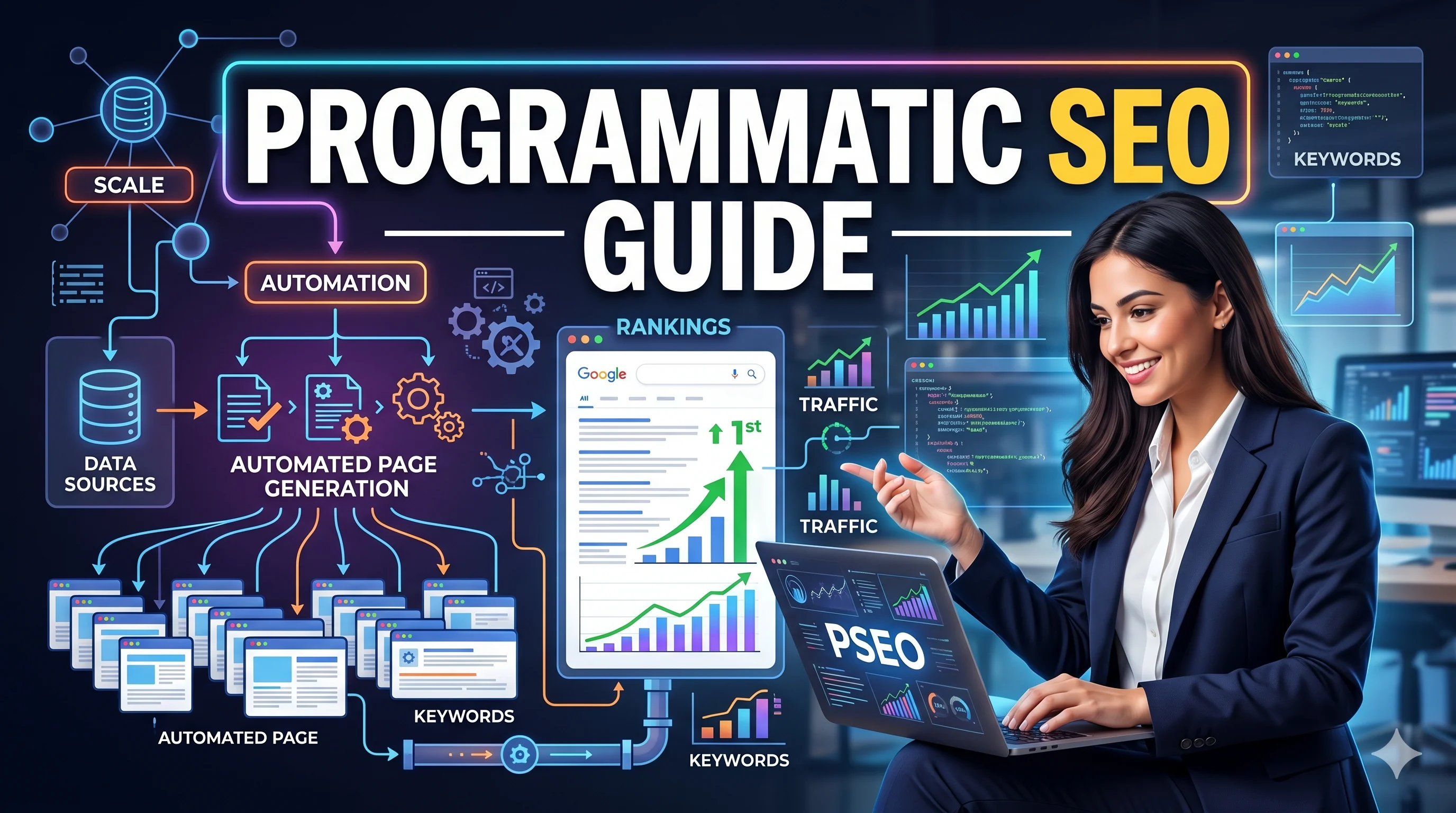
TL;DR: Programmatic SEO is the automated creation of thousands of landing pages using structured data and templates. This guide will teach you how to build a scalable, AI-ready SEO system that ranks for long-tail queries and survives AI Overviews. Focus on entity-rich templates, semantic clustering, and user intent matching to future-proof your growth.
Table of Contents
- What is Programmatic SEO? (Direct Answer)
- Why Programmatic SEO is Critical in 2026
- The 5-Step Programmatic SEO Framework
- GEO & AI Overview Optimization
- Template Design & Semantic Entities
- Mini Case Study: Scaling from 0 to 500K Organic Visits
- Common Pitfalls & How to Avoid Them
- Tools & Tech Stack
- FAQ: Programmatic SEO Guide
- Conclusion: Your Next Steps
What is Programmatic SEO? (Direct Answer)
Programmatic SEO is the practice of generating large volumes of search-optimized pages automatically from a structured dataset. Instead of writing each page manually, you define a master template, map it to a database, and generate hundreds or thousands of unique pages—each targeting a specific keyword variant.
The Core Equation
Structured Data + Smart Template + Semantic Entities = Scalable Rankings
Example: A real estate site can automatically create unique pages for every street in a city by combining a template with local data (schools, commute times, house prices).
Why Programmatic SEO is Critical in 2026
The search landscape has shifted. AI Overviews (SGE) and zero-click searches reduce traffic for broad queries. However, long-tail and hyper-specific queries still drive high-intent traffic. Programmatic SEO is the only scalable way to dominate these hundreds of thousands of niche keywords.
| Strategy | Pages Created | Traffic Potential (Monthly) | Effort Level |
|---|---|---|---|
| Manual Blogging | 10-20 | 5K - 20K | High |
| Programmatic SEO | 500 - 10,000+ | 100K - 1M+ | Low (after setup) |
| AI-Generated Generic Content | Unlimited | Low (quality issues) | Medium |
Key Insight: Google rewards breadth of coverage on specific entities. A programmatic site covering all 50,000 zip codes in the US will outperform a manual site with 50 generic articles because each page perfectly answers a specific user need.
The 5-Step Programmatic SEO Framework
Step 1: Identify Your Core Entity & Attributes
Choose a central entity (e.g., “Hiking Trails,” “Software Tools,” “Lawyers”) and list all attributes that matter to users. Example for “Stock Photos”:
- Subject (e.g., “Mountain,” “Office,” “Sunset”)
- Color Palette
- Orientation (Landscape/Portrait)
- License Type
Step 2: Keyword Clustering & Intent Mapping
Group keywords by search intent using a semantic approach. For an “SEO tools” database:
| Primary Keyword | Modifier | Intent | Generated URL |
|---|---|---|---|
| Keyword research tool | for e-commerce | Commercial | /tools/keyword-research/ecommerce |
| Keyword research tool | free trial | Transactional | /tools/keyword-research/free-trial |
| Keyword research tool | semantic analysis | Informational | /tools/keyword-research/semantic |
Step 3: Design Semantic Templates
Your template must include dynamic sections for unique content—don’t just swap a city name. Include:
Template Anatomy
- Intro Entity Definition (e.g., “Learn about [Entity] in [Location]”)
- Unique Data Table (e.g., comparison of [Attribute A] vs [Attribute B])
- Semantic Embedding (related entities, synonyms, and LSI terms)
- User-Generated Content Feed (reviews, ratings, or comments for EEAT)
Step 4: Data Structuring & Automation
Use a headless CMS with a database. Typical stack:
- Data Source: API (Google Sheets, CSV, public datasets)
- Automation: Python script or Zapier to enrich data (e.g., fetch weather data for travel pages)
- CMS: WordPress with ACF, Contentful, or Next.js static generation
Step 5: Internal Linking Logic
Create a hub-and-spoke structure. Each programmatic page should link to 3-5 related entity pages. Use a related_pages field in your database to auto-populate relevant links.
GEO & AI Overview Optimization for Programmatic Pages
AI Overviews pull information from authoritative, well-structured content. Programmatic pages must be optimized for machine extraction.
GEO Rule #1: Every page must contain a concise answer block (50-100 words) directly after the H2 that defines the page's main query. This block should be easily parsable by LLMs.
| Optimization Tactic | Implementation | AI Overview Impact | ||||||||||||||||||
|---|---|---|---|---|---|---|---|---|---|---|---|---|---|---|---|---|---|---|---|---|
| Entity Schema Markup | Add JSON-LD for Product, Article, FAQ, or LocalBusiness | High | ||||||||||||||||||
| Structured Lists | Use
|
High | ||||||||||||||||||
| Comparative Tables | Use
Template Design: The Art of Semantic DiversityA bad template creates thin content; a great template becomes a knowledge panel. Dynamic Sections to IncludeChecklist: High-Performance Programmatic Template
Example: Programmatic Page for a Digital AgencyTemplate for: /web-design-agencies/[city]
Mini Case Study: From 0 to 500K Organic VisitsClient: A SaaS review platform targeting 50,000+ software tools. Challenge: Manual page creation was impossible; competition had hundreds of pages. Solution: Built a programmatic SEO system using a database of software tools with filters (pricing, features, user reviews). Each combo created a unique page. Result: 500K monthly organic visits in 8 months. 85% of traffic came from long-tail queries like “best project management software for small teams with free trials.” Key Takeaway: The database included sentiment analysis of reviews (positive, negative, neutral) to create unique, helpful content per page. Common Pitfalls & How to Avoid Them
Tools & Tech Stack for Programmatic SEO
FAQ: Programmatic SEO GuideIs programmatic SEO still effective after the Google Helpful Content Update?Yes, but only if your content is genuinely helpful. The update penalizes mass-produced content that lacks value. Programmatic SEO works when each page answers a specific, unique query with different data – not just by changing a city name in a paragraph. How many pages should I start with?Start small: 50-100 pages. Test indexation, click-through rates, and traffic. Scale up only after you see positive signals. A common mistake is launching 10,000 pages at once and getting hit with a manual action for thin content. Do I need coding skills to implement programmatic SEO?Not necessarily. Tools like Webflow CMS Collections, WordPress with ACF, and even Excel-to-HTML generators can work. However, having a developer (or no-code skills with Zapier/Make) will significantly expand your possibilities. What is the best data source for programmatic SEO?Open datasets (government data, Wikipedia), public APIs (Crunchbase, Weather, Zillow), or proprietary data. The key is uniqueness – if your data is publicly available, add a proprietary layer (e.g., your own ratings or calculations). How does programmatic SEO fit with AI Overviews?AI Overviews favor pages that provide immediate, well-structured answers. Programmatic pages with clear H2s, tables, and concise definition blocks are more likely to be cited. Focus on entity-based content that the AI can easily extract and cross-reference. Author Insight: The Future of Programmatic SEO“In 2026, programmatic SEO is not just about volume – it’s about semantic depth. The winning sites will be those that can dynamically generate content that matches a user's context, not just their query. Embedding entity graphs inside your templates is the next frontier. Build a database that understands relationships, not just rows.” — SMARTCHAINE Editorial Team Conclusion: Your Next StepsProgrammatic SEO remains the single most scalable strategy for dominating long-tail search traffic in 2026. But the era of “just changing the city name” is over. You must build semantically rich templates, use real data, and optimize for AI extraction. Take Action Today:
About the AuthorElena Rivas is part of the SMARTCHAINE editorial team focused on SEO, GEO optimization, AI Overviews, structured data, and technical search visibility. |