SEO Content Clusters
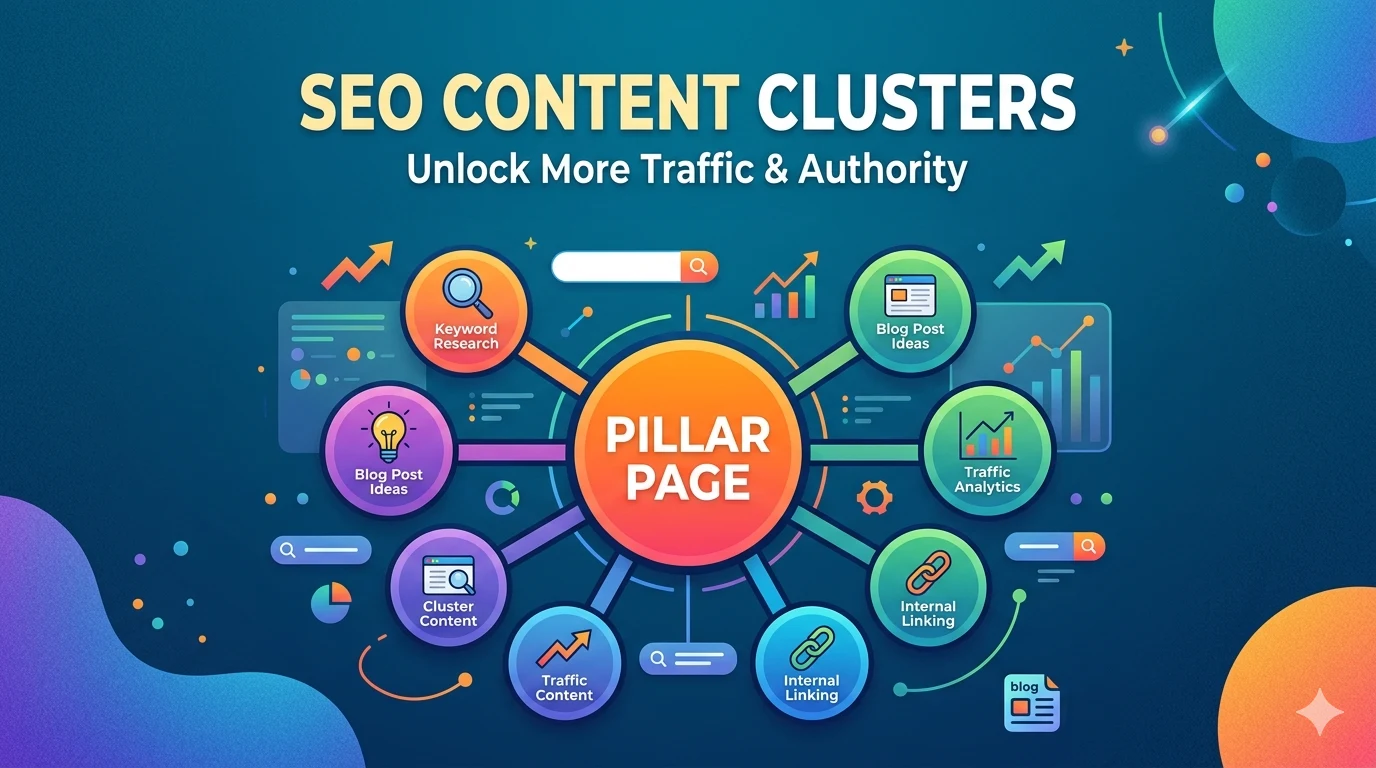
Direct Answer: An SEO content cluster is a strategic content model where a single pillar page covers a broad topic comprehensively, supported by multiple cluster pages that dive into related subtopics. This structure signals topical authority to search engines, improves internal linking, and helps users find in-depth answers. To build one, identify a core topic, create a comprehensive pillar page, then write cluster articles targeting long-tail keywords that link back to the pillar.
In this guide, you will learn:
- Why content clusters outperform traditional blog formats
- How to choose a pillar topic with real ranking potential
- Step-by-step workflow for building a cluster from scratch
- How to measure whether your cluster is actually working
| 1. What Are SEO Content Clusters? | 2. Why Clusters Matter in 2026 |
| 3. How to Build a Cluster | 4. Practical Example: Running Shoes |
| 5. Mini Case Study | 6. Actionable Checklist |
| 7. FAQ | |
What Are SEO Content Clusters?
An SEO content cluster (also called a topic cluster) is a group of interlinked web pages centered around a core "pillar" page. The pillar page broadly covers a main topic, while each cluster page targets a specific subtopic or long-tail keyword. Every cluster page links back to the pillar, and the pillar links out to each cluster page.
This structure is fundamentally different from the old model of publishing standalone blog posts on random topics. Instead of chasing scattered keywords, a content cluster builds cohesive topical authority—something search engines increasingly reward.
Core Components of a Cluster
- Pillar Page: A long-form, comprehensive guide covering the primary topic. Example: "The Complete Guide to Running Shoes."
- Cluster Articles: Deep dives on specific subtopics. Example: "Best Running Shoes for Flat Feet," "How to Choose Trail Running Shoes," "Nike vs. Adidas Running Shoes."
- Internal Links: Every cluster article must link to the pillar, and the pillar must link to every cluster article.
Pro Tip: Think like a library, not a filing cabinet
Imagine a library shelf labeled "Running." A single book (the pillar) explains everything about running. Each chapter reference card (a cluster article) points back to the shelf. A filing cabinet scatters random papers everywhere. Clusters keep your content organized and discoverable.
Why Content Clusters Matter in 2026
Search engines have evolved beyond simple keyword matching. They now evaluate topical depth and semantic relevance. A well-constructed content cluster signals to Google that your website is an authoritative resource on a given subject. This is a key factor for AI Overviews and featured snippets.
| Aspect | Traditional Blogging | SEO Content Clusters |
|---|---|---|
| Structure | Isolated posts, no linking strategy | Interlinked hub-and-spoke model |
| Keyword targeting | One keyword per post | Primary topic + long-tail variations |
| Search intent | Often mismatched across posts | Intent aligned from pillar to cluster |
| Authority signal | Low | High (topical depth) |
| User experience | Users leave after one post | Users navigate between related content |
Expert Tip: AI Overview Optimization
When building clusters, structure your pillar page with clear, concise answer blocks under H2 headings. This increases the likelihood of your content appearing in Google's AI-generated overviews. For example, directly answer "What are the best running shoes for beginners?" within the first 50 words of a dedicated section.
How to Build an SEO Content Cluster (Step-by-Step)
Step 1: Choose a Pillar Topic
Select a topic with enough breadth to support at least 5-10 cluster articles. It should have monthly search volume and commercial or informational intent. Avoid topics that are too narrow (e.g., "Blue Running Shoes") or too broad (e.g., "Sports").
Step 2: Conduct Keyword Research
Use a keyword research tool to find long-tail variations of your pillar topic. For "Running Shoes," cluster article ideas include:
- Best running shoes for overpronation
- How to clean running shoes
- Minimalist vs. cushioned running shoes
- Running shoe size guide
- Best budget running shoes under $100
Step 3: Create the Pillar Page
Write a comprehensive pillar guide (2,000-4,000 words) that covers everything a user needs to know about the topic. Include a table of contents, use H2 sections for each major subtopic, and feature a "Key Takeaways" box at the top.
Step 4: Write Cluster Articles
Each cluster article should be 1,000-2,000 words, targeting a specific long-tail keyword. Include one internal link to the pillar page within the first 200 words, and link back to relevant cluster articles where natural.
Step 5: Link Everything Together
After publishing, update the pillar page to link to each new cluster article. Use descriptive anchor text that includes the target keyword of the cluster article.
Practical Example: Building a Cluster for "Running Shoes"
Let's walk through a hypothetical example to illustrate the process.
Scenario
You run a fitness blog and want to dominate the "running shoes" topic.
Pillar Page
Title: "The Ultimate Guide to Running Shoes (2026)"
Content: Covers types of running shoes, how to choose based on foot type, terrain, budget, and maintenance tips. Includes a comparison table of top brands.
Cluster Article 1
Title: "Best Running Shoes for Flat Feet"
Links to: Pillar page (anchor text: "choosing running shoes")
Cluster Article 2
Title: "Nike vs. Brooks Running Shoes: A Detailed Comparison"
Links to: Pillar page (anchor text: "running shoe guide")
Cluster Article 3
Title: "How to Clean Your Running Shoes Without Ruining Them"
Links to: Pillar page (anchor text: "running shoe maintenance")
Result
The pillar page ranks for "running shoes," while cluster articles rank for "best running shoes for flat feet," "Nike vs Brooks," and "how to clean running shoes." Link equity flows from cluster to pillar and vice versa, boosting the entire group.
Mini Case Study: Hypothetical Fitness Blog
Background: A fitness blog (fictional example) had been publishing standalone articles on various cardio topics for two years. Traffic on their "running" content was flat.
Action: The team created a "Running Shoes" content cluster with one pillar page and eight cluster articles over three months. They linked every cluster article to the pillar and added navigation cues.
Result (Hypothetical): After four months, the pillar page ranked on page one for "running shoes" (previously page three). Organic traffic to the entire cluster grew noticeably, and the site began ranking for 12 additional long-tail keywords that were not targeted before. Average session duration increased as users clicked between cluster articles.
Actionable Checklist for Building Your First Cluster
- ✅ Identify a core topic with search volume and commercial/informational intent.
- ✅ Use a keyword tool to find 5-10 long-tail subtopics.
- ✅ Write the pillar page first (2,000+ words with clear H2 sections).
- ✅ Include a direct answer box or executive summary at the top of the pillar.
- ✅ Write each cluster article as a deep dive into one subtopic.
- ✅ Add internal links: cluster to pillar (within first 200 words) and pillar to cluster.
- ✅ Update existing old posts on the same topic to link to the pillar.
- ✅ Monitor rankings for the pillar keyword and top 3 cluster keywords after 90 days.
- ✅ Expand the cluster over time by adding new cluster articles on related questions.
Frequently Asked Questions About SEO Content Clusters
What is the difference between a content cluster and a silo?
A silo structure separates content into distinct, non-overlapping categories (e.g., Running Shoes cannot link to Sports Apparel). A content cluster encourages linking between related subtopics under a single pillar, which is more flexible and better aligned with modern search algorithms.
How many cluster pages do I need?
Start with at least 5 to 8 cluster articles for a meaningful impact. You can expand as you discover new subtopics. Quality and relevance matter more than quantity.
Can I have multiple clusters on the same website?
Yes, but ensure each cluster focuses on a distinct core topic. For example, a fitness site could have a "Running Shoes" cluster, a "Strength Training" cluster, and a "Nutrition" cluster without cannibalizing authority.
How long does it take to see results from a content cluster?
Results vary, but many sites see initial ranking improvements for the pillar page within 8-12 weeks after publishing the full cluster. Fully establishing topical authority may take 4-6 months or more.
Do content clusters work for small websites?
Yes. In fact, smaller sites often benefit more because a well-executed cluster can establish authority on a niche topic faster than trying to rank for many unrelated keywords.
Should I update my pillar page regularly?
Yes. Refresh your pillar page every 6-12 months with new data, examples, and links to new cluster articles. This signals freshness and ongoing authority.
Expert Tip from Our Team
When writing cluster articles, include a "See our complete guide" link in the first paragraph. This not only helps SEO but also improves user navigation. For example: "For a complete overview of choosing the right footwear, see our Ultimate Guide to Running Shoes." (Note: This is a hypothetical link format—do not use actual URLs in your implementation.)
Conclusion: Clusters Are the Future of SEO
SEO content clusters are not a passing trend. They represent a fundamental shift toward how search engines evaluate expertise and depth. By organizing content around a central pillar, you provide a better user experience, build internal linking strength, and demonstrate topical authority. Start small: pick one core topic, write a pillar page, and add 5 cluster articles. Track your progress, and expand from there. That is the framework that consistently delivers sustainable organic growth.
About the Author
The SMARTCHAINE Editorial Team focuses on SEO, GEO optimization, AI Overviews, structured data, and practical search visibility strategies.