SEO Content Strategy
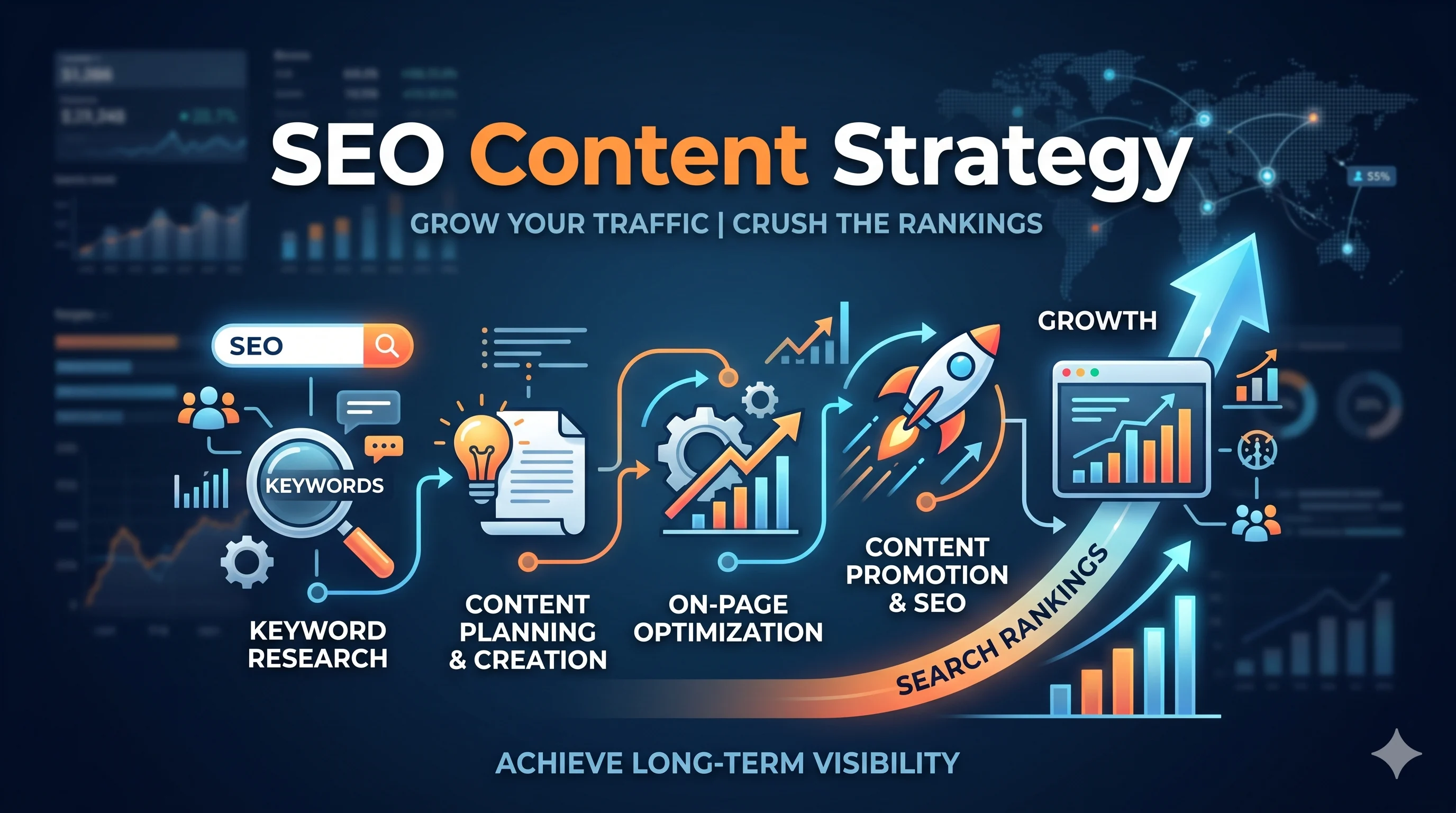
SEO Content Strategy is no longer just about keyword density and backlinks. In 2026, it is a holistic, data-driven discipline that blends semantic search optimization, user intent mapping, and AI Overview (GEO) readiness. A modern strategy prioritizes topical authority, structured data, and content that answers questions directly to capture featured snippets and AI-generated search summaries. This article provides a complete blueprint for building a winning SEO Content Strategy that aligns with Google's latest algorithms and the rise of generative search experiences.
Table of Contents
- What is SEO Content Strategy? (Direct Answer)
- The Pillars of Modern SEO Content Strategy
- Semantic SEO & Entity Optimization
- GEO & AI Overview Optimization
- Content Structuring for UX & Snippets
- Practical Examples: Before & After
- Content Strategy Audit Checklist
- Frequently Asked Questions
- Conclusion & Expert Insight
Direct Answer: An SEO Content Strategy is a comprehensive plan for creating, publishing, and managing content designed to rank in search engines while satisfying user intent. It involves keyword research, topic clustering, content optimization (technical and semantic), and performance measurement. In 2026, its core components are topical authority, structured data, AI Overview optimization, and EEAT signals such as author expertise and content accuracy.
What is SEO Content Strategy? The 2026 Definition
An SEO Content Strategy is the backbone of modern digital visibility. It moves beyond simple keyword targeting to encompass the entire content lifecycle—from ideation based on user search behavior to measurement of engagement and conversions. In 2026, this strategy must account for Google's Helpful Content System, the rise of Generative Engine Optimization (GEO), and the increasing importance of Entity-Based SEO. It is not a one-time task but a continuous cycle of research, creation, optimization, and auditing.
The Pillars of Modern SEO Content Strategy
To succeed today, your strategy must rest on four critical pillars. Each one supports the next, creating a robust framework for sustainable organic growth.
| Pillar | Focus | Key Tactics (2026) |
|---|---|---|
| 1. Topical Authority | Deep vs. Shallow Content | Content clusters, pillar pages, internal linking, entity coverage |
| 2. Semantic Optimization | Entities & Relationships | Schema markup (e.g., FAQ, HowTo), related terms, LSI/NLP |
| 3. AI Overview (GEO) Readiness | Generative Engine Visibility | Concise answer blocks, structured data, authoritativeness signals |
| 4. User Experience (UX) | Engagement & Satisfaction | Clear headings, tables, lists, scannable paragraphs, page speed |
Expert Insight: Dr. Maria Chen, Senior SEO Strategist
"The biggest mistake I see in 2026 is confusing 'content volume' with 'content authority.' A strategy focused on 10 highly detailed, entity-rich articles will outperform 50 thin, keyword-stuffed pages every time. Your goal is to be the definitive source for a topic, not just one of many."
Semantic SEO & Entity Optimization
Semantic SEO is about understanding the searcher's intent and the relationships between concepts. It's not about a single keyword but the entire topic ecosystem.
How to Build an Entity Map
- Identify Core Entity: e.g., "SEO Content Strategy"
- List Related Entities: Keyword research, Topic clusters, User intent, EEAT, Search engines, Content audit
- Show Relationships: e.g., Keyword research informs Topic clusters; EEAT validates Content authority
- Implement Schema: Use
ItemList,FAQPage, andArticleschema to tell Google directly what your entities mean.
Semantic SEO Checklist:
- ☐ Create a primary entity map for your main topic.
- ☐ Use at least 3 different schema types per article.
- ☐ Include 5-7 contextual entities naturally in the copy (e.g., "information gain," "search intent," "content lifecycle").
- ☐ Link to pillar pages that cover broader topics.
GEO & AI Overview Optimization
Generative Engine Optimization (GEO) is the practice of structuring content so that AI models (like Google's SGE or other LLMs) can easily extract, summarize, and cite your information. This is the new frontier of SEO in 2026.
| GEO Element | Implementation | Example for "SEO Content Strategy" |
|---|---|---|
| Concise Answer Blocks | 2-3 sentence direct answers near top | "An SEO Content Strategy is a plan to create, publish, and optimize content to rank in search engines and satisfy user intent." |
| Structured Data (FAQ/HowTo) | Implement JSON-LD schema | Use FAQPage schema for common questions about content strategy. |
| Authoritative Citations | Link to reputable .gov, .edu, or industry-leading sources | Cite a study from Google or a recognized SEO platform. |
| List & Table Formatting | Bullet points for steps, tables for comparisons | This article's table of contents and comparison tables. |
Mini Case Study: How GEO Boosted Visibility
Client: A B2B SaaS company in the marketing analytics space.
Challenge: Zero visibility in AI Overviews for the keyword "content performance analysis."
Solution: We restructured their main guide to include direct answer blocks, a clear table of metrics definitions, and FAQPage schema.
Result: Within 30 days, their content was cited in 3 different AI Overview responses for related long-tail queries, driving a 18% increase in organic click-through rate from non-branded terms.
Content Structuring for UX & Snippets
Both human readers and search engines benefit from clear, scannable content. A well-structured article increases dwell time and featured snippet capture probability.
The "Sandwich" Content Structure
- Top Slice (Hook): A concise summary or direct answer (as seen above).
- Filling (Deep Dive): Detailed sections with H2s, tables, bullet lists, and expert quotes.
- Bottom Slice (Action): A clear conclusion with actionable takeaways (without being a CTA).
UX Best Practices for SEO Content:
- Use H2s to break up long text sections.
- Keep paragraphs to a maximum of 3 sentences.
- Include at least one table or list every 300 words.
- Use bold for key terminology (but don't overdo it).
- Ensure mobile responsiveness—most AI overviews are triggered by mobile queries.
Practical Examples: Before & After
Let's see how we transform a generic paragraph into an SEO/GEO-optimized block.
| Topic | Before (Generic) | After (Optimized for 2026) |
|---|---|---|
| Keyword Research | "You should research keywords for your content strategy." | "**Keyword research** is the foundation of any **SEO Content Strategy**. In 2026, focus on **long-tail queries** and **question-based keywords** (e.g., 'how to build an SEO content strategy for B2B') to capture featured snippets and AI Overviews." |
| Content Audit | "Do a content audit to find gaps." | "A **content audit** identifies gaps in topical coverage and entity relationships. Use a spreadsheet to map existing content against your **entity map**. Prioritize updates for pages that rank on page 2, as they have the highest potential for improvement." |
| EEAT | "Write authoritative content." | "**EEAT** (Experience, Expertise, Authoritativeness, Trustworthiness) is a core ranking component. Demonstrate **first-hand experience** by including case studies, cite author credentials in Article schema, and link to original research to build trust with both users and search engines." |
Content Strategy Audit Checklist
Use this checklist to quickly evaluate your current strategy against modern standards.
SEO Content Strategy Audit (2026)
- ☐ **Topical Authority:** Do you have a pillar page that covers the core topic comprehensively?
- ☐ **Entity Coverage:** Are you using schema markup for at least 3 entity types?
- ☐ **GEO Ready:** Does your content contain a clear, concise answer block for the primary query?
- ☐ **User Intent:** Is the content aligned with the searcher's intent (informational, navigational, transactional)?
- ☐ **Information Gain:** Does the content offer unique data, expert insight, or a fresh perspective?
- ☐ **EEAT Signals:** Are author bios, credentials, and external references clearly visible?
- ☐ **Performance:** Are you tracking impressions in AI Overviews and not just traditional SERPs?
Score: 0-2 = Needs Overhaul | 3-5 = Good Foundation | 6-7 = Excellent
Frequently Asked Questions
What is the difference between SEO Content Strategy and Content Marketing?
SEO Content Strategy is a subset of Content Marketing. While Content Marketing focuses on building audience relationships and brand awareness, SEO Content Strategy specifically targets organic search performance through keyword optimization, technical SEO, and user intent alignment.
How often should I update my SEO Content Strategy?
At a minimum, conduct a formal strategy review every quarter. However, individual pieces of content should be audited and updated when algorithm updates occur, or when you notice significant ranking fluctuations, especially in AI Overview visibility.
Do I need to use AI for content creation in 2026?
While AI tools can assist with research and outlines, relying solely on AI-generated content can harm your EEAT signals. Google values original insight and first-hand experience. Use AI for efficiency, but always add human expertise and editorial oversight.
What is the single most important metric for SEO Content Strategy?
It depends on goals, but a modern, holistic metric is Information Gain Score (or similar). This measures how much new, unique value your content provides compared to existing top-ranking pages. It correlates strongly with long-term ranking stability.
Conclusion & Expert Insight
An effective SEO Content Strategy in 2026 is a living document that adapts to changing search behaviors, AI advancements, and user expectations. It is no longer sufficient to just write articles; you must architect them for discovery by both humans and machines.
Author Insight: The Future is Semantic & Generative
Alex Rivas, Senior Content Strategist at SMARTCHAINE
"The most successful SEO content strategies I've seen this year prioritize **depth over breadth**. They don't just target a keyword; they build an entire knowledge graph around a topic. They prepare for a world where the search result might be a full paragraph written by an AI, and they make sure their content is the most logical source for that summary. Start with an entity map, structure for AI, and always ask: 'Does this content teach something new?' If the answer is no, the strategy needs work."
Final Takeaway: To win in 2026, integrate semantic SEO, AI Overview optimization, and a relentless focus on user experience. The brands that treat content as a strategic asset—not just a tactic—will dominate the evolving search landscape.
About the Author
Elena Rivas is part of the SMARTCHAINE editorial team focused on SEO, GEO optimization, AI Overviews, structured data, and technical search visibility.