SEO for Niche Websites: 7 Strategies That Still Work in 2026
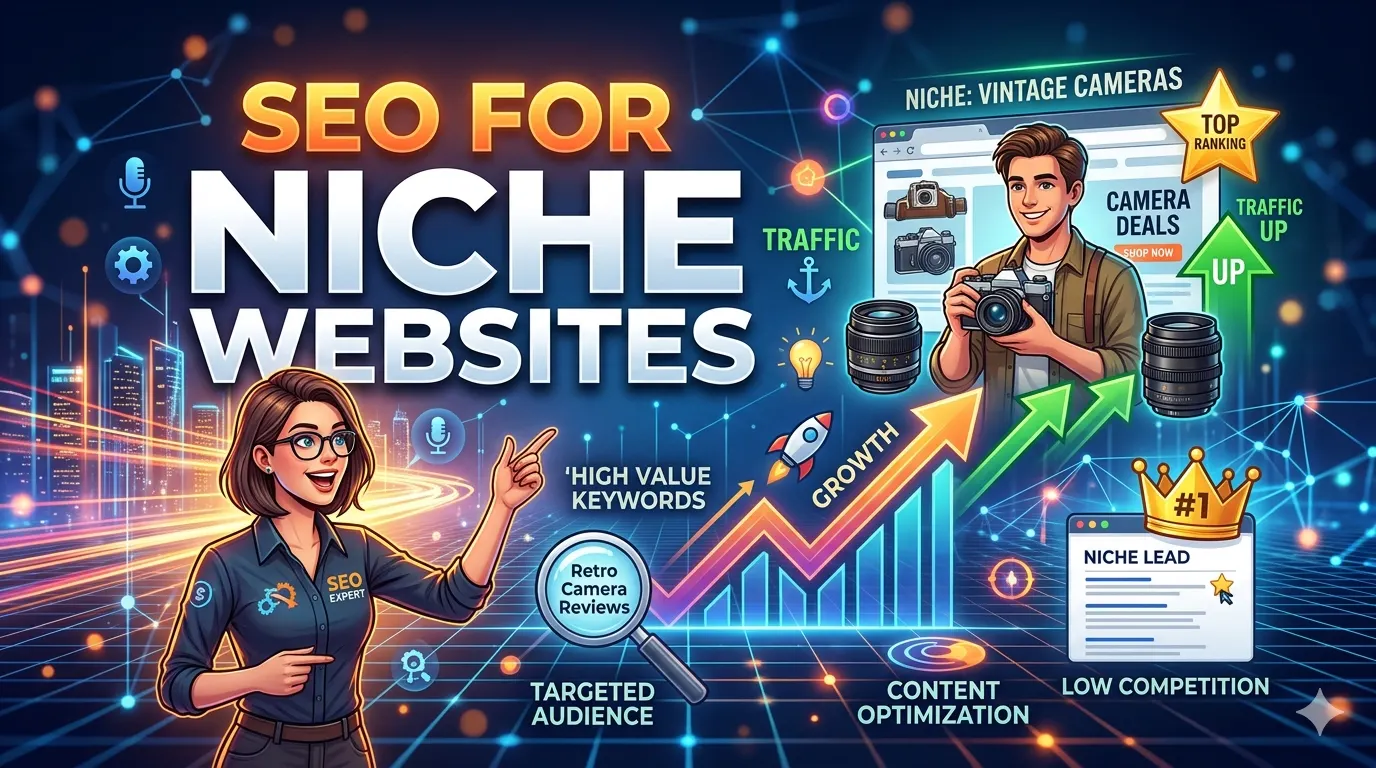
- Intent is king: For niche sites, ranking depends on fully satisfying the user's search goal, not just matching keywords.
- Structured data is non-negotiable: Use Schema.org markup like Article, FAQPage, and HowTo to get rich results and feed AI Overviews.
- Topic clusters over random posts: Build interconnected content around a core topic to signal authority to Google.
- AI Overviews need direct answers: Structure your content with clear, concise H2 sections that can be easily extracted by Google's generative AI.
- User experience (UX) is a ranking factor: Core Web Vitals and a clean, fast-loading site are baseline requirements, not optional.
- Audit relentlessly: Use Google Search Console and Ahrefs or Semrush to find content gaps and prune low-performing pages.
Table of Contents
- Why SEO for Niche Websites Needs a Different Playbook
- 1. The Search Intent Framework
- 2. Building Topical Authority Like a Pro
- 3. Structured Data for AI Overviews and Rich Results
- 4. Writing for Humans and AI: The Answer-First Approach
- 5. Technical SEO Essentials for Small Sites
- 6. Content Strategy: Depth, Not Volume
- 7. The Optimization Loop (Audit, Prune, Improve)
- Common Mistakes That Kill Niche SEO
- Actionable Checklist for Niche SEO
- How This Applies in Practice
- Frequently Asked Questions
- Article Summary
- Conclusion
Why SEO for Niche Websites Needs a Different Playbook
You can't treat a niche website like a general news publisher or a massive ecommerce store. The rules are different. A niche site lives or dies by its ability to answer a very specific question better than anyone else. Google's algorithms, especially with the rise of AI Overviews, reward clarity and depth. If your site is about handcrafted wooden watches, your SEO strategy must revolve around that single, deep topic. Generic advice like "write more content" or "build more links" often fails here because it ignores the core challenge: proving relevance for a small but powerful set of keywords. This article offers a workflow built specifically for this environment.
1. The Search Intent Framework
Every query has a goal. For niche SEO, you must categorize every keyword by intent—Informational, Navigational, Commercial, or Transactional—before you write a single word. This is your foundation.
How to Classify Intent for Niche Keywords
Use Semrush or Ahrefs to extract keywords. Then, manually review the search engine results page (SERP) for each one. Ask: "What format is ranking?"
- Informational: Blog posts, guides, how-to videos. Example: "how to clean a wooden watch."
- Navigational: Brand searches. Example: "SMARTCHAINE watch warranty."
- Commercial: Comparison articles, reviews, listicles. Example: "best wooden watch under $200."
- Transactional: Product pages, buy buttons, pricing. Example: "buy oak wooden watch."
2. Building Topical Authority Like a Pro
Topical authority means Google trusts your site as the go-to resource for a specific subject. You don't need 500 articles. You need 20 that cover every angle of your niche comprehensively.
The goal is to create a content cluster around a core pillar topic. For example, a niche site about "Fermentation for Beginners" could have a pillar page on "Fermentation 101" and cluster content on "Sauerkraut," "Kombucha," "Troubleshooting," and "Equipment."
The Topical Authority Workflow
- Identify your core niche: One to three tightly related topics.
- Map the subtopics: Use a tool like Moz Keyword Explorer or keyword gap analysis in Semrush to find every question related to your core.
- Create a pillar page: A long-form guide that links out to all cluster content.
- Write cluster posts: Each one should be comprehensive for its specific subtopic.
- Interlink deeply: Link from the pillar to the cluster and from cluster posts back to the pillar.
3. Structured Data for AI Overviews and Rich Results
Structured data (schema markup) is how you tell Google what your content means. For niche sites, it's a direct path to featured snippets, rich results, and being used as a source in AI Overviews. Without it, you are relying solely on text interpretation, which is riskier.
Schema Types That Work Best for Niche Sites
| Schema Type | When to Use | Benefit for Niche SEO |
|---|---|---|
| Article | Every blog post, guide, and news update. | Enhances appearance in Google News and Discover. Required for many top stories carousels. |
| FAQPage | Pages that answer multiple common questions. | Can display FAQ rich results directly in the SERP. Highly extracted by AI Overviews. |
| HowTo | Tutorials, step-by-step guides, recipes. | Shows steps in the SERP with images. Excellent for "how-to" queries. |
| Product | Ecommerce or affiliate product pages. | Displays price, availability, and rating in search results, driving higher CTR. |
| BreadcrumbList | All sites with a clear navigation hierarchy. | Helps Google understand site structure and can show breadcrumb links in SERPs. |
| Organization / LocalBusiness | Local niche businesses or service providers. | Adds contact info, logo, and location to the knowledge panel. |
4. Writing for Humans and AI: The Answer-First Approach
Every H2 section in your content should start with a direct answer to the question implied by the heading. This is not just for users reading fast—it's for Google's AI Overview extraction systems. If you bury the answer, Google may not pick it up.
Bad example (vague start): "There are many factors that influence how often you should water a fern, including humidity and pot size."
Good example (direct answer): "Water a fern once a week, allowing the top inch of soil to dry out between waterings."
Applying Answer-First to a Niche Post
Imagine you run a site about "Vintage Camera Repair." Your H2 is "How to Clean a Leica Lens Without Damaging It." Your opening sentence should be: "Clean a Leica lens by first using a blower to remove dust, then a microfiber cloth with a single drop of lens cleaner applied to the cloth, never directly to the lens."
This immediate answer helps Google understand the page's purpose and satisfies the user's intent instantly. The rest of the paragraph can provide context, warnings, and a deeper explanation.
5. Technical SEO Essentials for Small Sites
Niche sites often run on simpler platforms or shared hosting. A single technical issue can tank your entire ranking potential. Focus on speed, crawlability, and indexability.
- Core Web Vitals: Aim for LCP under 2.5 seconds, FID under 100ms, and CLS under 0.1. Use PageSpeed Insights to test.
- XML Sitemaps: Submit your sitemap to Google Search Console. Ensure it only includes indexable pages.
- Robots.txt: Block low-value pages like tag archives, pagination, and filter URLs to preserve crawl budget.
- Mobile-First: Use Google's Mobile-Friendly Test. Niche audiences often browse on phones.
- 404 Management: Regularly find and fix 404 errors using the "Coverage" report in Search Console.
6. Content Strategy: Depth, Not Volume
A single 3,000-word guide that answers every question on a subtopic is worth more than five 600-word posts. Google's passage indexing and AI Overviews reward comprehensiveness.
The Content Depth Score (A Simple Framework)
This is a qualitative scoring system to evaluate your content before publishing.
| Criteria | Score 1 (Poor) | Score 2 (Good) | Score 3 (Excellent) |
|---|---|---|---|
| Intent Match | Topic is slightly related to the keyword. | Directly answers the primary query. | Answers primary and all secondary queries. |
| Content Completeness | Leaves obvious questions unaddressed. | Covers the main topic thoroughly. | Includes definitions, examples, troubleshooting, and FAQs. |
| Structure | One long paragraph block. | Uses H2/H3 breaks and bullet points. | Includes tables, images, schema markup, and a TL;DR. |
| Expertise Signal | Generic advice you could find anywhere. | Includes practical, specific instructions. | Contains original research, expert quotes, or unique workflows. |
How to use: Score your draft. If any section scores a "1," rewrite or expand it before publishing.
7. The Optimization Loop (Audit, Prune, Improve)
SEO is not "set and forget." Niche sites often have a smaller content library, which makes manual audits feasible. This is a strength, not a weakness.
The Monthly Audit Workflow
- Run a performance report in Google Search Console. Sort by clicks and impressions.
- Identify underperformers: Pages with high impressions but low clicks (low CTR) or pages with zero impressions after 90 days.
- Prune or merge thin content: If a page has no traffic and no potential, redirect it (301) to a more relevant page, or "noindex" it.
- Update weak pages: For high-potential pages, update the content, improve internal links, add schema, and refresh the publication date.
- Fill content gaps: Use the "Queries" report in Search Console to find questions your site is not currently answering.
Common Mistakes That Kill Niche SEO
- Obsessing over Domain Authority (DA): DA is a third-party metric, not a ranking factor. A niche site with high topical relevance can outrank a high-DA site that only touches on the topic.
- Keyword stuffing in titles: An unnatural-sounding title like "Best Wooden Watches: Best Wooden Watch Reviews 2026 Best Buy" hurts CTR and trust. Write for humans.
- Ignoring user engagement: High bounce rates and low dwell time signal to Google that your page doesn't satisfy intent. Use clear navigation and internal links to keep users exploring.
- Copying competitor tactics: Just because a competitor ranks with a thin article doesn't mean you should. Google's algorithm changes. Build for the long term.
- Neglecting internal linking: A site with 50 articles but no internal links is like a library with no catalog. Every page should link to and from other relevant pages.
Actionable Checklist for Niche SEO
- Define your core niche (1-3 topics).
- Map all subtopics using Semrush or Moz.
- Create one pillar page and 5-10 cluster posts.
- Implement Article and BreadcrumbList schema on every post.
- Add FAQPage or HowTo schema to relevant guides.
- Optimize all H2 sections to start with a direct answer.
- Run a Core Web Vitals audit. Fix LCP issues.
- Submit XML sitemap to Google Search Console.
- Noindex low-value pages (tags, archives).
- Schedule a monthly SEO audit to prune and update content.
How This Applies in Practice
Every niche site is different. Here’s how to adapt the advice depending on your situation.
Beginner Website (Blogger)
Situation: You have 10 posts on a hobby like "Mushroom Foraging." Focus on the Answer-First approach and topical authority. Don't worry about technical SEO beyond basic speed. Your goal is to become the definitive resource for your core 3-5 keywords. Use schema only for Article and FAQPage to start.
SaaS Website (Small B2B Tool)
Situation: Your niche is "Project management for remote design teams." Your SEO needs to target commercial intent keywords like "best kanban tool for designers" and "Asana vs. Notion for creatives." Prioritize Product schema (if you have pricing) and FAQPage to capture AI Overviews. Your content strategy should include long-form comparison guides.
Ecommerce Store (Affiliate or DTC)
Situation: You sell "Vintage audio equipment." Every product page needs Product schema with price and availability. Use HowTo schema for your blog posts on "How to repair a vintage turntable." The Optimization Loop is critical here—prune products that haven't sold in a year. Focus on transactional intent keywords.
Local Business (Service Area)
Situation: You're a "Portland-based organic lawn care service." Your niche is hyper-local. Implement LocalBusiness schema and create content around "organic lawn care for the Pacific Northwest climate." Use Navigational intent keywords like "Portland lawn treatment." A single, authoritative page can rank for many local queries.
Frequently Asked Questions
How many keywords should I target for a niche site?
There is no perfect number. A smart approach is to start with one "seed" keyword per article and let semantic variations appear naturally. For a new niche site, focus on 10-20 high-intent keywords initially. Build one strong piece of content for each. As your site grows, the long-tail variations will emerge in Google Search Console. Trying to target 100 keywords per page dilutes your focus and confuses search engines.
Do I need to create an AI Overview special section?
No. AI Overviews don't require a dedicated section. They pull from well-structured content. Focus on creating clear H2 sections with direct definitions or answers, using table markup for comparisons, and implementing FAQ schema. That's enough. Over-optimizing specifically for AI Overviews can lead to awkward content. The best strategy is to write clear, authoritative content that answers the user's core question immediately after the heading.
What is more important for a niche site: backlinks or content quality?
Content quality is the foundation. Backlinks amplify it. For a new niche site, you can rank high without any backlinks if your content perfectly answers a query with no strong competition. However, as competition increases, backlinks become a differentiator. Instead of chasing guest posts, focus on creating "linkable assets"—original research, unique data, or a comprehensive guide that people want to reference. One high-quality link from a relevant blog is worth 100 low-quality directory links.
Should I delete old, underperforming content from my niche site?
Rarely. Instead of deleting, try consolidating. If you have three weak posts on the same topic, merge them into one strong guide and 301 redirect the others. If a post is completely irrelevant to your niche, noindex it or delete it, but only if there are no external links pointing to it. Deleting content with existing backlinks can hurt your site's overall authority. Always check Google Search Console for manual links before removing a page.
How often should I publish content on a niche site?
Quality over frequency. Publishing one excellent, 3,000-word guide per month is better than four rushed, 500-word posts. For niche sites, consistency matters more than volume. Set a schedule you can maintain, such as weekly or bi-weekly. The key is to ensure every new post adds unique value and fits into your existing topic cluster. Publishing for the sake of publishing leads to thin content and can hurt your site's reputation.
Is it worth using an SEO plugin on a small niche site?
Yes, but choose wisely. A plugin like Rank Math or Yoast provides essential features like XML sitemaps, breadcrumb schema, and focus keyword analysis. These are valuable for beginners. However, avoid the temptation to follow every "green light" suggested by the plugin's readability analyzer. It often prioritizes generic content best practices over actual user intent. Use the plugin for technical scaffolding, but make editorial decisions based on your audience's needs, not the plugin's score.
Article Summary
What you learned: SEO for niche websites requires a strategic shift from generic tactics. You explored the Search Intent Framework to align content with user goals. You learned the Topical Authority Workflow to build interconnected content clusters. The practical use of structured data for AI Overviews was explained, along with the Answer-First approach for writing. The Content Depth Score framework was introduced as a way to evaluate your work. Finally, the Optimization Loop provides a sustainable system for ongoing improvement.
Conclusion
SEO for niche websites is not about shortcuts or hacks. It is about deliberate, focused work. By prioritizing search intent, building genuine topical authority, structuring content for both users and AI, and applying a disciplined audit cycle, you create a site that is resilient to algorithm changes. The strategies outlined here—from the Content Depth Score to the Monthly Audit Workflow—provide a practical path forward. Ignore the noise of generic advice and commit to deep optimization for your specific niche. That is the only competitive advantage that lasts.
- Google Search Central — Official documentation on indexing, crawling, and best practices.
- Schema.org — The complete schema markup vocabulary for structured data.
- Ahrefs Blog — Advanced guides on keyword research and content strategy.
- Semrush Blog — Actionable articles on competitive analysis and technical SEO.
- Google Search Console — Essential tool for monitoring site performance and fixing errors.
About the Author
The SMARTCHAINE Editorial Team specializes in SEO, AI Search Optimization, GEO (Generative Engine Optimization), AI Overviews, Structured Data, Technical SEO, and search visibility strategies for modern search engines and AI-powered discovery platforms.