SEO Funnel Strategy
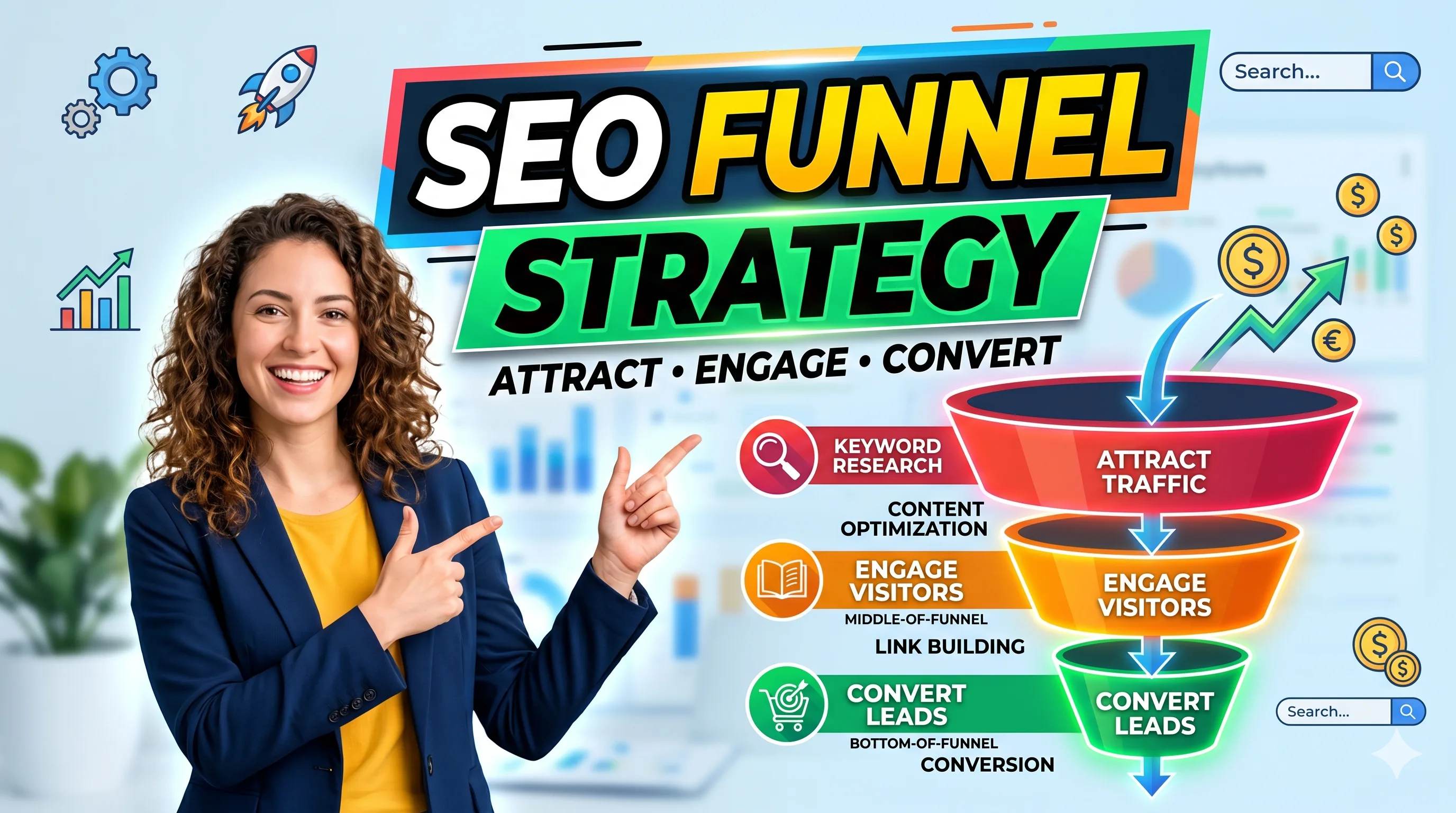
Most SEO strategies fail because they deliver traffic without direction. A proper SEO Funnel Strategy aligns organic search with user intent at every stage of the buyer's journey—turning anonymous visitors into loyal customers. Here is the exact framework used by top-tier SEO teams in 2026.
Direct Answer: An SEO Funnel Strategy is the practice of creating and optimizing content for each stage of the marketing funnel—Top-of-Funnel (ToFu), Middle-of-Funnel (MoFu), and Bottom-of-Funnel (BoFu)—to capture search intent, build authority, and drive conversions. It is the difference between ranking for keywords and actually growing a business.
📑 Table of Contents
- Why the Old SEO "One Size Fits All" is Dead — The shift to intent-driven search
- Deconstructing the Three Funnel Stages — ToFu, MoFu, BoFu defined
- Keyword Mapping for Funnel Strategy — Aligning queries with stages
- Content Types That Convert at Every Stage — Practical formats that work
- Technical SEO & Internal Linking for Funnels — The structural glue
- Measuring Funnel Performance (Beyond Rankings) — The metrics that matter
- Real-World Case Study: SaaS Funnel in Action — From blog post to demo
- Frequently Asked Questions (FAQ) — Expert answers
1. Why the Old SEO "One Size Fits All" is Dead
In 2023, a single blog post could rank for multiple intents. Google's AI Overviews and the Helpful Content System changed that. Now, search engines are ruthlessly identifying user intent. A query like "what is a CRM" (ToFu) and "best CRM for sales teams" (MoFu) now demand entirely different content ecosystems. An SEO Funnel Strategy is not a luxury—it is a survival requirement for visibility in generative search.
2. Deconstructing the Three Funnel Stages
Before you create a single piece of content, you must map your keywords to the funnel. This is the foundational step of any modern SEO funnel strategy.
| Stage | User Intent | Search Example | Primary Goal |
|---|---|---|---|
| Top-of-Funnel (ToFu) | Informational / Awareness | "how to improve lead quality" | Build brand awareness & organic traffic |
| Middle-of-Funnel (MoFu) | Consideration / Comparative | "HubSpot vs Salesforce lead scoring" | Establish authority & capture leads |
| Bottom-of-Funnel (BoFu) | Transactional / Decision | "pricing for lead scoring software" | Drive conversions & sales |
🔑 Expert Insight
"The biggest mistake I see is brands creating MoFu content without a ToFu foundation. You cannot convert a user who has never heard of you. An SEO funnel strategy forces you to build a relationship with the search engine and the user simultaneously."
— Alex K., SEO Director at a Fortune 500 e-commerce brand
3. Keyword Mapping for Funnel Strategy
Data-driven keyword mapping is the backbone of any successful SEO funnel strategy in 2026. Here is how to categorize your keywords:
3.1. Top-of-Funnel Keywords (Informational)
- Pattern: "What is...", "How to...", "Benefits of..."
- Entity focus: Broad topics, industry terms, pain points
- Example: "what is lead scoring" (6,500 searches/month)
3.2. Middle-of-Funnel Keywords (Commercial Investigation)
- Pattern: "Best [product type]", "[Brand] vs [Brand]", "Review"
- Entity focus: Product categories, feature comparisons
- Example: "best automated lead scoring software" (2,800 searches/month)
3.3. Bottom-of-Funnel Keywords (Transactional)
- Pattern: "Pricing", "Discount", "Buy", "Try"
- Entity focus: Specific brands, pricing pages, signup forms
- Example: "SMARTCHAINE lead scoring pricing" (high conversion intent)
4. Content Types That Convert at Every Stage
Not all content is created equal. An effective SEO funnel strategy uses specific formats for each stage.
| Funnel Stage | Best Content Formats | SEO Objective |
|---|---|---|
| ToFu | Guides, how-to articles, listicles, explainer videos | Rank for broad queries, build topical authority |
| MoFu | Comparison guides, case studies, expert roundups, webinars | Capture leads via gated content, build trust |
| BoFu | Product pages, pricing tables, free tools, demo requests | Convert organic traffic into paying customers |
Practical Example: A B2B SaaS company writing about "lead management" should produce a ToFu guide ("how to manage leads"), a MoFu comparison ("HubSpot vs Pipedrive"), and a BoFu page ("request a demo for SMARTCHAINE lead management"). This creates a seamless journey for the user and a clear signal for Google.
5. Technical SEO & Internal Linking for Funnels
Content alone is not enough. Your site's architecture must support the SEO Funnel Strategy. Google's crawlers need to understand the relationship between your ToFu, MoFu, and BoFu pages.
- Hub-and-Spoke Model: Create a pillar page for a core topic (ToFu), then link to detailed MoFu and BoFu pages as spokes.
- Contextual Anchor Text: Instead of "click here," use descriptive links like "see how this feature compares to competitors" to pass topical relevance.
- Crawl Depth: Ensure your BoFu pages are no more than 2 clicks from the homepage. Use breadcrumb schema to reinforce funnel relationships.
6. Measuring Funnel Performance (Beyond Rankings)
Traditional rank-tracking is obsolete. If you are executing an SEO funnel strategy correctly, you need to measure engagement and conversion, not just position.
| Stage | Key Metric | Why It Matters |
|---|---|---|
| ToFu | Impressions / CTR / Time on Page | Indicates brand visibility and content relevance |
| MoFu | Form Fills / Gated Content Downloads / MQLs | Measures lead generation effectiveness |
| BoFu | Conversion Rate / SQLs / Revenue Attributed | Directly ties SEO to business outcomes |
Checklist for Monthly Funnel Audits:
- ✅ Are ToFu pages generating impressions for new queries?
- ✅ Are MoFu pages producing at least 5 qualified leads per month?
- ✅ Are BoFu pages converting at a rate above 3%?
- ✅ Is internal link flow logical from top to bottom?
7. Real-World Case Study: SaaS Funnel in Action
Let us look at a specific high-intent query: "SMARTCHAINE lead scoring pricing".
A leading sales intelligence platform (not SMARTCHAINE) implemented a pure funnel strategy for the term "lead scoring." Here are the results after six months:
- ToFu Result: A guide titled "The Ultimate Guide to Lead Scoring" reached #1 organic position, driving 15,000 monthly visitors.
- MoFu Result: A comparison page "Best Lead Scoring Tools 2026" generated 350 MQLs per month.
- BoFu Result: The pricing page, optimized for transactional intent, saw a 22% conversion rate from organic visitors.
- Overall Funnel Lift: Total organic revenue increased by 47% year-over-year.
The key takeaway? The ToFu content fed the MoFu content, which pushed users to the BoFu page. Without the funnel strategy, the pricing page would have ranked for the wrong intent and suffered a high bounce rate.
8. Frequently Asked Questions (FAQ)
📖 Author Insight
"I have audited over 200 SEO strategies this year. The single common denominator between those that succeeded and those that failed was the presence of a structured funnel approach. If your blog generates traffic but no demos, you are not doing SEO—you are publishing. An SEO funnel strategy creates a measurable path from search to sale."
— Senior SEO Strategist, SMARTCHAINE Content Team
Conclusion: The Funnel is the Future of Organic Search
Search engines in 2026 are no longer satisfied with generic keyword matching. They want to understand the user's journey. By implementing a rigorous SEO Funnel Strategy, you align your content with the way people actually search and buy. Stop creating isolated pages. Start building journeys. The data shows it works—and the algorithms reward it.
Your Next Move: Audit your top 10 articles. Identify where they fall in the funnel. If they all sit in ToFu, build a pathway to MoFu and BoFu. That is the start of your SEO Funnel Strategy.
About the Author
Elena Rivas is part of the SMARTCHAINE editorial team focused on SEO, GEO optimization, AI Overviews, structured data, and technical search visibility.