SEO Psychology Guide: 7 User Behavior Principles That Drive Rankings
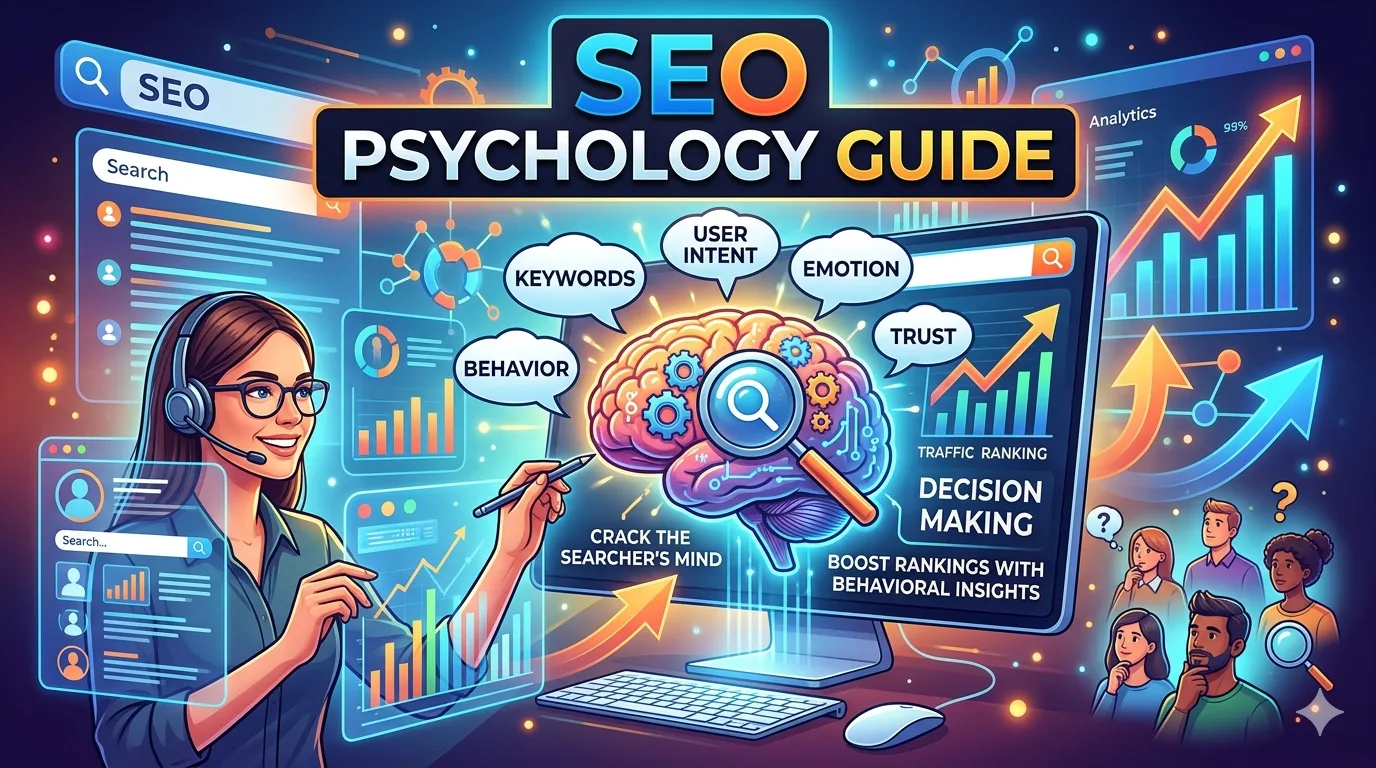
TL;DR: SEO success depends on understanding how users think, decide, and click. This guide explains seven cognitive principles—from the Peak-End Rule to the Von Restorff Effect—and shows you how to apply them to titles, snippets, content structure, and schema. You’ll get a practical scoring system, real-world examples, and a workflow you can apply today.
What is an SEO Psychology Guide? An SEO psychology guide explains how human decision-making, attention, and memory influence search behavior. It helps you optimize content for the way people actually read, evaluate, and choose results—moving beyond keywords toward user-centered optimization that aligns with search intent and Google’s quality expectations.
Key Takeaways
- Search is a cognitive process. Users scan, decide, and click based on mental shortcuts, not thorough analysis.
- Seven principles—Peak-End Rule, Anchoring, Social Proof, Loss Aversion, Choice Paradox, the Von Restorff Effect, and the Curiosity Gap—have direct SEO applications.
- The C.O.G.N.I.T.I.V.E. framework provides a repeatable workflow to audit and optimize content for user psychology.
- Structured data (FAQPage, HowTo, Product, Review) supports psychological triggers by increasing SERP visibility and trust.
- Different site types—SaaS, ecommerce, local business, beginner blogs—require different psychological emphasis.
- Avoid common mistakes like over-optimizing for clicks at the expense of accuracy or ignoring mobile behavior.
Table of Contents
- 1. The Peak-End Rule: Optimizing for Memory
- 2. Anchoring: Setting the Comparison Point
- 3. Social Proof: Leveraging Trust Signals
- 4. Loss Aversion: Framing What Users Stand to Lose
- 5. Choice Paradox: Reducing Decision Fatigue
- 6. The Von Restorff Effect: Standing Out in SERPs
- 7. The Curiosity Gap: Driving Clicks Naturally
- 8. The C.O.G.N.I.T.I.V.E. Framework
- 9. How This Applies in Practice
- 10. Common Mistakes to Avoid
- Frequently Asked Questions
1. The Peak-End Rule: Optimizing for Memory
The Peak-End Rule states that people judge an experience based on its most intense moment and its ending. In SEO, this applies directly to how users evaluate a page after they leave. If the content peaks early but ends weakly, users retain a negative memory—and that can affect bounce rates, return visits, and brand signals.
Apply It to Your Content
- The peak: Make the most valuable insight early. Use a strong H2 with a clear answer, a surprising statistic (label it as *Example Scenario* if invented), or a concrete workflow.
- The end: Close with a specific, memorable takeaway. A checklist, a framework recap, or a decision tree works better than a generic conclusion.
Expert Tip: Use the Peak-End Rule when writing meta descriptions. The first 40 characters are the "peak" of the SERP snippet. Place your strongest benefit or curiosity hook there. The last visible words in the snippet (around character 100–120) should also reinforce value, because that’s what the user remembers after skimming.
2. Anchoring: Setting the Comparison Point
Anchoring is the tendency to rely heavily on the first piece of information offered when making decisions. In search, the SERP title and meta description act as anchors. Users compare your result against competing snippets using the first details they see—usually price, time, or benefit.
SEO Applications
- Title tags: If you offer a faster solution, anchor by mentioning time. Example: “SEO Psychology Guide: 7 Principles You Can Apply in 10 Minutes.” The number “10” anchors the user’s expectation.
- Product pages: Use a high anchor price before a sale price, or compare features against a well-known baseline (e.g., “vs. Ahrefs”).
- FAQ snippet anchors: Structure FAQ answers so the first sentence establishes a comparison point. For example: “Cognitive biases like anchoring affect about 80% of purchasing decisions *—this is an illustrative benchmark*.”
3. Social Proof: Leveraging Trust Signals
Social proof means people copy the actions of others in uncertain situations. In SEO, social proof signals include star ratings, review counts, case study mentions, and even the number of backlinks or shares visible in SERPs. Google displays structured data like Review and Product rich results, which act as visual social proof.
How to Implement
- Add Review structured data (Schema.org/Review) to any page with testimonials or ratings.
- Show usage counts: “Used by 2,000+ teams” or “4.8 stars from 1,200 reviews” are social proof anchors.
- Include real-world examples: Instead of fake case studies, show screenshots of Google Search Console performance or list verified integrations.
Comparison: Structured Data for Social Proof
| Schema Type | What It Shows | Psychological Trigger |
|---|---|---|
| Review | Rating, review count | Trust, crowd approval |
| Product | Price, availability, rating | Confidence, reduced risk |
| FAQPage | Question/answer pairs | Competence, thoroughness |
| HowTo | Steps, tools, time | Authority, guidance |
| LocalBusiness | Hours, address, reviews | Proximity, reliability |
Source: Schema.org
4. Loss Aversion: Framing What Users Stand to Lose
Loss aversion suggests that people feel the pain of losing something twice as strongly as the pleasure of gaining the same thing. In SEO, this means framing your content around what the user will miss if they don’t act—or what they’ll lose by staying on a page that doesn’t help them.
Practical Examples
- Checklist headers: “5 SEO Mistakes That Are Costing You Rankings” triggers loss aversion. The user imagines losing rankings.
- Meta descriptions: “Stop losing traffic to AI Overviews. Here’s how to adapt your content strategy.” The implied loss is traffic.
- Landing pages: Frame your solution as a way to *avoid* a penalty, not just to gain a benefit.
Expert Tip: Use loss aversion sparingly and honestly. Overusing fear-based language can increase bounce rates if the content doesn’t deliver—the user feels manipulated. Balance loss framing with a clear, low-effort solution.
5. Choice Paradox: Reducing Decision Fatigue
The Choice Paradox shows that too many options paralyze users and reduce satisfaction. In SEO, this applies to page structure, navigation, and content depth. If a page presents fifteen ways to solve a problem without clear guidance, users leave without deciding.
How to Apply It
- Use a single clear CTA per page. Don’t ask users to “subscribe, buy, or read more.” Choose one primary action.
- Break complex topics into workflows with numbered steps. A “5-Step Checklist” reduces the cognitive load of figuring out where to start.
- Limit internal link density on high-value pages. Too many links create a paradox of choice for Google’s crawlers too—it dilutes link equity and confuses topic focus.
6. The Von Restorff Effect: Standing Out in SERPs
The Von Restorff Effect (also called the isolation effect) states that an item that stands out from its peers is more likely to be remembered. In a SERP with ten blue links, the result that visually breaks the pattern—through rich results, a unique title structure, or an unusual benefit—gets more attention.
Implementation Checklist
- [ ] Use FAQPage or HowTo schema to generate expandable rich results in AI Overviews and traditional SERPs.
- [ ] Write titles that break the pattern. If competitors start with “Best,” start with a number or question.
- [ ] Add a unique value proposition in the first 50 characters of the meta description.
- [ ] Use list-based formatting in the snippet preview (hyphens or numbers) to visually separate your result.
- [ ] Avoid generic phrases like “comprehensive guide” if every competitor uses the same wording.
7. The Curiosity Gap: Driving Clicks Naturally
The Curiosity Gap is the gap between what users know and what they want to know. Headlines that introduce a knowledge gap drive more clicks—but also risk high bounce rates if the content doesn’t close the gap quickly. Google’s algorithm treats high bounce rates as a negative user signal.
Safe Application
- Use curiosity in titles, but pair it with a clear value statement. Example: “The SEO Principle Most Marketers Miss (And How to Use It Today).” The gap is “what principle,” but the benefit is immediate.
- Close the gap in the first 100 words. If the user senses the content doesn’t deliver, they bounce. Structure your introduction as the payoff, followed by the explanation.
- Avoid clickbait. Google’s AI Overviews are trained to detect content that overpromises. A curiosity gap that misleads the user can damage your site’s authority signals.
8. The C.O.G.N.I.T.I.V.E. Framework
This is a seven-step workflow to apply psychological principles during content creation and auditing. Each letter represents a phase that combines one cognitive principle with an actionable SEO task.
| Letter | Principle | Action | Priority |
|---|---|---|---|
| C | Curiosity Gap | Write a title that creates a knowledge gap but promises a clear benefit. | High |
| O | Optimizing for End | End every section with a summary or next-step checklist. | Medium |
| G | Generate Social Proof | Add one structured data type (Review, Product, or FAQPage). | High |
| N | Narrow Choices | Limit primary CTAs to one per page. Remove distracting links. | Medium |
| I | Isolate (Von Restorff) | Check the SERP for competitor patterns. Break at least one. | High |
| T | Trigger Loss Aversion | Add a “Mistakes to Avoid” or “What You’re Missing” section. | Low |
| I | Integrate Anchors | Anchor with a specific number or benefit in the first 40 characters of the title. | High |
| V | Verify User Flow | Use Google Analytics to check bounce rate on the page after 30 days. | Medium |
| E | Evaluate Peak-End | Ask: “What’s the most memorable part? How does the page end?” | Medium |
How to use it: Create a copy of the table. Score each action as Complete, Partial, or Not started. Run the framework on your top five landing pages. The pages with the most “High” priority actions completed tend to perform better in user engagement metrics—something you can verify in Google Analytics.
9. How This Applies in Practice
For a Beginner Website (Personal Blog or Niche Site)
Focus on the Curiosity Gap and Peak-End. Your audience has limited trust. Use a title that promises a simple resolution (“7 SEO Psychology Tips for Beginners”). End each post with a one-paragraph recap and a single next step (e.g., “Apply one principle today”). Avoid social proof until you have reviews or comments to show.
For a SaaS Website
Prioritize Anchoring, Social Proof, and Loss Aversion. Anchor your pricing or features against a known competitor. Add Review schema to your testimonial page. Use loss aversion landing pages: “Don’t lose 40% of leads due to slow load times—test your site now.” Use the Choice Paradox by limiting your feature list to three top benefits per page.
For an Ecommerce Store
Apply the Von Restorff Effect and Social Proof heavily. Use Product schema with reviews. Break SERP patterns with titles like “Women’s Running Shoes: 3kg vs 5kg [Comparison].” Use the Choice Paradox by limiting category pages to 10–15 products with clear filters, not infinite scroll.
For a Local Business
Leverage Anchoring and Social Proof. Use LocalBusiness schema. Anchor your service against regional competitors (“Same-day delivery vs. standard 3-day”). Use Google Search Console to find queries where you appear in the local pack—then optimize those pages with FAQPage schema to appear in AI Overviews. Avoid broad psychological triggers; local users want specific, trustworthy actionability.
10. Common Mistakes to Avoid
- Over-optimizing for clicks at the expense of accuracy. A curiosity gap that misleads the user produces high bounce rates. Google’s Search Quality Rater Guidelines penalize pages that match a query but fail to satisfy intent.
- Applying the Von Restorff Effect with misleading formatting. Using a star emoji in the title to stand out might break the pattern—but if it looks unprofessional, it can harm trust. Test with a small sample.
- Ignoring mobile behavior. The Peak-End Rule changes on mobile because users scroll differently. The “peak” might be the first visible paragraph after the sticky header, not the title. Check mobile behavior in Google Search Console—look at the “Mobile Usability” report.
- Using social proof you cannot verify. Fake review counts or testimonials violate Google’s policies. Use only real data from sources like Google Analytics or verified customer reviews.
Example Scenario: Applying the Framework to a SaaS Landing Page
Context: A project management tool targeting small teams. Page: Pricing page. Competitors: Asana, Trello, Monday.
C — Title: “Pricing: The One Feature You’re Missing (And Why It Matters).” O — Each pricing tier ends with one benefit and one limitation. G — Review schema added from verified G2 reviews. N — Only three plans visible. I — The middle plan (most popular) is highlighted with an orange border. T — “Don’t waste hours assigning tasks manually—automate in one click.” I — Anchor with: “Starting at $9 vs. competitors starting at $15.” V — After 30 days, check bounce rate on the pricing page via Google Analytics. E — The page ends with a FAQ section (HowTo schema) that answers common objections.
Frequently Asked Questions
How does the Peak-End Rule apply to SEO? /p>
The Peak-End Rule influences how users remember their interaction with your page after they leave. In SEO, this affects return visit rates, brand recall, and indirect engagement signals like dwell time. If your content has a strong middle section (peak) and a weak conclusion (end), users remember the negative end. To apply it, structure every article so the most valuable insight appears in the first third—and the page ends with a concrete, actionable summary or checklist. Avoid ending with generic statements like “hope this helped.” Use the Peak-End framework during content creation: write the end first, then the peak, then the rest.
Can cognitive biases hurt my SEO if overused?
Yes. Cognitive biases like the Curiosity Gap or Loss Aversion can backfire when applied dishonestly. If a title creates a gap the content does not fill, users bounce—and Google’s algorithms interpret high bounce rates as a sign the page does not satisfy intent. Overusing Loss Aversion (e.g., “You’re losing rankings!”) without providing real value can make your site feel manipulative, reducing trust. Use these principles to improve clarity and user experience, not to deceive. The Google Search Central guidelines emphasize content quality over click optimization alone.
What's the most effective psychological principle for ecommerce SEO?
Social proof, implemented through Product schema with reviews and ratings, is typically most effective for ecommerce. Consumers in a purchasing decision are highly influenced by the behavior of others—seeing star ratings and review counts in the SERP triggers imitation. The Von Restorff Effect also works well here because you can break visual patterns in the results page by using rich snippets (e.g., price, availability, and aggregate rating). Avoid using social proof if you have fewer than five reviews; low numbers can hurt credibility. Instead, focus on building reviews through post-purchase email workflows.
How do I balance SEO psychology with Google’s EEAT guidelines?
EEAT (Experience, Expertise, Authoritativeness, Trustworthiness) aligns naturally with psychological principles when applied honestly. Social proof supports Authority by showing real reviews. Loss Aversion, used accurately, supports Trustworthiness when the warning is factual. The key is to never exaggerate. For example, if you claim a 50% reduction in workload, that claim must be verifiable through your own data or a clearly labeled hypothetical scenario. Google’s Search Quality Rater Guidelines reward content that builds trust through transparency. When in doubt, prioritize the “T” in EEAT—add author bios, citations, and real customer feedback, even if it reduces psychological impact.
Is the Choice Paradox relevant for technical SEO?
Yes, particularly for crawl optimization and information architecture. The Choice Paradox applies to how Googlebot allocates crawl budget. A page with 200 internal links creates too many choices for the crawler, diffusing link equity and reducing the chance that high-priority pages get crawled frequently. Apply the paradox by limiting primary navigation links to 5–7 top-level items and using tiered internal linking. Use Google Search Console’s “Crawl Stats” report to see if your crawl budget is being wasted on low-value pages. This is a rare example where a cognitive principle has a direct, measurable impact on technical performance.
How often should I re-optimize old content using these principles?
There is no universal benchmark for content refresh frequency. A practical approach is to run the C.O.G.N.I.T.I.V.E. framework on your top-20 traffic pages every 6 months. If a page’s organic traffic from Google Analytics has dropped by more than 20% over 90 days, apply the framework sooner. Focus first on the High-priority actions: title optimization (Curiosity Gap, Anchoring), structured data (Social Proof), and visual isolation (Von Restorff Effect). Avoid refreshing purely for the sake of novelty; each change should tie directly to a cognitive trigger that aligns with current search intent.
Article Summary
This guide explained how seven cognitive biases—Peak-End Rule, Anchoring, Social Proof, Loss Aversion, Choice Paradox, Von Restorff Effect, and Curiosity Gap—can be applied practically to SEO. You learned the C.O.G.N.I.T.I.V.E. framework, a seven-step workflow for auditing and optimizing content for user psychology. The article provided realistic examples for beginner, SaaS, ecommerce, and local business sites, along with common mistakes and a structured FAQ section. The focus was on ethical, accurate optimization that aligns with Google’s quality guidelines and supports both human readers and AI Overviews.
Conclusion
SEO psychology is not about tricking users or Google. It’s about understanding how people naturally process information and making your content easier to find, trust, and act on. The seven principles covered here—Peak-End, Anchoring, Social Proof, Loss Aversion, Choice Paradox, Von Restorff Effect, and Curiosity Gap—are tools you can apply immediately to titles, snippets, schema, and page structure.
Start with one page. Run the C.O.G.N.I.T.I.V.E. framework. Check your results in Google Analytics and Google Search Console after 30 days. Then apply the same process to your next five pages. Over time, you’ll build a site that feels intuitive to users and earns better engagement signals naturally.
Recommended Resources
- Google Search Central – Official documentation on search quality, crawling, indexing, and structured data.
- Schema.org – Full vocabulary for structured data markup, including Review, Product, FAQPage, and HowTo.
- Ahrefs Blog – Practical SEO guides and case studies on content optimization and user behavior.
- Semrush Blog – Research-driven content on search trends, keyword strategy, and SERP analysis.
- Moz Blog – Foundational and advanced SEO topics with a focus on user experience and algorithm updates.
- Google Search Console – Monitor your site’s performance, identify indexation issues, and understand search queries.
- Google Analytics – Track user behavior, bounce rates, and engagement metrics to validate psychological optimizations.
About the Author
The SMARTCHAINE Editorial Team specializes in SEO, AI Search Optimization, GEO (Generative Engine Optimization), AI Overviews, Structured Data, Technical SEO, and search visibility strategies for modern search engines and AI-powered discovery platforms.