Topic Clusters SEO
What is Topic Clusters SEO? (A 2026 Definition)
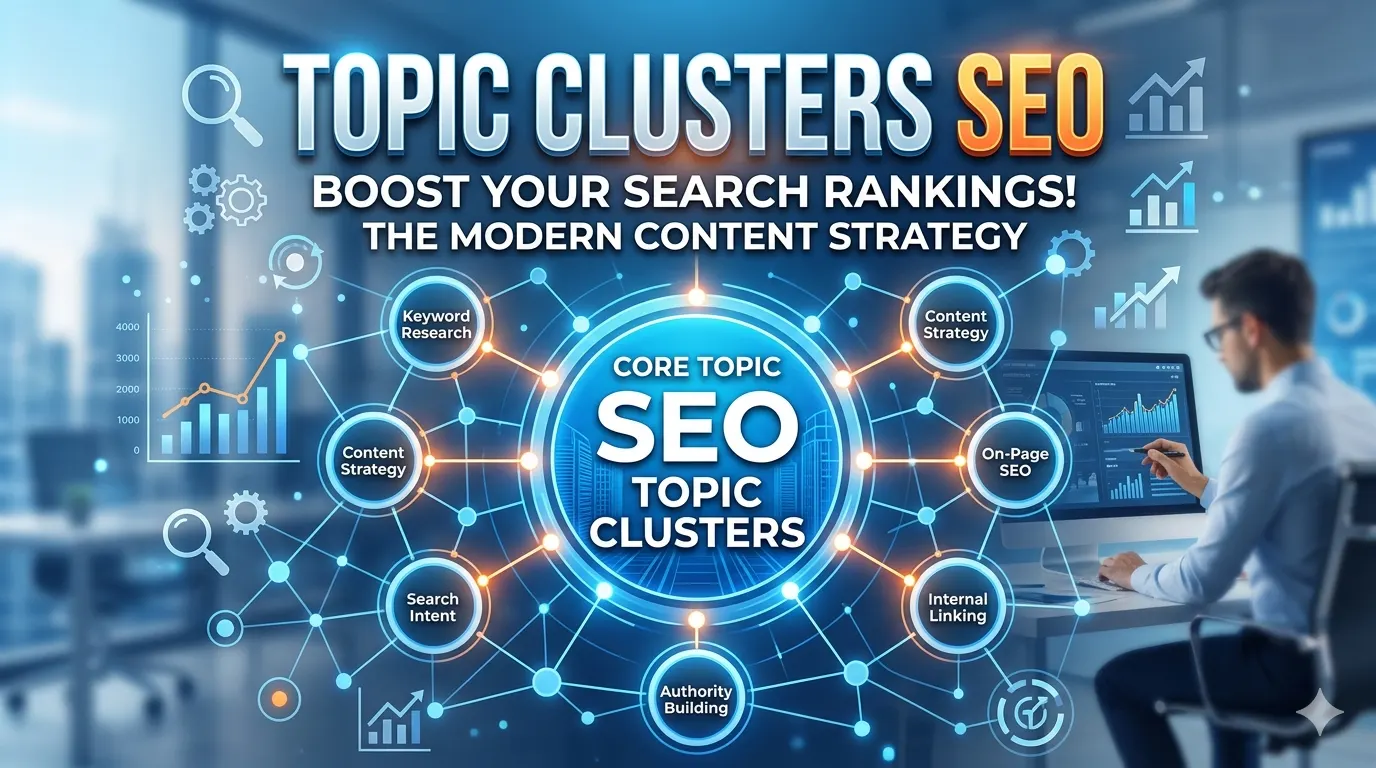
Topic Clusters SEO is the modern replacement for the outdated “keyword silo” approach. Instead of scattering individual articles targeting single keywords, you build a central “pillar” page that comprehensively covers a broad topic. You then link this pillar to several “cluster” pages, each targeting a specific subtopic or long-tail query. This creates a semantic web of content that signals deep expertise to both users and search engines. For 2026, this strategy is now essential for AI Overview optimization because Generative AI models prioritize authoritative source structures over isolated pages.
Direct Answer: How does a Topic Cluster work?
You choose one core topic (e.g., “Email Marketing Strategy”). You write a comprehensive pillar page covering the entire strategy. Then, you write 10–20 cluster articles (e.g., “Best Email Marketing Software for Startups,” “How to Write a Sales Email Sequence”). The pillar page links to each cluster, and each cluster links back to the pillar page. Search engines see this linked network as a sign of topical authority.
Why Topic Clusters Matter More in 2026
Google’s Helpful Content System and the rise of AI Overviews have changed the game. Isolated articles rarely rank well. The key reasons for prioritizing clusters in 2026 are:
- AI Overview Optimization: AI model summaries often pull from pillar pages and their supporting cluster content to create a comprehensive answer. A well-linked cluster increases your chances of being cited.
- Entity-Based Ranking: Clusters help search engines associate your site with a specific entity (e.g., “Email Marketing Expert”) rather than just a string of keywords.
- Internal Link Equity: A structured cluster distributes PageRank efficiently across all related pages, boosting the performance of every article in the group.
- User Experience: Visitors can easily navigate from a broad concept to specific details, keeping them on your site longer and reducing bounce rates.
The Core Anatomy of a Topic Cluster
A successful cluster has three primary components. Understanding these is fundamental to building a scalable strategy:
| Component | Role | Example (Topic: Project Management) |
|---|---|---|
| Pillar Page | The definitive, long-form guide on the core topic. Covers the “big picture.” | The Ultimate Guide to Project Management Methodologies |
| Cluster Content | Detailed articles on specific subtopics, long-tail queries, or related entities. | Scrum vs. Kanban: Key Differences, Waterfall Project Planning, Best Tools for Remote Teams |
| Internal Links | Hyperlinks connecting pillar and cluster pages. Bi-directional linking is mandatory. | Pillar links to “Scrum vs. Kanban” article; “Scrum vs. Kanban” links back to the pillar. |
Expert Tip: Start with 5–7 Cluster Articles
Don’t try to build a 50-article cluster overnight. Start by identifying the top 5–7 most searched subtopics related to your pillar. Publish those first, build the links, and monitor performance. Add more cluster content based on keyword data and user questions. This iterative approach builds sustainable topical authority without overwhelming your editorial calendar.
How to Build the Pillar Page
The pillar page must be the most comprehensive resource on the topic. It is not a blog post; it is a landing page for the entire topic cluster.
Content Structure for a High-Performing Pillar
- Comprehensive Coverage: Cover every major aspect of the topic. Use subheadings that mirror your cluster content. If you have a cluster article on “Tool A,” the pillar should have a section mentioning the comparison.
- Hyperlinks to Clusters: Every major subtopic section should link directly to the relevant cluster article. Use descriptive anchor text.
- Visual Summary: Include a table or list that summarizes the links to your cluster content.
- Answer Snippet Optimization: Write a very clear, concise definition or overview at the top of the pillar to target featured snippets for the core keyword (e.g., “Topic Clusters SEO”).
Pillar Page Example Outline
Pillar Topic: Remote Team Collaboration
Pillar Title: The Complete Guide to Remote Team Collaboration in 2026
- Section 1: The State of Remote Work (link to cluster article: “Remote Work Statistics 2026”)
- Section 2: Best Software for Remote Teams (link to cluster article: “Best Video Conferencing Tools Compared”)
- Section 3: Building Company Culture (link to cluster article: “Virtual Team Building Activities”)
- Section 4: Productivity & Workflows (link to cluster article: “Asynchronous Communication Best Practices”)
How to Build the Cluster Content
Cluster articles are the workhorses of the strategy. They target specific long-tail keywords and user intent. Each cluster article must clearly link back to the pillar page.
Cluster Content Requirements
- Target One Specific Subtopic: Do not stray from the assigned subtopic. Keep it focused. Example: “Best SEO Tools for Topic Clusters” is a cluster article; it should not also talk about social media.
- Answer User Questions: Use tools like “People Also Ask” or forum threads to find real user questions. Answer them directly within the cluster content.
- Link Back to Pillar: Use the primary keyword of the pillar as the anchor text when linking back. Example: “For a full overview of remote team collaboration, see our complete guide.”
- Maintain Semantic Relationships: Link to other cluster articles when it makes sense contextually. This creates a dense internal link graph.
Internal Linking Architecture
Without a solid linking structure, you just have a collection of related articles. The links are what make it a cluster.
The Golden Rule of Cluster Linking
- Pillar to Cluster: The pillar page must link out to every single cluster article.
- Cluster to Pillar: Every cluster article must link back to the pillar page, preferably from the introduction or first body paragraph.
- Cluster to Cluster: Link cluster articles to each other when the topic logically connects. This reinforces the semantic depth.
Practical Example: The Linking Grid
Imagine a cluster for “Email Marketing.” The linking looks like this:
- Pillar: The Ultimate Guide to Email Marketing → links to “Email Segmentation,” “A/B Testing Subject Lines,” and “Deliverability Tips.”
- Cluster: Email Segmentation → backlinks to “The Ultimate Guide to Email Marketing” and forward-links to “A/B Testing Subject Lines” (because segmentation affects testing).
This creates a hub-and-spoke model that search engines recognize as a knowledge center.
Practical Example: SaaS Content Strategy
Scenario: A B2B SaaS company, “TaskFlow,” wants to rank for project management queries. They decide to use a Topic Cluster approach.
Pillar Page: “The Complete Guide to Project Management for Software Teams” (covers methodologies, tools, reporting).
Cluster Articles (5 articles):
- “Kanban vs. Scrum: Which Workflow is Best for Developers?”
- “Best Project Management Tools for Remote Startups”
- “How to Create a Sprint Retrospective Report (Template)”
- “Burndown Charts: A Beginner’s Guide to Tracking Progress”
- “Top Time-Tracking Integrations for Project Managers”
Implementation: The pillar page includes a section titled “Choosing Your Methodology” with a link to article #1. It also has a “Tools” section linking to article #2. Each cluster article starts with a sentence like, “As part of our comprehensive guide to project management for software teams, we’ve broken down the key differences between Kanban and Scrum.” This instantly creates the semantic link back to the pillar.
Hypothetical Mini Case Study: E-commerce Category Revamp
Hypothetical Example: PetFoodShop.com
Problem: An e-commerce site selling dog food had 100+ product pages but no topical authority. Their category page for “Grain-Free Dog Food” was a thin product list. Visitors left quickly.
Solution: The team created a pillar page titled “The Complete Guide to Grain-Free Dog Food” explaining ingredients, benefits, and safety. They then wrote 10 cluster articles such as “Best Grain-Free Dog Food for Allergies,” “How to Transition Your Dog to Grain-Free,” and “Grain-Free vs. Grain-Inclusive: A Comparison.” Every cluster article linked back to the pillar. The pillar page also linked to the best-selling product pages within the cluster context.
Outcome (Hypothetical): Over 4 months, the pillar page started ranking for the main keyword “grain-free dog food.” The cluster articles dominated featured snippets for long-tail queries. Organic traffic to the category increased as users moved from the cluster articles to the pillar, then to the product pages. This is a realistic example of how a content cluster supports both informational and transactional user intent.
Actionable Implementation Checklist
Use this checklist to build your first topic cluster:
- Identify 1 core topic that aligns with your business objectives.
- Brainstorm 10–20 subtopics based on keyword research and user questions.
- Select the top 5 subtopics for your initial content batch.
- Write the pillar page (1500–3000 words) covering every major subtopic.
- Write each cluster article (800–1500 words) targeting one specific subtopic.
- Add hyperlinks from the pillar to every cluster article.
- Add hyperlinks from each cluster article back to the pillar.
- Add 2–3 contextual links between cluster articles.
- Update the pillar page’s navigation or table of contents to include the cluster links.
- Monitor rankings for the pillar page keyword and cluster keywords after 4–6 weeks.
- Expand the cluster by adding more articles based on performance data.
Frequently Asked Questions
How many cluster articles do I need for a topic cluster to work?
There is no fixed minimum, but most successful clusters start with at least 5 strong cluster articles. The key is comprehensiveness, not quantity. One well-written cluster article covering a unique subtopic is more valuable than ten thin articles. Focus on covering the most important subtopics thoroughly, then expand over time.
Can I update an existing blog post to be a pillar page?
Yes, absolutely. If you have an existing long-form article that covers a broad topic, you can convert it into a pillar page. You will need to add sections that link to your new cluster articles and ensure the content is comprehensive enough to serve as the authoritative resource. However, starting fresh often yields better structure and focus.
Does Topic Cluster SEO help with AI Overviews?
Yes. Topic Clusters demonstrate topical depth and internal authority. When a generative AI model scans the web to answer a user query, a site with a clear, linked cluster structure is more likely to be cited as a reliable source. The pillar page often becomes the primary source for the definition, while cluster articles provide supporting detail for specific facets of the query.
What is the difference between Topic Clusters and Keyword Siloing?
Keyword siloing was a rigid, folder-structure approach where sites divided content into isolated sections (home > blog > category > post). Topic Clusters are fluid, using bi-directional internal links instead of folder hierarchy. Clusters focus on semantic relevance (topics and entities) rather than exact-match keywords. Google’s modern algorithms prefer the flexible, user-focused linking approach of Topic Clusters.
Author Insight: The Future of Content Structure
From an editorial perspective, the biggest shift in 2026 is moving from “keyword targeting” to “entity targeting.” Topic Clusters are the tactical vehicle for this. Your pillar page should represent the main entity, and your cluster articles should represent the related entities or attributes. For example, if your entity is “Content Marketing,” your cluster articles should target entities like “Content Distribution,” “Content Measurement,” and “Content Formats.” This aligns perfectly with how search engines and AI models process information.
Final Strategy Notes
Topic Cluster SEO is not a one-time project; it is an ongoing editorial strategy. Regularly audit your clusters. See which cluster articles drive the most traffic and update them. Add new cluster articles as your industry evolves and new subtopics emerge. The pillar page should be updated at least quarterly to reflect the latest information and to link to any new cluster content you create. By consistently maintaining your clusters, you build a long-term asset that generates organic growth, earns featured snippets, and positions you as an authority for your chosen topic. Start small, focus on quality, and let your links do the heavy lifting.
About the Author
The SMARTCHAINE Editorial Team focuses on SEO, GEO optimization, AI Overviews, structured data, and practical search visibility strategies.