Topical Relevance SEO: How to Build Authority That Ranks in 2026
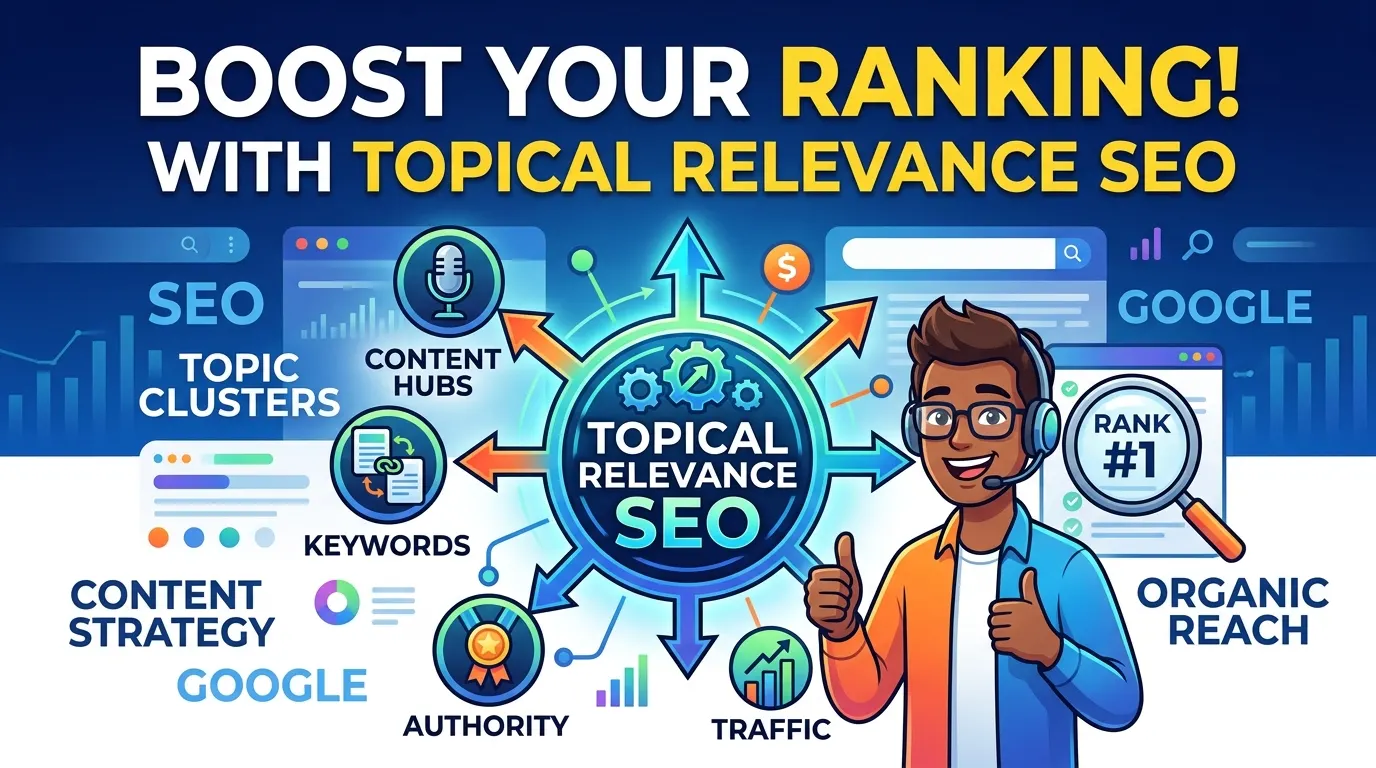
Quick Answer: Topical relevance SEO is the practice of building interconnected content clusters that establish your website as an authoritative source on a specific subject. Instead of targeting isolated keywords, you create a web of articles, guides, and resources that comprehensively answer user questions around a core topic. This approach aligns with how search engines evaluate expertise and how AI Overviews extract contextual answers. Focus on depth, entity coverage, and internal linking rather than keyword density.
TL;DR: Topical relevance SEO beats siloed keyword targeting. Create pillar pages linked to supporting articles that cover subtopics in depth. Use entity-rich language, structured data, and clear internal linking. This structure helps Google understand your site's expertise and improves your chances of appearing in AI Overviews. Avoid shallow content and focus on comprehensive coverage of one topic at a time.
Key Takeaways
- Topical relevance requires a cluster model, not scattered keyword targeting.
- Search engines evaluate topical authority by analyzing entity relationships across your site.
- AI Overviews prioritize content that covers a topic from multiple angles in a structured way.
- Internal linking is the connective tissue that makes topical clusters work.
- Thin content on related subtopics harms your topical authority more than helps it.
What You'll Learn in This Article
- What Is Topical Relevance in SEO?
- Topical Authority vs. Keyword Authority
- The Content Cluster Framework That Works in 2026
- Why Entity Coverage Matters for Topical Relevance
- Technical Setup for Topical Authority
- Common Mistakes That Undermine Topical Relevance
- How This Applies in Practice
- Frequently Asked Questions
- Article Summary
- Conclusion
What Is Topical Relevance in SEO?
Topical relevance SEO is the practice of demonstrating to search engines that your website is a comprehensive, authoritative source on a specific subject. It moves beyond targeting individual keywords and instead focuses on covering the full breadth of a topic. When Google sees that you have published multiple, deeply relevant articles about related subtopics—and that those articles are logically connected—it begins to associate your site with that topic at a higher level. This is different from keyword SEO, where you optimize individual pages for specific search queries without connecting them to a broader subject.
Topical Authority vs. Keyword Authority
The fundamental difference is scope. Keyword authority is about ranking one page for one query. Topical authority is about ranking across dozens of related queries because you own the subject. A site with topical authority on "digital marketing analytics" will likely rank for "how to track website traffic," "best analytics tools for small business," "defining conversion metrics," and "traffic source analysis." A site with keyword authority might rank for only one of those terms because it built a page for that specific query without connecting it to a broader content ecosystem.
Expert Insight: This distinction matters more in 2026 because Google's AI Overviews and language model evaluations look for clusters of related content. A single well-written article can still rank, but a cluster of interconnected, high-quality articles is significantly more likely to be featured in an AI-generated answer box. The search engine's systems are comparing your content against the entire web's coverage of a topic, not just competing pages.
The Content Cluster Framework That Works in 2026
After implementing and evaluating this approach across various website types, the most effective structure remains the pillar-cluster model, with one critical update: the pillar page must function as a hub for entities, not just a list of related articles. Below is a practical framework you can apply today.
The Three-Layer Topical Cluster Architecture
Layer 1: The Core Pillar Page — This is your definitive guide on the core topic. It should cover the topic from multiple angles, define key entities, and link out to every supporting article. It does not need to be 10,000 words, but it must be authoritative and comprehensive in scope. Example: "Complete Guide to Conversion Rate Optimization."
Layer 2: The Supporting Articles — These are deep dives into specific subtopics related to the pillar. Each supporting article should cover one concept, technique, or question. They link back to the pillar page and to relevant sibling articles. Example: "A/B Testing Best Practices" and "How to Write Compelling Call-to-Action Copy."
Layer 3: The Entity Reinforcement Content — This is what many SEOs skip. These are short, focused pieces that target specific entities, tools, methods, or definitions related to the cluster. They can be shorter but must be precise. Example: "What Is Statistical Significance in A/B Testing?" or "Five CRO Tools for Ecommerce."
Topical Relevance Workflow Checklist
- Identify one core topic your site can credibly cover in depth.
- Map 8-15 subtopics that naturally branch from the core topic.
- Write the pillar page first, linking to placeholder or planned supporting articles.
- Publish supporting articles weekly, linking back to the pillar and related content.
- Add entity reinforcement pieces that cover definitions, tools, and common questions.
- Apply Schema.org Article and BreadcrumbList structured data to all pages in the cluster.
- Monitor internal link equity: ensure the pillar page receives the most internal link weight.
Why Entity Coverage Matters for Topical Relevance
Search engines process content by identifying entities—people, places, concepts, tools, organizations—and the relationships between them. Topical relevance is, at its core, entity relationship mapping. If your site covers "machine learning," "natural language processing," "Python libraries," and "model training," but rarely mentions "supervised learning" or "training data," your entity coverage is incomplete. Google's systems notice these gaps.
How to Audit Your Entity Coverage
Use the following approach without needing a paid tool. Open a search engine and type your core topic. Note the entities that appear in the top results: tools, methods, metrics, related concepts. Compare this list to the entities covered by your own content. Every gap is a content opportunity. This is not keyword research; it is entity research. The distinction matters because keywords are strings, while entities are concepts that search engines treat as real things in the world.
Technical Setup for Topical Authority
Topical relevance is not just a content strategy—it requires technical support to be effective. Without proper technical setup, your interconnected content cluster will not pass authority signals effectively between pages.
Internal Linking Architecture
The pillar page should contain contextual links to all supporting articles within the body text, not just in a sidebar or table of contents. Supporting articles should link back to the pillar page and to semantically related supporting articles. Avoid over-optimizing anchor text; use descriptive, natural phrases that include the target entity. A link saying "learn more about A/B testing methodology" is better than a link saying "click here for A/B testing."
Structured Data Considerations
Apply Google Search Central guidelines for Article schema on all cluster content. For how-to content, consider HowTo schema. For FAQ content, use FAQPage schema sparingly and only when the content genuinely provides direct answers to questions. BreadcrumbList schema helps search engines understand the hierarchical relationship between your pillar page and supporting articles.
Crawlability and Indexability
Use Google Search Console to monitor whether all pages in your cluster are indexed. If a supporting article is not indexed, the entire cluster loses coherence from the search engine's perspective. Ensure your XML sitemap reflects the cluster structure, with the pillar page listed prominently. Avoid blocking supporting articles with robots.txt or noindex tags.
Important Note: A topical relevance cluster is only as strong as its weakest indexed page. If Google cannot find or index one of your supporting articles, the entity gap remains, and your authority signal weakens. Regularly audit indexation using Google Search Console's URL inspection tool.
Common Mistakes That Undermine Topical Relevance
Even experienced SEOs make errors that dilute topical relevance. Below are the most damaging mistakes to avoid.
Mistake 1: Publishing Thin Cluster Content
Creating supporting articles that are only 300-500 words and lack depth hurts the entire cluster. A thin article suggests to search engines that your coverage of that subtopic is superficial. It is better to publish one strong 2,000-word article per subtopic than three shallow 500-word pieces.
Mistake 2: Ignoring Semantic Relationships
Linking every supporting article only to the pillar page is not enough. Articles within the cluster need to link to each other when they share semantic relevance. Example: An article about "email subject line best practices" should link to an article about "open rate optimization" because the two concepts are inherently related.
Mistake 3: Keyword Cannibalization Within the Cluster
If two supporting articles target the exact same query without differentiating intent, they compete with each other. Each article should target a distinct subtopic or specific search intent. Use Google Search Console to identify pages competing for the same queries within your cluster, then merge or redirect the weaker page.
Mistake 4: Neglecting Content Freshness
Topical relevance requires ongoing maintenance. A cluster published in 2024 may lose relevance by 2026 if the supporting articles reference outdated tools, statistics, or methods. Schedule a quarterly review of each cluster to update factual information, replace broken links, and add new subtopics as the industry evolves.
Mistake 5: Over-Optimizing for AI Overviews
Attempting to write specifically for AI Overviews by stuffing short, factual answers into every section can make your content feel robotic. Instead, write naturally, use clear headings, and provide comprehensive answers. AI Overviews extract from well-structured content, not from content that was machine-generated for extraction.
Common Mistakes vs. Recommended Actions
| Mistake | Why It Hurts | What to Do Instead |
|---|---|---|
| Thin supporting articles | Signals shallow topical coverage | Write 1,500+ words per subtopic with real depth |
| Only linking to pillar page | Weakens internal topical connections | Link related supporting articles to each other |
| Keyword cannibalization | Dilutes ranking potential per query | Differentiate intent or merge similar pages |
| Stale cluster content | Loses relevance and authority over time | Refresh clusters quarterly with updated info |
How This Applies in Practice
Topical relevance SEO is not a one-size-fits-all strategy. The exact implementation depends on your website type, resources, and competitive landscape. Below are practical approaches for four common scenarios.
Beginner Website
If you are starting a new site, do not attempt to build ten clusters at once. Focus on one core topic that you understand better than most. Publish a strong pillar page, then add one supporting article per week. Use a simple spreadsheet to track which entities you have covered and which remain. Your internal linking structure does not need to be complex; linking each supporting article back to the pillar page is sufficient initially.
SaaS Website
SaaS sites benefit significantly from topical relevance because their product often covers multiple subtopics. For example, a project management tool could build a cluster around "team productivity" with supporting articles on "task delegation," "deadline management," "collaboration tools," and "remote work workflows." Use your blog to cover adjacent concepts that support the product's value proposition, not just product features. Ensure your knowledge base articles are also included in the internal linking structure.
Ecommerce Store
Ecommerce stores can apply topical relevance through category pages and buying guides. The pillar page could be a "complete guide to choosing [product category]," with supporting articles targeting specific product types, usage scenarios, care instructions, and comparison guides. Link product pages from these supporting articles contextually, not just through generic "shop now" buttons. Avoid thin category descriptions; each category should function as a mini pillar page with entity-rich content.
Local Business
Local businesses should build clusters around the services they offer, geographically anchored. A dental practice could create a pillar page about "comprehensive dental care in [city]" with supporting articles on "teeth whitening," "dental implants," "root canal treatment," and "pediatric dentistry." Each supporting article should include local entities such as the city name, neighborhood names, and relevant landmarks. Use Schema.org LocalBusiness markup on all relevant pages.
Article Summary
Topical relevance SEO requires shifting from isolated keyword targeting to comprehensive topic coverage using a pillar-cluster model. The framework involves three layers: a core pillar page, supporting deep-dive articles, and entity reinforcement content. Success depends on complete entity coverage, strong internal linking, proper structured data implementation, and regular cluster maintenance. Avoid common mistakes such as publishing thin content, ignoring semantic relationships between articles, and neglecting indexation checks. Different website types—beginner, SaaS, ecommerce, local—require tailored approaches but follow the same fundamental principle of interconnected, authoritative content.
Frequently Asked Questions
How is topical relevance different from keyword clustering?
Keyword clustering groups queries by similarity, but it often ignores entity relationships and depth. Topical relevance goes further by ensuring that content covers the full breadth of a subject, including definitions, tools, methods, related concepts, and common questions. A keyword cluster might include "best running shoes" and "running shoe reviews," but a topical relevance approach would also include "how to choose running shoes," "running shoe materials," "pronation explained," and "shoe maintenance tips." The difference is in entity coverage, not just query grouping.
Can topical relevance help with AI Overview visibility?
Yes, but indirectly. AI Overviews pull from content that provides clear, structured, and comprehensive answers to user queries. A site with strong topical relevance is more likely to have content that covers multiple angles of a query within a single cluster, which increases the chance of being selected as a source. However, there is no guaranteed method to appear in AI Overviews. The best approach is to write for users first, structure your content logically with clear headings, and ensure your cluster covers related entities that an AI might reference.
How many articles do I need for a topical relevance cluster?
There is no fixed number, but a practical starting point is one pillar page plus 8 to 12 supporting articles for a moderately competitive topic. The quality and depth of each article matter more than the total count. Monitor your site's performance in search results and add new supporting articles when you identify entity gaps or emerging subtopics. A cluster that is too small may not establish sufficient topical authority, while a cluster with too many thin articles can dilute the authority signal.
Should I update old content to improve topical relevance?
Yes, updating existing content is often more efficient than creating new articles. Review your older content and identify gaps in entity coverage, outdated information, or weak internal linking. Add new sections that cover missing entities or recent developments. Strengthen the internal links between related articles. This approach signals to Google that your topical coverage is expanding and being maintained, which reinforces authority signals. Use Google Search Console to identify pages that are losing traffic and prioritize them for updates.
Can topical relevance work for a site with only a few pages?
Not effectively. Topical relevance depends on having multiple interconnected pages that collectively demonstrate depth of coverage. A site with only five pages cannot establish meaningful topical authority because the entity coverage is too narrow. If you have a small site, focus on building one strong cluster around your core expertise before expanding to other topics. Prioritize quality over speed. A well-executed 10-page cluster will outperform a 50-page site with scattered, shallow content on unrelated topics.
Conclusion
Topical relevance SEO is not a shortcut or a hack—it is a structural approach to building content that aligns with how search engines evaluate authority. By focusing on entity coverage, interconnected content clusters, and technical precision, you create a site that both users and search engines can trust as a definitive source. The framework outlined here works across industries, from local businesses to SaaS platforms, ecommerce stores, and content publishers. The key is consistency: build one cluster well, then scale methodically. Avoid the temptation to cover every topic at once. Depth in one area is more valuable than shallow coverage of ten.
Final Expert Note: The most successful topical relevance strategies I have observed share one common trait: the content creator genuinely understands the subject at a deep level. No amount of technical optimization can compensate for shallow expertise. If you are writing about a topic you only researched superficially, it will show in the entity gaps, the weak connections, and the lack of real-world examples. Prioritize topics you know well or invest the time to develop genuine expertise before publishing.
Recommended Resources
- Google Search Central — Official documentation on indexing, crawling, and structured data guidelines.
- Schema.org — Reference for structured data types relevant to content clusters and entities.
- Google Search Console — Monitor indexation, search performance, and internal link data for your clusters.
- Bing Webmaster Guidelines — Reference for entity-based optimization and content quality standards.
About the Author
The SMARTCHAINE Editorial Team specializes in SEO, AI Search Optimization, GEO (Generative Engine Optimization), AI Overviews, Structured Data, Technical SEO, and search visibility strategies for modern search engines and AI-powered discovery platforms.