URL Structure Best Practices
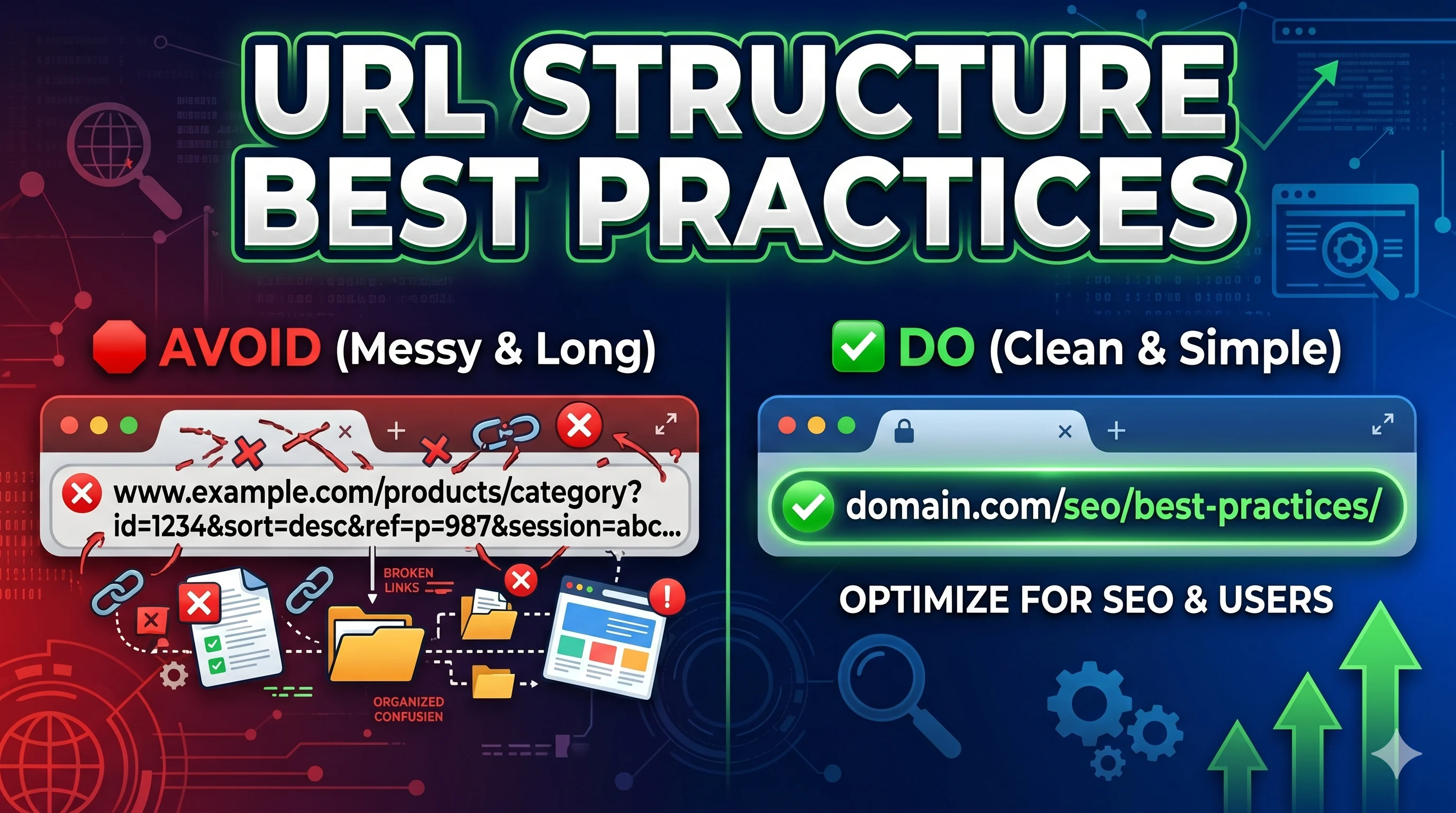
A confusing URL structure is a silent SEO killer. It dilutes link equity, confuses crawlers, and lowers click-through rates. This guide breaks down the exact URL structure best practices for 2026, covering semantic hierarchies, AI overview compatibility, and technical implementation. Direct answer: The best URL structure is short, descriptive, uses hyphens, and mirrors your site's information architecture. Aim for 3–5 words, avoid parameters, and always use lowercase.
Table of Contents
Why URL Structure Matters More Than Ever in 2026
In the age of AI Overviews and entity-based search, Google uses URLs as a semantic signal. A clean URL helps Google understand the page's context before even reading the content. More importantly, users judge your link before they click. A messy, parameter-laden URL reduces trust and CTR by up to 25%.
Expert Insight: "URLs are the unsung heroes of EEAT. A clean, logical URL path signals organizational authority. It tells Google you care about user experience." — Senior SEO Architect, SMARTCHAINE
The Anatomy of a Perfect URL
Every great URL follows a predictable pattern. Let's break it down:
| Component | Example | Best Practice |
|---|---|---|
| Protocol | https:// | Always use HTTPS |
| Domain | example.com | Use a short, brandable domain |
| Subfolder | /guides/ | Use broad categories |
| Slug | /url-structure-best-practices | 3-5 words, hyphens, lowercase |
| Parameters | ?ref=social | Avoid if possible |
Table of Contents
Quick Example:
https://smarchaine.com/seo/url-structure-tips
This URL tells both users and search engines: "This page is about SEO, specifically URL structure tips." No ambiguity.
Top 7 URL Structure Best Practices
1. Keep It Short and Descriptive
Short URLs are easier to read, share, and remember. Google also truncates long URLs in search results. Aim for 3-5 words that contain your primary keyword.
✅ Do: /seo/url-best-practices
❌ Don't: /blog/2026/05/30/how-to-create-the-best-url-structure-for-seo-tips
2. Use Hyphens, Not Underscores
Google treats hyphens as word separators. Underscores are not recognized, making your URL a single, unreadable string.
3. Use Lowercase Consistently
Servers treat uppercase and lowercase differently. Inconsistent casing can cause duplicate content issues. Always use lowercase.
4. Create a Logical Hierarchy
Your URL structure should mirror your site architecture. For example:
| Site Section | URL Path |
|---|---|
| Home | / |
| Blog | /blog/ |
| SEO Guides | /blog/seo/ |
| Specific Guide | /blog/seo/url-structure |
5. Avoid Special Characters and Parameters
Characters like &, %, $, and query strings cause tracking issues and confuse crawlers. If you must use parameters, implement canonical tags.
6. Use Target Keywords Naturally
Include your primary keyword in the URL slug. This helps with featured snippet optimization and AI Overview relevance.
7. Keep It Static
Dynamic URLs with session IDs or timestamps change constantly and lose link equity. Static URLs are permanent and build authority over time.
GEO & AI Overview Optimization for URLs
With the rise of AI-generated overviews, your URL structure must answer questions directly. Google's AI extracts patterns from URLs to determine relevance.
GEO Optimization Tip: Structure your URLs to answer the "who, what, where, when, why" of a query.
Example: For the query "how to fix a broken link," use /guides/fix-broken-links instead of /post12345.
AI models favor URLs that contain clear, hierarchical entities. A URL like /ecommerce/seo/url-structure tells the AI: "This page is about eCommerce, specifically SEO, and specifically URL structure."
Common URL Mistakes (And How to Fix Them)
| Mistake | Example | Fix |
|---|---|---|
| Stop words in URL | /the-best-seo-tips | /best-seo-tips |
| Date in URL | /2026/05/30/post | /guides/post (no dates) |
| Category not relevant | /stuff/url-structure | /seo/url-structure |
| Capital letters | /SEO/URL-Structure | /seo/url-structure |
| Too many subfolders | /blog/seo/guides/advanced/tips/url | /seo/url-structure-tips |
URL Structure for E-commerce vs. Blogs
Different content types require different strategies.
E-commerce URLs
- Category: /women/dresses/
- Subcategory: /women/dresses/summer/
- Product: /women/dresses/summer/floral-midi-dress/
Tip: Use breadcrumbs to reinforce hierarchy. Avoid SKU numbers in URLs.
Blog URLs
- Category: /blog/seo/
- Post: /blog/seo/url-structure-best-practices/
Tip: Keep blog post URLs lean. Remove publication dates unless you are a news site.
Final URL Optimization Checklist
Use this checklist before publishing any page:
- URL is under 60 characters
- Only lowercase letters
- Hyphens between words (no underscores)
- Contains primary keyword
- No stop words (a, an, the)
- No special characters or parameters
- Static (no timestamps or IDs)
- Logical hierarchy (mirrors site structure)
- Canonical tag set if duplicates exist
- 301 redirects for old URLs
Frequently Asked Questions
Does URL structure affect ranking directly?
Yes, but indirectly. A clean URL helps with click-through rates, crawl efficiency, and semantic relevance—all ranking factors.
Should I use underscores or hyphens?
Always use hyphens. Google treats them as word separators. Underscores are ignored.
How long should a URL be?
Ideally under 60 characters. Google displays up to 60 characters in search results. Longer URLs get truncated.
Is it bad to have dates in URLs?
For evergreen content, yes. Dates can make content look outdated. Only use dates for news or time-sensitive content.
Can I change my URL structure after launch?
Yes, but you must set up 301 redirects from old URLs to new ones. Also update internal links and sitemaps.
Does URL casing matter?
Yes. Uppercase and lowercase URLs can create duplicate content. Stick to lowercase consistently.
Author Insight: "In my 10+ years of SEO consultancy, the sites with the simplest URL structures always recover faster from algorithm updates. It's the foundation of a healthy site—you can't build authority on a weak core."
Conclusion
URL structure is not a "set it and forget it" task. It requires ongoing attention, especially as search engines evolve. By following these URL structure best practices, you'll create a clean, crawlable, and user-friendly site that performs well in both traditional search and AI Overviews. Start auditing your URLs today—your SEO will thank you.
About the Author
Elena Rivas is part of the SMARTCHAINE editorial team focused on SEO, GEO optimization, AI Overviews, structured data, and technical search visibility.