What Are Google Rich Results? A Practical 2026 Guide for SEO
TL;DR
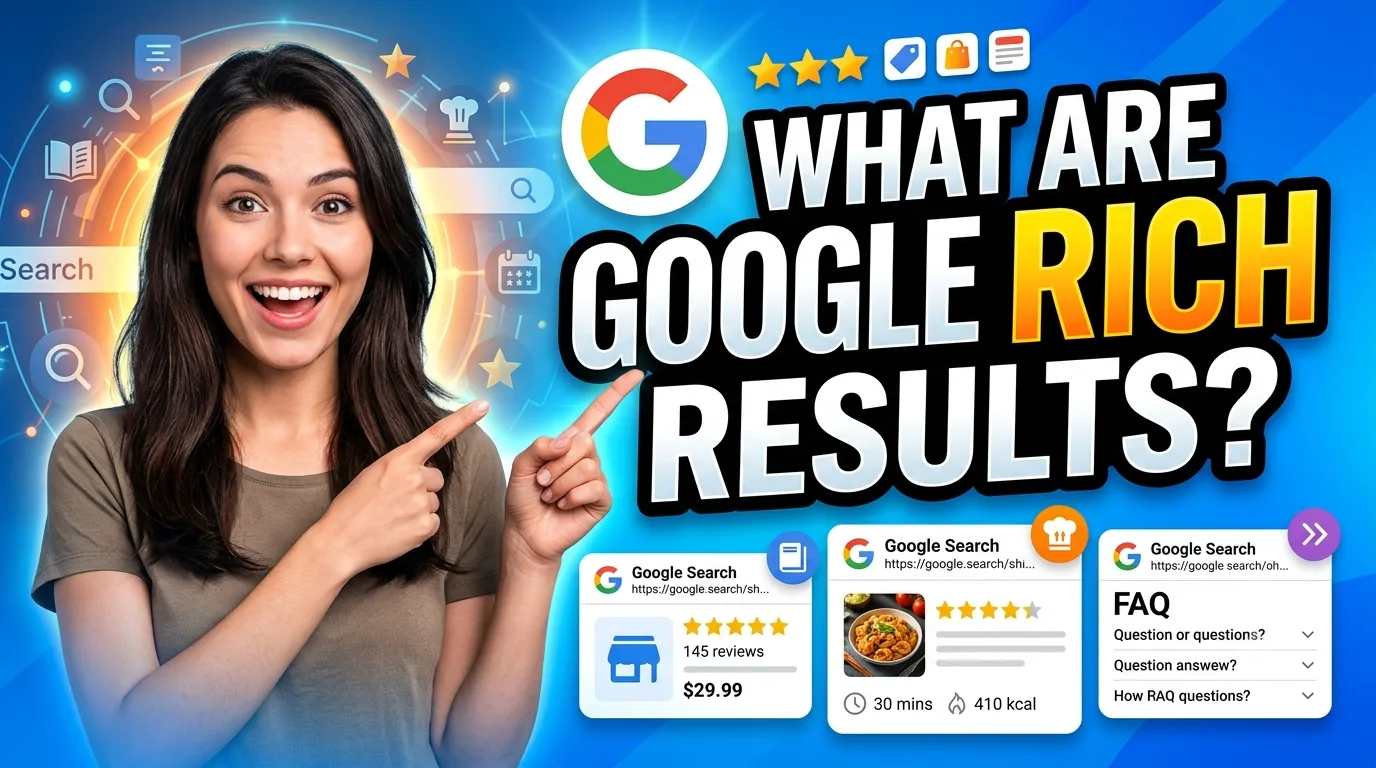
Google rich results are enhanced search listings that include additional visual or interactive elements like star ratings, images, pricing, or FAQs. They are powered by structured data markup and help pages stand out in search results. This guide explains the types, how to implement them correctly, and common pitfalls to avoid in 2026, with a focus on AI Overview compatibility.
Quick Answer
Google rich results are search listings that go beyond the standard blue link and description. They display extra information pulled from structured data on your page, such as product prices, recipe cooking times, FAQ questions, or event dates. To get them, you need to add specific schema markup to your HTML and pass Google's quality guidelines.
Key Takeaways
- Rich results require valid structured data using schema types like Article, FAQPage, HowTo, Product, or Review.
- Google uses rich results to improve click-through rates, but eligibility depends on content quality, not just markup.
- AI Overviews in 2026 can extract information from rich result markup, making structured data important for visibility beyond traditional search.
- Common mistakes include using inappropriate schema types, missing required fields, and marking up hidden content.
- The Rich Results Test tool from Google Search Console is the most reliable way to validate your markup before deployment.
- Rich results are not guaranteed even with correct markup — Google applies manual and automated quality checks.
Table of Contents
- What Are Google Rich Results?
- Types of Rich Results in 2026
- How Structured Data Powers Rich Results
- Implementation Workflow for Beginners
- Common Mistakes That Block Rich Results
- How AI Overviews Use Rich Results in 2026
- How This Applies in Practice
- Frequently Asked Questions
- Article Summary
- Conclusion
What Are Google Rich Results?
Google rich results are search listings that include enhanced visual or interactive elements beyond the standard title, URL, and meta description. They appear in search engine results pages (SERPs) as a way to provide users with more information at a glance, such as product ratings, recipe cook times, FAQ accordions, or job posting details. These elements are generated from structured data — specifically, schema markup — that you add to your webpage's HTML. Unlike regular snippets, rich results are designed to increase visibility and click-through rates by making your listing more informative and visually distinct.
The Difference Between Rich Results and Featured Snippets
A common point of confusion is the difference between rich results and featured snippets. Rich results are based strictly on structured data you provide, while featured snippets are often pulled from the page content directly by Google's algorithms without explicit markup. For example, a recipe card with a photo, rating, and cook time is a rich result. A paragraph of text about "how to bake bread" that appears at the top of the search results is a featured snippet. You can control rich results through schema; you cannot control featured snippets directly.
Expert Insight
Many SEOs treat rich results as a "set and forget" tactic after adding schema. In practice, Google can demote rich results if it detects user dissatisfaction signals, such as high bounce rates from the listing. You need to monitor your Search Console performance reports regularly to see which rich result types are being served and whether impression volumes change after algorithm updates.
Types of Rich Results in 2026
Google supports a wide range of rich result types in 2026, but not all are equally common or valuable. The most frequently used and impactful types include product snippets, review snippets, recipe rich results, FAQ rich results, how-to rich results, breadcrumb rich results, event rich results, job posting rich results, and video rich results. Each type requires a specific schema type and set of required properties. Below is a comparison of the most common types and their requirements.
| Rich Result Type | Schema Type | Common Use Case | Required Properties |
|---|---|---|---|
| Product | Product | Ecommerce product pages | name, offers.price |
| Review Snippet | Review | Product or service reviews | itemReviewed, reviewRating.ratingValue |
| Recipe | Recipe | Food blogs, cooking sites | name, recipeIngredient, recipeInstructions |
| FAQ | FAQPage | Question-and-answer content | mainEntity (Question + AcceptedAnswer) |
| HowTo | HowTo | Step-by-step guides, tutorials | name, step (with text or url) |
| Breadcrumb | BreadcrumbList | Site navigation structure | itemListElement (with name and item) |
| Video | VideoObject | Video content pages | name, description, thumbnailUrl, contentUrl |
The Rise of AI Overview Extraction
In 2026, AI Overviews (Google's generative search feature) increasingly pull data from structured markup to answer user queries directly in search results. This means that correctly marked-up FAQ and HowTo schema can be used to generate inline answers within AI Overviews, which can drive visibility even if the user never clicks through. However, this also means that inaccurate or low-quality structured data can lead to poor AI Overview citations, so precision matters more than ever.
How Structured Data Powers Rich Results
Structured data is a standardized format using schema.org vocabulary that tells Google what your content means. When Googlebot crawls your page, it reads the JSON-LD (the recommended format) or microdata and understands that a specific block of text is a product name, a price, a review rating, or a question. Google then uses this understanding to generate the rich result in the SERP. Without structured data, Google relies on heuristic analysis of your page content, which is less reliable and rarely produces rich results.
JSON-LD vs. Microdata vs. RDFa
Google strongly recommends JSON-LD for new implementations. JSON-LD is placed in the <head> or <body> of your page as a script tag, making it easy to manage and less prone to breaking page layout. Microdata and RDFa are older formats that embed schema directly into HTML attributes, which can make code harder to maintain. In 2026, most major CMS plugins for WordPress, Shopify, and other platforms output JSON-LD by default, so there is rarely a reason to use other formats unless you are working with legacy code.
Implementation Note
Always validate your JSON-LD using the Google Rich Results Test before deploying. The tool will tell you if your markup has errors, missing required fields, or warnings. Do not rely only on the Schema.org validator, as some valid markup may still fail Google's specific guidelines.
Implementation Workflow for Beginners
Getting rich results is a systematic process that involves planning, implementing, testing, and monitoring. Below is a step-by-step workflow that works for most websites, regardless of CMS.
- Identify which rich result type matches your content. Do not force a schema type that does not fit. For example, do not use FAQPage on content that is not a clear question-and-answer format.
- Use Google's structured data documentation. Read the specific guidelines for your chosen type on Google Search Central. Pay attention to required, recommended, and optional properties.
- Write your JSON-LD markup manually or use a plugin. For WordPress, plugins like Yoast SEO or Rank Math can generate basic schema. For custom sites, use a JSON-LD generator tool from Schema.org.
- Test with the Rich Results Test. Copy your page URL or paste your HTML directly into the tool. Fix any errors or warnings before going live.
- Deploy and monitor in Google Search Console. Use the "Rich results" report to see which pages are being served with rich results, and track impression data.
- Check for manual actions. If your rich result impressions drop suddenly, check Search Console for manual actions or algorithmic penalties related to structured data misuse.
Hypothetical Example: Adding FAQ Schema to a Blog Post
Imagine you run a blog post titled "How to Choose a Laptop for Programming." You already have a section with three common questions and answers. You could add FAQPage schema to that section. The JSON-LD would look like this:
{
  "@context": "https://schema.org",
  "@type": "FAQPage",
  "mainEntity": [
    {
      "@type": "Question",
      "name": "What processor is best for programming?",
      "acceptedAnswer": {
        "@type": "Answer",
        "text": "An Intel i5 or AMD Ryzen 5 is sufficient for most programming tasks."
      }
    }
  ]
}
After adding this, you use the Rich Results Test to confirm Google sees the FAQ markup. You then publish and wait for indexing. Within a few days, the search result for that post may show an expandable FAQ section.
Common Mistakes That Block Rich Results
Many websites fail to get rich results not because the content is bad, but because of specific implementation errors. Below are the most frequent mistakes seen in 2026 audits.
- Using the wrong schema type. For example, marking up a list of tips as FAQPage when it is not a formal Q&A format. Google's quality guidelines specifically penalize this.
- Missing required fields. Each schema type has minimum required properties. If you omit
priceon a Product page, the rich result will not appear. - Marking up invisible content. Google will not serve rich results for content hidden behind tabs, accordions, or login walls unless it is intentionally designed for user interaction.
- Duplicate or conflicting markup. Having multiple schema blocks on the same page that contradict each other — like two different prices for the same product — can cause Google to ignore all of them.
- Ignoring quality guidelines. Google expects the content inside the rich result to match the user's intent. If your FAQ answers are thin or unhelpful, Google may remove the rich result.
- Forgetting to update schema after content changes. If you change a product price or a recipe instruction but leave the old JSON-LD, Google will detect the mismatch and may remove the rich result.
How AI Overviews Use Rich Results in 2026
AI Overviews in Google Search have evolved significantly since their initial launch. In 2026, these generative responses often pull structured data from rich result markup to answer user queries directly. For instance, a user asking, "What are the steps to replace a bike tire?" may trigger a HowTo rich result that AI Overviews extract into a bulleted response. This means that properly marked-up content can be cited even if the user does not click any link, which has both benefits and risks.
Benefits and Risks for SEO
Benefit: Your brand appears in a high-visibility position, potentially driving brand awareness and indirect traffic. Users who see your answer in an AI Overview may later search for your site directly.
Risk: If the AI Overview provides enough information to satisfy the query, users may not click through to your page. This can reduce your organic click-through rate from that specific query, even though impressions remain high.
Mitigation: Do not rely solely on rich results for traffic. Ensure your page provides depth beyond what the rich result can summarize. Add unique analysis, tables, or actionable steps that the AI Overview cannot capture.
How This Applies in Practice
The approach to rich results differs significantly depending on the type of website. Below are practical examples for four common scenarios.
Beginner Website (Personal Blog or Hobby Site)
Focus on one rich result type that matches your content format. If you write how-to guides, implement HowTo schema. If you answer questions, use FAQPage. Avoid trying to implement multiple schema types on a single page. A personal blog about gardening might start with Recipe schema for plant care guides. The main challenge for beginners is correctly formatting JSON-LD without errors. Use a plugin or a generator tool to reduce mistakes. Monitor Search Console monthly to see if pages are being served with rich results.
SaaS Website
For a SaaS company, the most useful rich result types are FAQPage for feature documentation, HowTo for onboarding guides, and Product for pricing pages. A common workflow is to create a dedicated FAQ section for each major feature, then add structured data to those sections. Avoid marking up your entire knowledge base with FAQ schema — only apply it to pages where the primary format is question and answer. SaaS sites often have dynamic content, so ensure your schema pipeline updates automatically when pricing or feature descriptions change.
Ecommerce Store
Ecommerce stores benefit most from Product rich results, which show price, availability, and reviews directly in the SERP. Use the Product schema on every product page, and ensure that the offers.price and offers.availability properties are dynamically populated from your inventory system. A mistake many stores make is hardcoding a "in stock" value, which becomes incorrect when inventory runs out. Also, add aggregate rating schema if you have user reviews. This increases the likelihood of star ratings appearing in search results.
Local Business
Local businesses should focus on LocalBusiness schema combined with Review and FAQ schema. A local restaurant should mark up its menu, reviews, and frequently asked questions about hours and reservations. BreadcrumbList schema is also valuable for navigation. The main workflow involves claiming your Google Business Profile first, then adding JSON-LD on your website to confirm the name, address, and phone number. Inconsistent NAP (name, address, phone) data between your schema and your Google Business Profile is a common reason why rich results fail for local businesses.
Frequently Asked Questions
Do rich results guarantee higher click-through rates?
Rich results often lead to higher click-through rates because they occupy more visual space and provide immediate useful information. However, there is no universal percentage lift — results vary by industry and query type. A product rich result with a 4.5-star rating will likely outperform a plain listing, but a FAQ rich result that answers the user's question directly inside the SERP may reduce clicks. Measure your own data in Search Console rather than relying on aggregate benchmarks. The CTR change depends on how complete the rich result is and whether it satisfies the search intent without requiring a click.
Can I get rich results without using JSON-LD?
Yes, Google supports microdata and RDFa formats as well, but JSON-LD is strongly recommended for all new implementations. JSON-LD is easier to maintain, does not interfere with your HTML structure, and is less likely to cause validation errors. Most modern SEO plugins output JSON-LD by default. If you maintain a legacy site using microdata, consider migrating to JSON-LD over time, especially if you are expanding the types of schema you use. The format itself does not affect whether Google generates the rich result, as long as the markup is valid and complete.
How long does it take for rich results to appear after adding schema?
There is no fixed timeline. Google must recrawl and reindex the page after you add the structured data. If your site is crawled frequently, you may see rich results appear within a few days. For less frequently crawled sites, it could take weeks. You can speed up the process by using the URL Inspection tool in Google Search Console to request indexing after your schema update. After indexing, use the "Rich results" report to confirm whether Google recognized your markup. If you see "Page is eligible for rich results," the process is working.
Can rich results be removed after they appear?
Yes, Google can remove rich results for several reasons. Common causes include content quality drops, user dissatisfaction signals (such as high bounce rates from the listing), manual actions for schema abuse, or algorithm updates that change eligibility criteria. You can also voluntarily remove rich results by deleting or adjusting your structured data. If you notice a sudden drop in rich result impressions, check Search Console for any warnings or manual actions. Also review your page content to ensure it still meets Google's quality guidelines for the schema type you are using.
Do rich results affect AI Overview citations?
In 2026, AI Overviews commonly reference structured data from rich result markup to generate answers. This means that if your page has well-crafted FAQ or HowTo schema, there is a higher probability that the AI Overview will cite your content. However, this is not guaranteed. AI Overviews also analyze the page's text content, user signals, and other ranking factors. Rich result markup can help by providing explicitly structured information that the AI can easily parse, but it is only one factor among many. Focus on creating clear, authoritative content that works whether or not the AI cites your structured data.
Is it possible to get rich results for every page on my site?
Technically, you can add structured data to every page, but Google will only generate rich results for pages where the content matches a supported rich result type and meets quality standards. For example, adding Product schema to a blog post about SEO best practices will not generate a product rich result because the content does not match the intent. Focus on pages that naturally align with one of the common rich result types. Pages like about pages, contact pages, or privacy policies rarely benefit from rich results, and forcing inappropriate schema could lead to manual actions.
Article Summary
This article explained that Google rich results are enhanced search listings powered by structured data markup. You learned about the common types — product, review, FAQ, how-to, recipe, and video — and how to implement them using JSON-LD. The implementation workflow covered planning, testing, deploying, and monitoring using Google Search Console. We discussed common mistakes such as using the wrong schema type, missing required fields, and marking up invisible content. The guide also addressed how AI Overviews in 2026 interact with rich results and how the advice changes for beginners, SaaS sites, ecommerce stores, and local businesses. The unique contribution of this guide is the emphasis on treating schema as a quality signal, not just a technical checkmark, and the six-step implementation workflow that integrates validation and monitoring as continuous practices.
Conclusion
Rich results remain a valuable part of SEO strategy in 2026, but they require more than just adding a script tag to your page. The pages that benefit most are those where the structured data accurately reflects high-quality content that matches user intent. The key takeaway is to treat rich result implementation as a continuous process of testing, monitoring, and refinement. Start with one schema type that fits your content, use Google's validation tools, and adjust based on what Search Console reports. Do not chase every possible rich result type — focus on the ones that provide real value to your users and align with your content format. As AI Overviews continue to evolve, structured data becomes even more important as a signal of content clarity and authority.
Final Reminder
Schema markup alone will not fix fundamental content or site quality issues. If your page is not ranking well organically, adding rich result markup is unlikely to change that. Focus first on creating content that answers the user's question clearly and thoroughly. Then use structured data to make that content machine-readable. The rich result is the reward for good content, not the substitute for it.
About the Author
The SMARTCHAINE Editorial Team specializes in SEO, AI Search Optimization, GEO (Generative Engine Optimization), AI Overviews, Structured Data, Technical SEO, and search visibility strategies for modern search engines and AI-powered discovery platforms.