What Is Organic Search Traffic? (And Why It Still Matters in 2026)
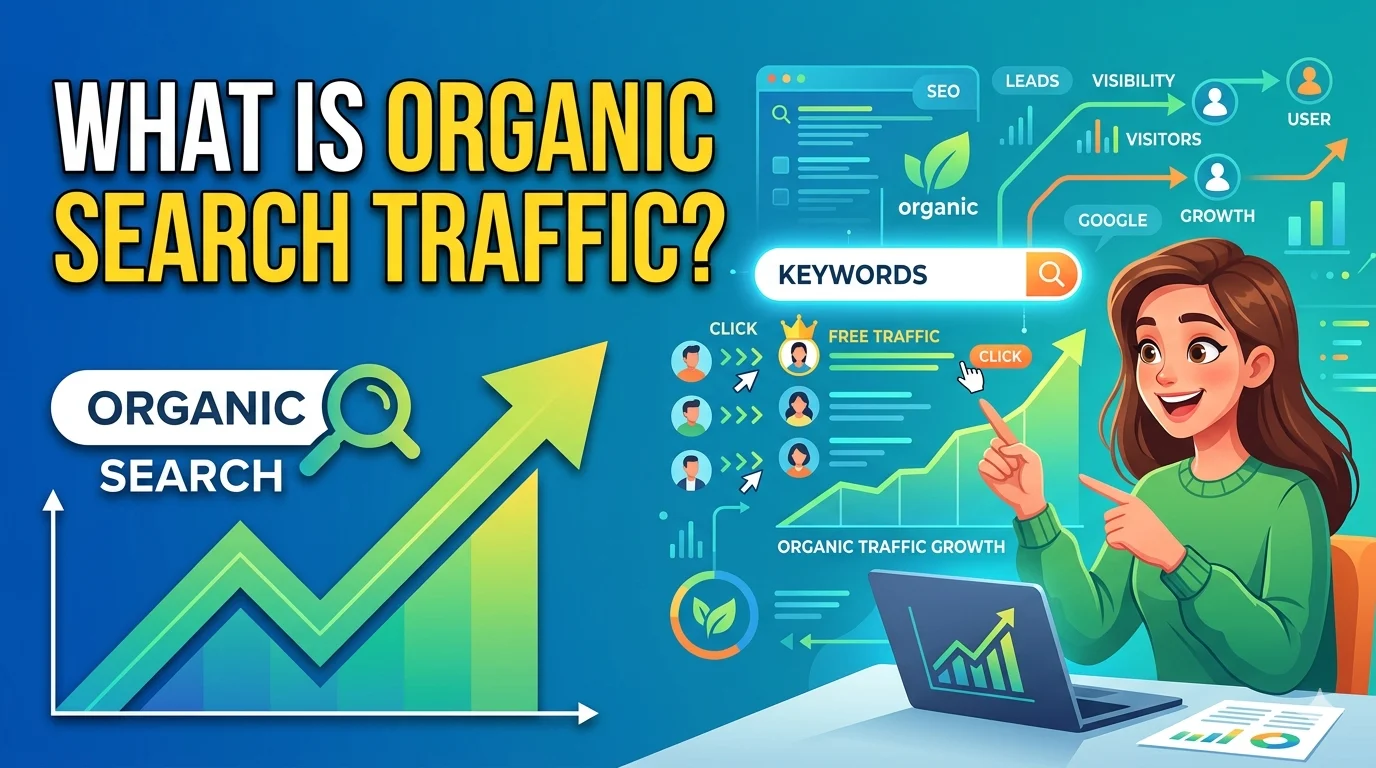
- Organic traffic is driven by relevance, authority, and technical health—not ad spend.
- AI Overviews (formerly SGE) can reduce or increase organic click volume depending on content structure.
- Transactional keywords often lose clicks to AI summaries, while informational keywords remain valuable.
- Core Web Vitals, structured data, and entity clarity are critical for organic visibility.
- Measuring organic traffic requires segmenting by source in Google Analytics.
Table of Contents
- What Is Organic Search Traffic?
- Organic vs. Paid vs. Referral Traffic
- How AI Overviews Affect Organic Search Traffic
- How to Measure Organic Traffic Properly
- The 3-Pillar Organic Content Methodology
- Common Mistakes That Kill Organic Traffic
- How This Applies in Practice
- Frequently Asked Questions
- Conclusion
What Is Organic Search Traffic?
Organic search traffic is the audience you attract from search engine result pages (SERPs) without paying for placement. When someone types a query into Google, Bing, or another engine, and clicks on a result that appears naturally—not an ad—that visit is recorded as organic traffic.
This traffic is the primary goal of SEO. Unlike paid traffic, which stops the moment you pause your ad budget, organic traffic can compound over time if your content earns authority and relevance signals. Google Search Central explains that organic results are ranked algorithmically based on hundreds of signals, including content quality, backlinks, and user experience.
In practice, organic traffic includes clicks on standard blue links, featured snippets, knowledge panels, and some elements of AI Overviews. Understanding which formats your target audience uses is essential for optimizing your content strategy.
The Core Components of Organic Traffic
- Visibility: Your page must rank on the first page of results for relevant queries.
- Relevance: The content must match the user's search intent.
- Clicks: Even if you rank, your title tag and meta description must compel a click.
- Technical Accessibility: Google must be able to crawl and index your pages.
Organic vs. Paid vs. Referral Traffic
Many website owners confuse organic traffic with other traffic channels. Here is a clear breakdown of the differences.
| Traffic Type | Source | Cost Model | Sustainability | Control |
|---|---|---|---|---|
| Organic Search | Unpaid search results | Content & SEO effort | High (compounds over time) | Low (algorithm-driven) |
| Paid Search | Search ads (Google Ads) | Per click (CPC) | Low (stops when budget ends) | High (bid & budget control) |
| Referral Traffic | Links from other websites | Free (earned) | Medium (depends on linker) | Low |
| Direct Traffic | Typed URL or bookmarks | Free | High (brand strength) | Low |
| Social Traffic | Social media platforms | Free or paid promotion | Medium (algorithm changes) | Medium |
When to use each: Rely on organic for sustainable long-term growth. Use paid search for product launches or seasonal promotions. Referral and social traffic help build brand awareness but rarely replace organic as a primary channel.
How AI Overviews Affect Organic Search Traffic
AI Overviews are AI-generated summaries that appear at the top of Google search results. They answer complex questions directly in the SERP, often without requiring the user to click through to a website. This has significant implications for organic traffic.
When AI Overviews Help vs. Hurt Organic Traffic
- Help: Complex "how-to" queries where the AI summary is incomplete. Users still click for step-by-step details.
- Hurt: Simple definitions (e.g., "what is organic search traffic") where the AI answer is self-contained.
- Neutral: Local queries where AI Overviews show maps and contact info—users may click through or call directly.
To thrive in this environment, structure your content with clear headings, concise definitions, and detailed expansions. This makes it possible for AI models to cite your content while still driving clicks for deeper engagement.
How to Measure Organic Traffic Properly
Measuring organic traffic requires more than looking at total sessions in Google Analytics. You need to filter out noise and understand the quality of that traffic.
Step-by-Step Workflow
- Open Google Analytics (GA4) and go to Reports → Acquisition → Traffic acquisition.
- Click the filter and select "Session default channel group = Organic Search."
- Review metrics: Sessions, New Users, Engagement Rate, and Conversions.
- Cross-check in Google Search Console for the same URLs. Look at clicks, impressions, and average CTR.
- Segment by landing page to identify which pages drive the most organic value.
The 3-Pillar Organic Content Methodology
This qualitative framework helps you evaluate and improve your content for organic search traffic. It is designed to be used during the content planning or audit stage.
Pillar 1: Intent Clarity
- Score 1 (Poor): Content matches the keyword but not the user's goal. Example: A blog post about "buy running shoes" that only explains how shoes are made.
- Score 2 (Good): Content matches both keyword and intent, but lacks supporting entities or depth.
- Score 3 (Excellent): Content directly answers the query, provides actionable value, and anticipates follow-up questions.
Pillar 2: Structure & Entity Richness
- Score 1 (Poor): No headings, no structured data, no related entities. Just plain text.
- Score 2 (Good): Proper H2/H3 structure, basic FAQ schema, and mentions of related concepts (e.g., "crawlability," "indexability").
- Score 3 (Excellent): Clear entity hierarchy, internal links to authoritative sections, and relevant schema types like Article, FAQPage, or HowTo.
Pillar 3: Authority Signals
- Score 1 (Poor): No external references, no author expertise signals, no links from other sites.
- Score 2 (Good): Links to authoritative sources (e.g., Google Search Central), some backlinks, and clear authorship.
- Score 3 (Excellent): Original research, expert quotes, peer-reviewed references, and consistent brand mentions.
How to use it: For each piece of content you plan to publish or update, assign a score from 1 to 3 in each pillar. Your goal is to reach a total score of at least 7 out of 9 before publishing. Anything below 5 should be revised or merged with stronger content.
Common Mistakes That Kill Organic Traffic
Even experienced SEOs make these errors. Recognizing them early protects your organic traffic from erosion.
- Ignoring search intent for "informational" vs. "transactional": Creating a product page for a keyword people use to learn something will not earn clicks.
- Over-relying on single keywords: Ranking for one broad term is risky. Build topical clusters around entity groups.
- Neglecting mobile experience: Core Web Vitals—especially Largest Contentful Paint—directly impact rankings.
- Publishing without schema: Missing structured data means you lose opportunities for rich results like snippets and carousels.
- Not auditing for cannibalization: Multiple pages targeting the same query confuse Google and dilute your authority.
How This Applies in Practice
For a Beginner Website
Focus on informational keywords with clear definitions. Use the 3-Pillar Methodology to score your first 10 articles. Ensure each article has at least one relevant entity link (e.g., to Schema.org for structured data). Avoid competing for high-difficulty terms until you have built some authority.
For a SaaS Website
Prioritize transactional and comparison keywords (e.g., "best project management tool"). Use HowTo schema for tutorials and FAQ schema for pricing pages. AI Overviews often cite comparison tables, so structure your data in tables rather than paragraphs alone.
For an Ecommerce Store
Category pages need strong product schema and internal linking. Organic traffic for product pages comes from long-tail queries like "women's waterproof hiking boots size 8." Avoid thin content on category pages—add buyer's guide material and user reviews.
For a Local Business
Optimize for "near me" queries and Google Business Profile. Use LocalBusiness schema and encourage reviews. Organic traffic for local SEO is heavily influenced by maps and local packs, which appear before AI Overviews for location-based queries.
Frequently Asked Questions
Does organic search traffic include clicks from AI Overviews?
Yes, but only if a user clicks on a link within the AI Overview. Many AI Overviews display citations that users can click to learn more. However, some users may find the answer completely within the overview and not click any link. Track this behavior by monitoring "attributed clicks" in Google Search Console under the "Search appearance" filter for "AI Overviews."
Is organic traffic better than paid traffic?
It depends on your goals. Organic traffic offers long-term sustainability and higher trust from users. Paid traffic provides immediate, high-control results. For most content-driven businesses, organic is the primary channel, while paid is used for testing or product launches. A balanced approach uses both without over-relying on either.
How long does it take to get organic search traffic?
New websites often see initial organic traffic within 3 to 6 months if they consistently publish relevant, well-optimized content. Established sites can see faster results by updating and expanding existing content. There is no guaranteed timeline because it depends on competition, authority, and search demand.
What tools measure organic search traffic?
Google Analytics is the standard for measuring traffic volume, engagement, and conversions. Google Search Console shows search-specific data like impressions, clicks, CTR, and average position. For competitive analysis, Ahrefs and Semrush provide keyword rankings and traffic estimates. Tool choice depends on your budget and reporting needs.
Can organic traffic decrease after an algorithm update?
Yes. Google updates frequently adjust ranking factors. Pages that relied on outdated SEO tactics (keyword stuffing, poor link profiles) often lose visibility. To protect against this, focus on genuine authority, user experience, and content freshness. Monitor Search Console for sudden drops and audit affected pages.
Does structured data improve organic traffic?
Structured data itself does not directly boost rankings, but it enables rich results like FAQ snippets, product carousels, and breadcrumbs. These visual enhancements can increase click-through rates, which indirectly benefits organic traffic. Use Schema.org types relevant to your content, such as Article, Product, or LocalBusiness.
Conclusion
Organic search traffic remains the foundation of sustainable online visibility. Despite the rise of AI Overviews and zero-click searches, well-structured, intent-focused content continues to earn clicks and build authority. The key is understanding where and how users interact with search results in your niche.
Apply the 3-Pillar Organic Content Methodology to evaluate every piece of content you produce. Monitor your performance in Google Search Console and Google Analytics, and adjust based on real data rather than assumptions. Organic traffic is not guaranteed, but it is earned by those who prioritize relevance, structure, and authority.
- Google Search Central – Official documentation on crawling, indexing, and ranking.
- Schema.org – Full vocabulary for structured data markup.
- Google Search Console – Free tool to monitor search performance.
- Google Analytics – Track user behavior and traffic sources.
About the Author
The SMARTCHAINE Editorial Team specializes in SEO, AI Search Optimization, GEO (Generative Engine Optimization), AI Overviews, Structured Data, Technical SEO, and search visibility strategies for modern search engines and AI-powered discovery platforms.