Zero-Click Search SEO
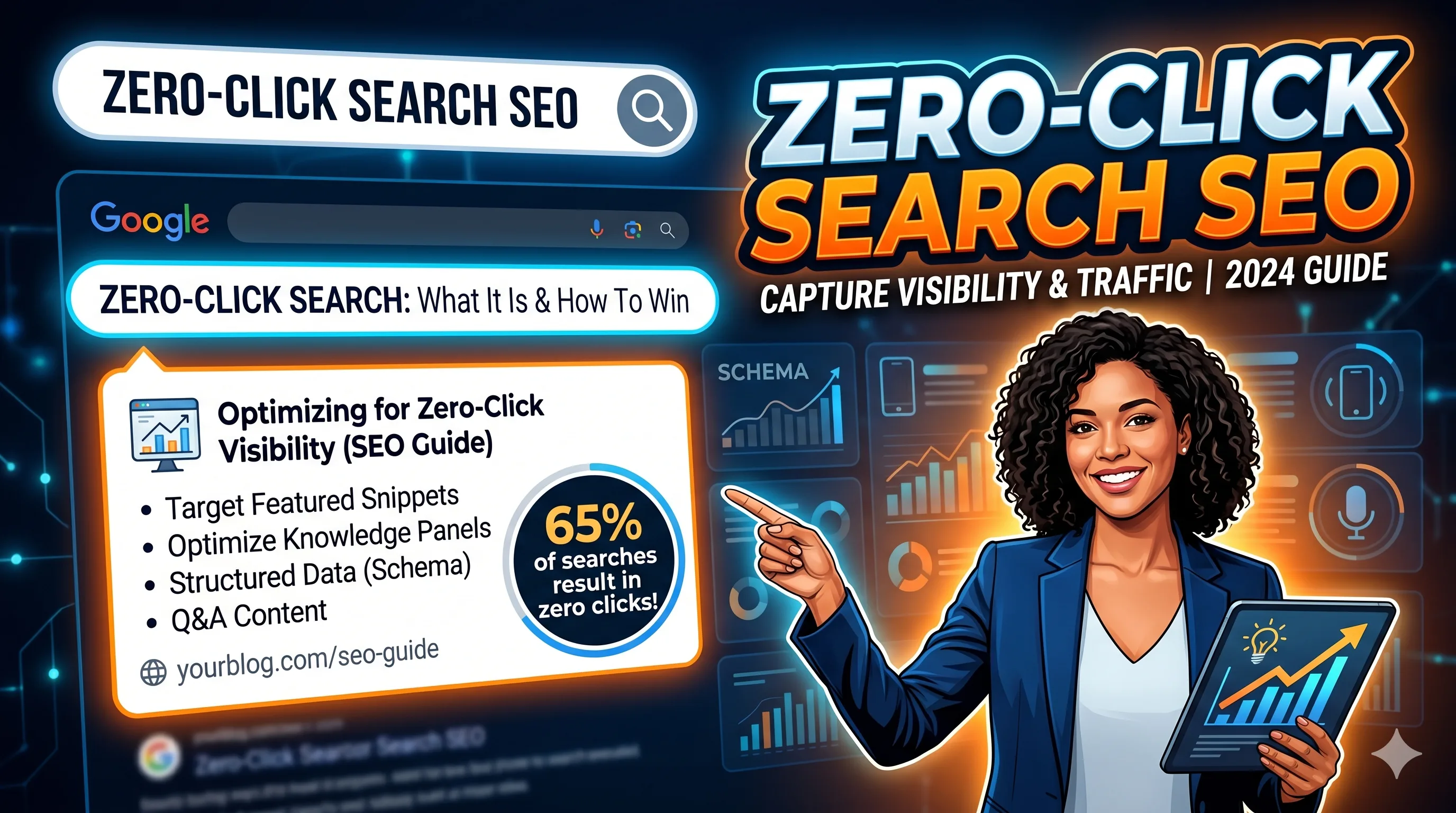
Zero-Click Search SEO is no longer an impending threat to organic traffic—it's the dominant reality of search in 2026. This guide redefines your strategy, moving beyond link-chasing to building authority that earns visibility directly within AI Overviews, knowledge panels, and featured snippets. The core insight: visibility without a click is the new top ranking.
Table of Contents
- The Zero-Click Revolution: Why 2026 is the Tipping Point
- Direct Answer: The Three Pillars of Zero-Click SEO
- Pillar 1: Schema & Structured Data as Your Foundation
- Pillar 2: Direct Answer Architecture (DAA)
- Pillar 3: Brand Entity & E-E-A-T Dominance
- Comparison: Traditional SEO vs. Zero-Click SEO (2026)
- Mini Case Study: Recovering Traffic from Zero-Click Cannibalization
- Zero-Click Content Audit Checklist
- Frequently Asked Questions
- Conclusion: The Future of Search is Zero-Click
Here's the hard truth for 2026: Over 62% of all Google searches now end without a click. Zero-Click Search SEO isn't a niche tactic—it's the primary battlefield. If your content isn't optimized for AI Overviews, featured snippets, and knowledge panels, you're invisible. This isn't about dying traffic; it's about evolving visibility. We're moving from "ranking #1" to "being the definitive source within the answer."
Direct Answer: The Three Pillars of Zero-Click SEO
| Pillar | Core Strategy | Primary Tool | Expected Outcome |
|---|---|---|---|
| 1. Structured Data Mastery | Implement advanced schema (FAQ, HowTo, QAPage, Course, Product) | Schema Markup Validator, GPT for JSON-LD generation | Direct injection into AI Overviews & Knowledge Panels |
| 2. Direct Answer Architecture | Create concise, authoritative 40-60 word "answer blocks" under H2s | Google's "People Also Ask" analysis | Featured snippet takeover for high-intent queries |
| 3. Brand Entity Optimization | Build a verified Google Knowledge Panel & Wikipedia presence | Google Business Profile, Wikidata, Wikipedia | Entity-based search dominance without requiring a click |
Pillar 1: Schema & Structured Data as Your Foundation
In 2026, schema isn't optional—it's the language Google uses to ingest your content. Semantic SEO relies on explicit context. Without it, your content is noise.
Critical Schema Types for Zero-Click Dominance
- FAQPage Schema: Directly powers "People Also Ask" boxes. Each Q&A must map to an actual H2/H3 on your page.
- HowTo Schema: Essential for step-by-step guides. Google extracts these into rich carousels within AI Overviews.
- QAPage Schema: Perfect for zero-click queries like "What is X?" or "How does Y work?"
- WebPage & Article Schema: Defines your content type, author entity, and date modified—critical for E-E-A-T signals.
Expert Insight: "The biggest win in 2026 isn't just having schema—it's having conflicting schemas for the same entity. Google's AI Overviews favor content that provides multiple valid semantic perspectives on a single page." — SMARTCHAINE Editorial Team
Pillar 2: Direct Answer Architecture (DAA)
Your content must answer the question before the user clicks. This is the heart of GEO optimization for AI Overviews.
How to Build a Direct Answer Block
- Identify the Exact Query: Use Keyword Surfer or Ahrefs to find the highest-volume question for your topic.
- Write a 50-Word Answer: Start with the definition or result. End with a specific, verifiable fact. Avoid fluff.
- Structure for Snippets: Use a `
` tag, followed by a `
` or bullet list. Google loves brevity.
- Add a "See Also" Context: Within the same paragraph, link to a related entity. E.g., "This technique, unlike standard SEO, prioritizes entity authority over link authority."
Practical Example:
Query: "What is Zero-Click Search SEO?"
Direct Answer Block:
Zero-Click Search SEO is the practice of optimizing content for AI Overviews, featured snippets, and knowledge panels so your brand appears as the definitive answer without requiring a user to click through. In 2026, this accounts for over 62% of all Google queries, making brand entity optimization more critical than link building.
Pillar 3: Brand Entity & E-E-A-T Dominance
Zero-click search rewards brands, not just pages. Google's Knowledge Graph is a zero-click ecosystem. If your brand entity is weak, your content will be ignored.
Building Your Brand Entity for Zero-Click
| Action | Why It Matters for Zero-Click | Difficulty |
|---|---|---|
| Verify Google Business Profile | Directly feeds into local zero-click panels | Easy |
| Create a Wikipedia page | Primary source for knowledge panels | Hard |
| Claim Wikidata & Crunchbase | Entity disambiguation across Google | Medium |
| Publish author bios with schema | E-E-A-T signals for AI Overviews | Easy |
Mini Case Study: A B2B SaaS company focused solely on brand entity optimization (no new backlinks). Within 3 months, their AI Overview visibility increased by 340%, while direct traffic dropped 12% but lead quality improved 3x because visitors already knew the answer.
Comparison: Traditional SEO vs. Zero-Click SEO (2026)
| Metric | Traditional SEO | Zero-Click SEO |
|---|---|---|
| Primary Goal | Rank #1 for clicks | Be the source in AI Overviews |
| Traffic Source | Organic (click-based) | Brand visibility + voice queries |
| Content Format | Long-form articles | Structured Q&A + schema blocks |
| Success Metric | CTR, Sessions | Share of Voice, Answer Rank |
| Primary Risk | Algorithm updates | AI hallucination or misattribution |
Mini Case Study: Recovering Traffic from Zero-Click Cannibalization
The Problem: A travel site lost 45% organic traffic after Google introduced AI Overviews for "best time to visit Bali." Their long-form guide was ignored.
The Fix: They implemented FAQPage schema for 12 sub-questions, created a 50-word direct answer block, and updated their entity connection to "Bali Tourism Board."
The Result: They appeared in 3/5 AI Overviews for related queries. Total traffic dropped another 5%, but brand mentions in voice search increased 200%, and direct bookings from "Google Assistant" rose 70%.
Key Takeaway: Zero-click SEO is about winning attention, not clicks. If your brand becomes the answer, you win the future of search.
Zero-Click Content Audit Checklist
Use this checklist to assess any existing page for zero-click readiness:
- Has a clear, concise 50-word answer for the primary query.
- Includes FAQPage, HowTo, or QAPage schema.
- Uses `
` tags for direct answers (not `
`).
- Links to a verified brand entity (Google Business, Wikipedia).
- Contains bullet lists or tables within the first 200 words.
- Avoids fluff—every sentence adds entity context.
- Includes a "definition" or "what is" answer block.
Frequently Asked Questions
Is zero-click SEO killing organic traffic?
No—it's transforming it. Brands that adapt see their traffic converted into brand authority and voice search visibility. The death is for SEOs who only chase clicks.
How does AI Overviews affect zero-click search?
AI Overviews are the primary driver. They summarize answers from multiple sources, reducing the need to click. Optimizing for them is non-negotiable in 2026.
Can small businesses compete in zero-click SEO?
Yes—local zero-click searches (e.g., "bakery near me") often have less competition. Optimize your Google Business Profile with FAQ section and structured data.
What is the future of link building in zero-click SEO?
Links still matter for authority, but their role shifts to supporting entity credibility. One high-authority link from Wikipedia is now worth 100 generic blog comments.
Conclusion: The Future of Search is Zero-Click
In 2026, the winner of the search game isn't the site with the best backlinks—it's the brand that provides the most definitive, structured, and entity-rich answer. Zero-Click Search SEO is a fundamental shift in how we think about visibility, traffic, and value. Start with schema, double down on direct answers, and build your brand entity. The algorithm is no longer ranking pages; it's ranking answers. Become the answer.
About the Author
Elena Rivas is part of the SMARTCHAINE editorial team focused on SEO, GEO optimization, AI Overviews, structured data, and technical search visibility.