FAQ SEO Optimization: Get Ranked in AI Overviews (2026)
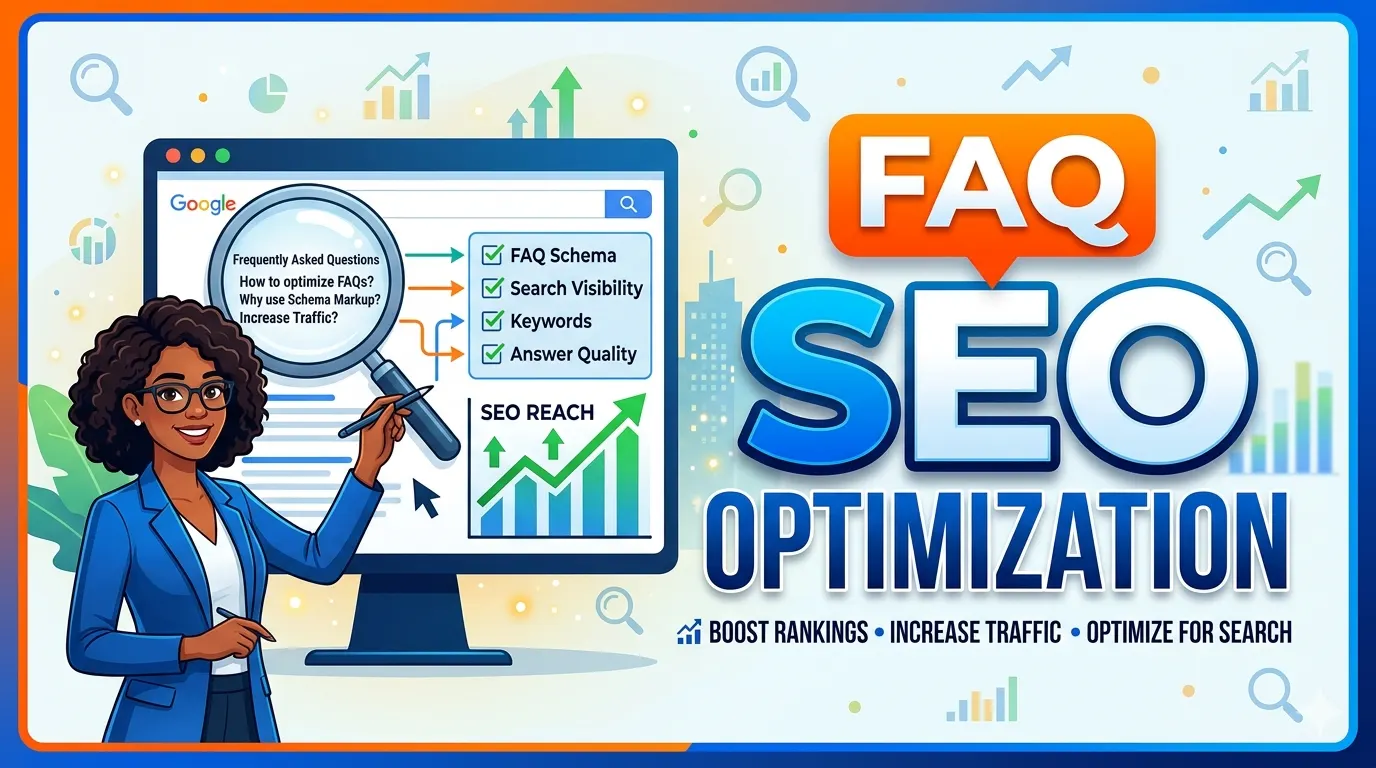
- FAQPage schema remains essential for rich results, but AI Overviews prioritize natural language answers over markup alone.
- Question research must go beyond keyword tools: mine "People Also Ask", forum threads, and customer support logs for real user queries.
- Each FAQ answer should stand alone as a concise, authoritative response—40-80 words for featured snippets, 100-150 words for depth.
- Entity-based optimization (linking questions to relevant topics, people, and concepts) improves contextual match for AI Overviews.
- Avoid duplicate questions across pages; each FAQ item should target a unique search intent.
- Regularly audit FAQ pages for pruning low-performing or outdated Q&As using Google Search Console performance data.
Table of Contents
- Why FAQ SEO Optimization Matters in 2026
- The Q-Rank Framework: Prioritizing Questions
- Schema & Structured Data for FAQ Optimization
- Writing FAQs for AI Overviews & Featured Snippets
- 5 Common Mistakes in FAQ SEO Optimization
- How This Applies in Practice
- Frequently Asked Questions
- Article Summary
- Conclusion
Why FAQ SEO Optimization Matters in 2026
FAQ pages have evolved from simple customer support tools into strategic content assets. With AI Overviews now pulling answers directly from well-structured FAQ content, optimizing your Q&A sections can determine whether your content gets surfaced or ignored. The challenge is that general advice—"add schema" or "answer questions"—is no longer enough. You need a systematic approach to question selection, answer formatting, and technical implementation.
The Shift from Schema-Only to Contextual Relevance
Historically, adding FAQPage schema was the primary optimization tactic. While schema still triggers rich results on Google, AI Overviews rely more on natural language understanding and entity relationships. A page with FAQPage markup but weak, generic answers is less likely to be cited than a page without schema but with precise, well-structured responses. This means you must optimize for both humans and AI extraction simultaneously.
What Has Changed with AI Overviews
Google's AI Overviews (formerly known as SGE) extract answers from multiple sources, often favoring pages that provide direct, entity-rich responses. FAQ content that uses conversational language and matches the query's intent pattern performs better. This makes question research—not just keyword research—the foundation of modern FAQ SEO.
The Q-Rank Framework: Prioritizing Questions
Not all questions deserve a dedicated FAQ entry. The Q-Rank framework helps you score and prioritize questions based on three criteria: search volume potential, answer uniqueness, and conversion relevance. This prevents you from wasting effort on low-impact questions.
The Three Q-Rank Criteria
- Search Volume Potential (SVP): How often is this question asked? Use tools like Ahrefs or Semrush to check keyword volume, but also review "People Also Ask" data and forum frequency.
- Answer Uniqueness (AU): How much unique value can you provide? If ten competitors already have identical answers, your contribution may be redundant unless you add depth, data, or a new perspective.
- Conversion Relevance (CR): Does answering this question move users closer to your business goal? A shipping policy question for an ecommerce store is high CR; a general industry trivia question is low CR.
Example Scenario: Applying Q-Rank
Question 1: "How long does shipping take?" — SVP: High, AU: Low (many identical answers), CR: Very High. Decision: Worth including if you add specific timeframes for different regions or services.
Question 2: "What is the history of encryption?" — SVP: Medium, AU: Medium, CR: Low for a SaaS security product. Decision: Skip unless you have unique research to share.
Question 3: "Does your software support two-factor authentication?" — SVP: Medium, AU: High (your product specifics), CR: High. Decision: Include with product-specific details.
Schema & Structured Data for FAQ Optimization
FAQPage schema from Schema.org remains the standard markup for FAQ content. However, implementation requires care: incorrect nesting, missing required properties, or duplicate markup can lead to manual action warnings or rich result disqualification.
Implementation Checklist
- Use the
FAQPageschema type withmainEntityarray containing Question objects. - Each Question must have
name(the question) andacceptedAnswerwithtext(the answer). - Do not use FAQPage schema for content that isn't formatted as Q&A. Google's guidelines explicitly prohibit this.
- Validate your markup using the Google Search Console Rich Results Test before publishing.
- If your FAQ page contains more than 10-15 questions, consider paginating or using accordion components for better UX.
Common Schema Errors to Avoid
One recurring mistake is applying FAQPage schema to content that mixes Q&A with non-Q&A text, like introductory paragraphs or navigation. Schema validation tools will flag this. Another error is using Question schema without properly nesting it within mainEntity. Always test after any content update.
Writing FAQs for AI Overviews & Featured Snippets
AI Overviews and featured snippets both favor concise, authoritative answers. The key difference is that AI Overviews often synthesize multiple sources, so your answer must be self-contained enough to be extracted without context.
Answer Structure Guidelines
- Lead with the direct answer in 1-2 sentences (40-80 words). This is what gets extracted for snippets and AI Overviews.
- Follow with supporting details: examples, exceptions, or actionable steps (100-150 words total).
- Use natural conversational language. Avoid marketing fluff or hedging phrases like "it depends" unless the answer genuinely varies.
- Include relevant entities: mention specific tools, platforms, or concepts that contextualize your answer.
Hypothetical Example: Before vs. After
Before (generic, low chance of extraction): "Yes, our platform supports two-factor authentication. It is an important security feature that helps protect your account from unauthorized access. Many users find it useful."
After (structured, extraction-ready): "Yes, [Platform Name] supports two-factor authentication (2FA) via authenticator apps, SMS codes, and hardware security keys. To enable it, go to Settings > Security > Two-Factor Authentication and follow the setup wizard. 2FA adds an extra layer of protection against credential theft."
5 Common Mistakes in FAQ SEO Optimization
- Writing questions for search engines instead of users. Questions like "What is the best FAQ optimization strategy for 2026?" are keyword-stuffed and unnatural. Users ask "How do I optimize my FAQ page?" instead.
- Creating long, unstructured answers. AI extraction requires clear boundaries. If your answer spans multiple paragraphs with no clear conclusion, Google may not extract it correctly.
- Using FAQPage schema on non-FAQ content. This violates Google's guidelines and can result in penalties. Only use FAQ schema for actual question-and-answer pairs.
- Indexing all FAQ items on a single page. A page with 50+ collapsed questions creates crawl inefficiency. Consider splitting high-value FAQs into dedicated pages or using a hub-and-spoke structure.
- Neglecting answer freshness. Old FAQ answers with outdated information signal low quality. Set a quarterly review cadence for your FAQ pages using Google Analytics engagement metrics.
How This Applies in Practice
The approach to FAQ SEO optimization shifts depending on your site type. Here is how to adapt the framework:
Beginner Website (e.g., personal blog)
Start small: identify 5-10 questions from your most popular articles. Use the Q-Rank framework to prioritize. Implement FAQPage schema manually or via a plugin. Focus on answer uniqueness rather than volume. A blog about photography might target "How do I clean my camera sensor?" with specific step-by-step instructions, rather than generic photography tips.
SaaS Website
SaaS FAQ optimization should prioritize conversion relevance. Questions about pricing, integrations, compliance, and onboarding often have high CR. Create dedicated FAQ pages for feature documentation. For example, a project management tool should have separate FAQ sections for "task dependencies," "workload views," and "time tracking." Use Q-Rank to decide which features get FAQ support.
Ecommerce Store
Shipping, returns, sizing, and product specs dominate ecommerce FAQ queries. Use Product schema combined with FAQPage for individual product pages. A clothing retailer might have "What size should I order?" with a sizing chart embedded directly in the answer. Avoid generic answers like "Refer to our size guide" when you can provide the guide inline.
Local Business
Local businesses should focus on questions about hours, services, location, and pricing. Use LocalBusiness schema alongside FAQPage. A dentist's FAQ might include "Do you accept emergency patients?" with a clear yes/no answer followed by the process. Avoid answers like "Please call us" when the query could be fully answered on the page.
Frequently Asked Questions
What is FAQPage schema and how does it affect SEO?
FAQPage schema is a structured data format defined by Schema.org that allows you to mark up question-and-answer content on your page. When implemented correctly, Google may display your FAQs as an expandable rich result in search, which can increase click-through rates and visibility. However, FAQPage schema alone does not guarantee ranking—the quality and relevance of your answers matter more for AI Overviews. Use the Rich Results Test in Google Search Console to validate your markup before publishing. Avoid using FAQPage schema on non-question content, as this violates Google's guidelines.
How many FAQs should I include on one page?
There is no fixed limit, but practical constraints matter. Pages with more than 10-15 collapsed FAQ items can create crawl issues and poor user experience. If you have more questions, consider grouping them into separate pages by topic or using an accordion design that reveals answers on user interaction. Use Google Search Console to check whether all your FAQ items are being indexed. If you notice crawl errors or low impressions on older FAQ items, pruning or consolidation may help.
Can I use FAQ schema on product pages for ecommerce?
Yes, but with caution. Google allows FAQPage schema on product pages as long as the content is genuine Q&A. However, you must not use FAQPage schema for content that is better suited to Product schema (e.g., pricing or availability). A product page could have both Product schema for structured product data and FAQPage schema for specific customer questions. Avoid using FAQPage schema to repeat what Product schema already covers. Test both markups using the Rich Results Test to ensure there is no conflict.
How do I optimize FAQs for AI Overviews specifically?
AI Overviews extract answers based on natural language understanding, not just markup. To optimize, focus on answer clarity, entity richness, and conversational phrasing. Lead each answer with a direct, concise response (40-80 words) that a language model can extract easily. Include relevant entities like tool names, concepts, or metrics to provide context. Avoid hedging, excessive fluff, or promotional language. Also, ensure your FAQ content is linked internally to relevant topic pages, as AI systems consider topical depth and interconnectedness.
Should I update my FAQs periodically?
Yes. FAQ content can become outdated quickly, especially for topics like pricing, regulations, or technology. Set a review schedule—quarterly is a reasonable starting point for most industries. Use Google Search Console performance data to identify FAQ pages with declining clicks or impressions. Update answers that contain time-sensitive information, and prune questions that no longer receive search traffic. Freshness signals can positively impact ranking for competitive queries.
Article Summary
This article covered the full scope of FAQ SEO optimization in 2026, with a focus on AI Overview readiness. You learned the Q-Rank framework for prioritizing questions based on search volume, answer uniqueness, and conversion relevance. You also learned how to implement FAQPage schema correctly, write extraction-ready answers, and avoid common mistakes. Practical guidance was provided for beginner websites, SaaS, ecommerce, and local businesses. The key insight: FAQ SEO is now a blend of technical markup and content strategy, with AI extraction as the primary success metric.
Conclusion
FAQ SEO optimization in 2026 demands more than adding schema and hoping for rich results. The rise of AI Overviews has made answer quality, question relevance, and entity-based optimization critical factors. By applying the Q-Rank framework, writing direct answers, and auditing your FAQ content regularly, you can create pages that win visibility in both traditional SERPs and generative AI responses. The pages that succeed will be those that treat every question as an opportunity to provide real, unique value—not just another line in a markup file.
- Google Search Central — Official documentation for structured data and search guidelines.
- Schema.org — Reference for FAQPage and other schema types.
- Google Search Console — Validate FAQ schema and monitor performance.
- Semrush Blog — Keyword research and competitive analysis for question targeting.
About the Author
The SMARTCHAINE Editorial Team specializes in SEO, AI Search Optimization, GEO (Generative Engine Optimization), AI Overviews, Structured Data, Technical SEO, and search visibility strategies for modern search engines and AI-powered discovery platforms.