Gray Hat SEO Explained: Risks, Examples & Smart Tactics
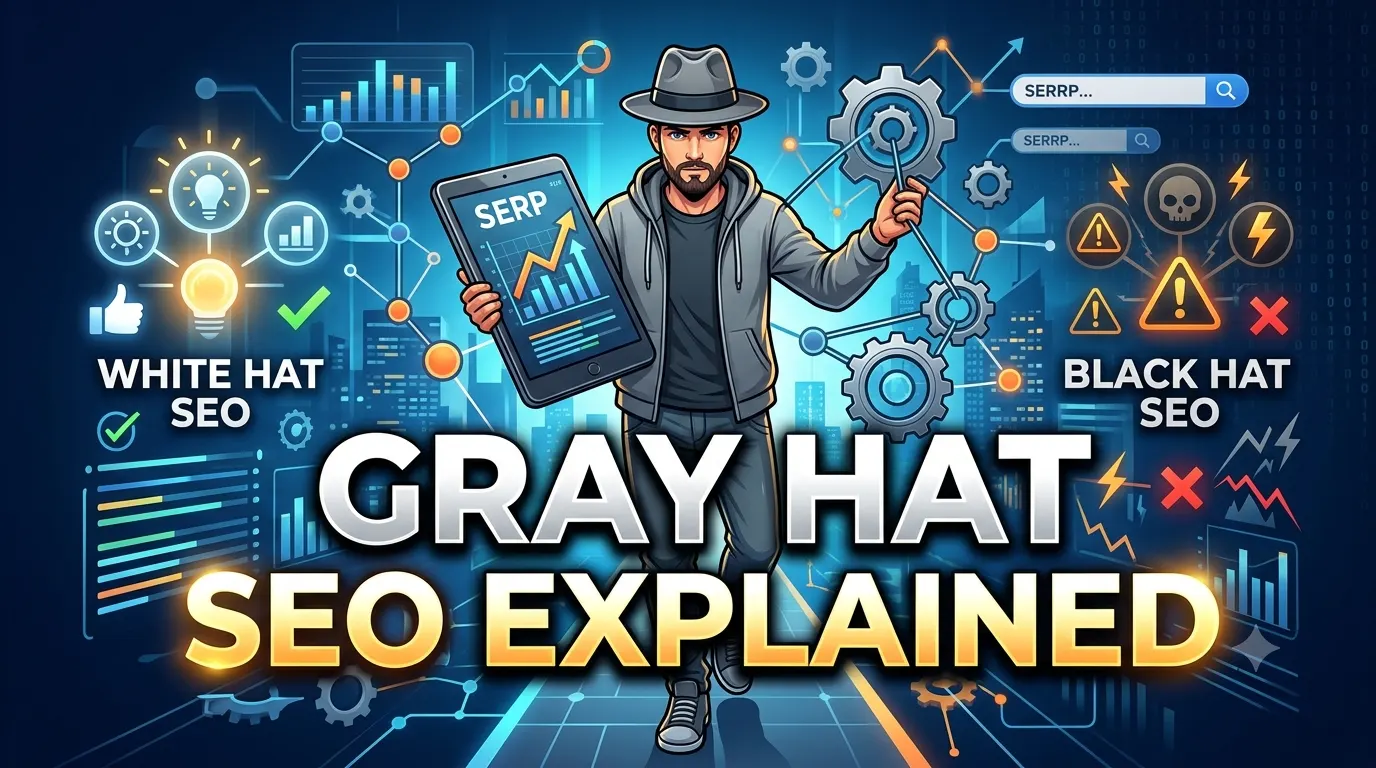
- Gray hat SEO is not one thing — it spans a spectrum from “aggressive white hat” to “subtle black hat.”
- Google Search Central’s guidelines are the baseline; any tactic that exploits loopholes in those guidelines is gray hat.
- The most common gray hat techniques include expired domain reuse, private blog networks (PBNs), paid links with editorial wrapping, and content repurposing at scale.
- AI Overviews may penalize gray hat content differently than standard Google search — especially if the content lacks genuine utility.
- A simple risk evaluation framework can help you decide whether a tactic is worth trying or should be avoided.
- The best approach is to document your assumptions, test on low-stakes sites first, and never rely on gray hat tactics as a primary strategy.
Table of Contents
What Is Gray Hat SEO?
Gray hat SEO refers to optimization techniques that fall outside Google Search Central’s official guidelines but are not as overtly manipulative as black hat tactics. These tactics typically exploit algorithmic gaps, ambiguous guideline language, or detection limitations. Gray hat SEO is not inherently penalized — but it carries risk, especially as Google’s AI Overviews and spam detection improve.
The Spectrum of SEO Tactics
Think of SEO as a continuum rather than three distinct categories. On one end, white hat tactics follow Google’s Webmaster Guidelines exactly — create quality content, earn links naturally, optimize for users. On the other end, black hat tactics explicitly violate guidelines with clear intent to manipulate — cloaking, hidden text, link farms. Gray hat occupies the middle: techniques that are technically compliant but ethically ambiguous.
| Category | Examples | Penalty Risk | Detection Difficulty |
|---|---|---|---|
| White Hat | Original research, guest posting, technical SEO fixes | Low | Easy to detect (but fine) |
| Gray Hat | Expired domain redirects, PBNs, paid links with disclosure | Medium | Variable |
| Black Hat | Cloaking, link farms, keyword stuffing, hidden text | High | Often easy for Google |
Common Gray Hat SEO Tactics
Below are the most frequently used gray hat techniques. Each one carries different risk levels and works differently across industries.
Expired Domain Redirects
Buying an expired domain with existing backlinks and redirecting it to your site. This passes link equity, but Google has become better at detecting irrelevant redirects or sites where the expired domain’s content didn’t match yours.
Risk level: Medium. Google’s John Mueller has explicitly warned against expired domain redirects for SEO gain. A manual action is possible if Google determines the redirect is manipulative.
Private Blog Networks (PBNs)
Building a network of sites specifically to create links back to your money site. PBNs are detectable through common hosting IPs, similar themes, duplicate content, and registration patterns. Google has actively targeted PBNs in multiple updates.
Risk level: High. Even well-maintained PBNs eventually get caught. A single manual action can de-index your entire network.
Paid Links with Editorial Wrapping
Paying for a link on a site but presenting it as an earned editorial link (no rel="sponsored" or rel="nofollow"). Google’s guidelines require sponsored links to be disclosed. This practice can work for years, but a competitor report or algorithmic detection can trigger penalties.
Risk level: Medium-high. The penalty may only affect the specific page or the entire site depending on scale.
Automated Content at Scale
Using AI tools or content spinners to produce hundreds of articles with partial rewriting. While Google’s AI Overviews can detect low-effort content, well-edited AI content is harder to flag. The risk grows with volume and lack of human oversight.
Risk level: Low-Medium. Google’s focus is on content quality, not content source. A thorough human review and fact-checking step makes this safer.
Negative SEO
Building bad links to competitor sites in hopes of triggering Google penalties. This is technically black hat but is often used as a competitive tactic. Google has improved at distinguishing between a site’s own link building and external attacks.
Risk level: Variable. Mostly ineffective today, but still unethical. Focus on your own site instead.
The Gray Hat Risk Evaluation Framework
This framework helps you decide whether a specific gray hat tactic is worth trying for your site. It uses qualitative scoring rather than exact numbers because risk assessment depends on context.
| Risk Factor | Low Risk | Medium Risk | High Risk |
|---|---|---|---|
| Scale | 1-5 links/pages | 5-50 links/pages | 50+ links/pages |
| Detection footprint | Unique IPs, different registrars | Shared host, similar themes | Same IP block, same CMS |
| Intent visibility | Looks natural to users | Users could notice | Users immediately suspect |
| Auto-recovery chance | High (reevaluation possible) | Medium | Low (manual action) |
How to Use the Framework
- Choose a tactic you are considering (e.g., expired domain redirect).
- Rate each factor from 1 (low risk) to 3 (high risk).
- If any factor scores 3, reconsider the tactic entirely.
- If all factors score 1-1.5, the tactic may be worth limited testing.
- Document your decision and monitor Google Search Console for manual actions.
Google’s Stance and AI Overviews
Google Search Central’s guidelines explicitly forbid link schemes, cloaking, and automated content intended to manipulate rankings. However, Google’s enforcement is not perfect — which is why gray hat techniques can work temporarily. AI Overviews change the calculation because they prioritize content that demonstrates clear user value and authoritative structure.
How AI Overviews Treat Gray Hat Content
AI Overviews pull featured snippets and summarized answers from pages that Google deems trustable. Gray hat content — especially content produced at scale without human quality control — often fails this test. The content may rank in standard search but won’t be featured in AI Overviews. This reduces its visibility and ROI.
For gray hat tactics to also work in AI Overviews, the following conditions must be met:
- Content must answer the query directly and concisely.
- The page must have clear entity usage (not keyword stuffing).
- Structured data (FAQPage, HowTo, Article) should be present.
- Links must look natural and relevant to the content.
Real Source: Google Search Central
Google’s official documentation on Search Central clearly outlines what constitutes a violation. Gray hat tactics often exploit ambiguity rather than outright violation. Understanding the difference between a guideline and a strict rule helps you evaluate risk.
How This Applies in Practice
For a Beginner Website
A beginner website should generally avoid gray hat SEO entirely. New domains have no trust capital, and any penalty can be crippling. Focus on white hat fundamentals: content quality, internal linking, and earning links through outreach or guest posting. If you do experiment, use a different domain that you don’t care about losing.
For a SaaS Website
SaaS sites often benefit from content marketing, programmatic SEO, and aggressive link building. Gray hat tactics like expired domain redirects may offer short-term wins, but the risk of losing organic traffic — especially for high-LTV customers — is not worth it. Instead, invest in original research, data-driven content, and strategic partnerships.
For an Ecommerce Store
Ecommerce sites have thin product pages that are hard to rank. Some sites use gray hat methods like review scraping, automated product descriptions, or paid links from niche sites. The risk here is that product pages are often the last to be re-evaluated by Google, so penalties may take months to surface. Use the risk framework above and test on low-traffic categories first.
For a Local Business
Local businesses rarely need gray hat SEO. Google Business Profile optimization, local citations, and review management provide faster, safer results. Gray hat tactics like location pages with fake addresses or fake reviews are against Google’s guidelines and can result in a complete Google Maps ban.
Common Mistakes to Avoid
- Using gray hat as your primary strategy: If more than 30% of your link building or content creation is gray hat, you are gambling with your site’s future.
- Scaling too fast: Gray hat tactics that work at small scale often fail when scaled. Google’s detection algorithms trigger on patterns, not individual actions.
- Ignoring manual action recovery timelines: If you get a manual penalty, recovery can take weeks or months. Plan for that downtime.
- Assuming AI Overviews won’t detect gray hat content: Google’s evaluation systems are getting better at assessing content quality regardless of link profile.
- Not documenting your tactics: If you cannot explain why each link or page was created, you are not managing risk properly.
FAQ
Does Google automatically penalize gray hat SEO?
No, Google does not automatically penalize every gray hat tactic. Penalties depend on scale, intent, and detection. A single paid link may go unpunished for years, while a PBN with 100 sites will trigger a manual action relatively quickly. Google’s algorithmic systems (including the link spam update) have improved at detecting link schemes and low-quality content. If your gray hat tactic is small-scale and well-disguised, it may never be penalized — but the risk is always present. Regularly check Google Search Console for manual actions and monitor traffic for unexpected drops.
Is using expired domains for redirects always gray hat?
Using expired domains is not inherently gray hat. If you buy an expired domain that is topically relevant to your content and you redirect it to a related page without intent to manipulate rankings, it can be considered legitimate. The gray hat aspect comes from buying domains solely for their backlink profile and redirecting them to irrelevant or low-quality pages. Google’s John Mueller has stated that redirecting an expired domain for SEO benefit violates guidelines. If you do this, ensure that the redirected content is genuinely relevant and valuable to users.
Can AI Overviews be manipulated with gray hat tactics?
Manipulating AI Overviews is more difficult than standard search results because Google’s evaluation involves content quality, entity usage, and user satisfaction signals. Gray hat tactics like link building or expired domain redirects have limited effect on AI Overviews. To appear in AI Overviews, your content must be clear, authoritative, and directly answer queries in a structured way. Gray hat content that lacks depth or uses manipulative links is unlikely to surface. Investing in content quality and structured data (FAQPage, HowTo) is a safer and more effective approach.
What is the safest gray hat tactic?
The safest gray hat tactic is likely using automated or AI-assisted content with substantial human editing and fact-checking. When done carefully — with unique insights, real expertise, and original data — this content can pass as white hat. The key is to avoid content farms, avoid purely spinning existing content, and always add human oversight. Other gray hat tactics like PBNs or paid links carry higher detection risk. If you want to test gray hat approaches, start with content optimization rather than link manipulation.
How long does a gray hat penalty last?
A gray hat penalty can last anywhere from a few weeks to permanent de-indexation depending on the severity. Algorithmic penalties (from updates like Helpful Content or Link Spam) can be reversed if you clean up and wait for the next update. Manual actions require a reconsideration request, which Google typically reviews within weeks. The worst-case scenario is a site-wide manual action that stays in place until you remove all violating content or links. For this reason, never rely on gray hat tactics for more than 30% of your traffic or backlink profile.
Article Summary
You learned what gray hat SEO means, how it differs from white and black hat tactics, and where the real risk lies. We covered common gray hat techniques including expired domain redirects, PBNs, paid links, and automated content. The Gray Hat Risk Evaluation Framework helps you score each tactic on scale, detection footprint, intent visibility, and auto-recovery chance. You also learned how AI Overviews treat gray hat content differently and why content quality still matters even when using borderline tactics. Apply the framework before you act, never scale gray hat tactics quickly, and always monitor Google Search Console for signs of penalties.
Conclusion
Gray hat SEO is not a shortcut to sustainable growth — it is a calculated risk. Some techniques can work for months or even years, but Google’s detection systems improve with every update. The best approach is to use the risk evaluation framework in this article before trying any gray hat tactic, and to never let gray hat techniques become more than 20-30% of your overall SEO strategy. Focus on white hat fundamentals first: high-quality content, technical SEO, and genuine user value. Gray hat can be a tactical supplement, but it should never be your foundation.
If you decide to experiment, document everything, test on low-stakes sites, and be ready to undo your changes if needed. Google Search Console and Google Analytics will give you early warning signs — use them.
- Google Search Central — Official documentation for all Google search guidelines.
- Schema.org — Structured data vocabulary for better content representation.
- Bing Webmaster Guidelines — Bing’s guidelines for comparison with Google’s.
- Google Search Console — Monitor manual actions and site performance.
- Ahrefs Blog — Practical SEO insights and case studies.
- Moz Blog — SEO research and industry analysis.
About the Author
The SMARTCHAINE Editorial Team specializes in SEO, AI Search Optimization, GEO (Generative Engine Optimization), AI Overviews, Structured Data, Technical SEO, and search visibility strategies for modern search engines and AI-powered discovery platforms.