SEO Entity Optimization: How to Build Topical Authority in 2026
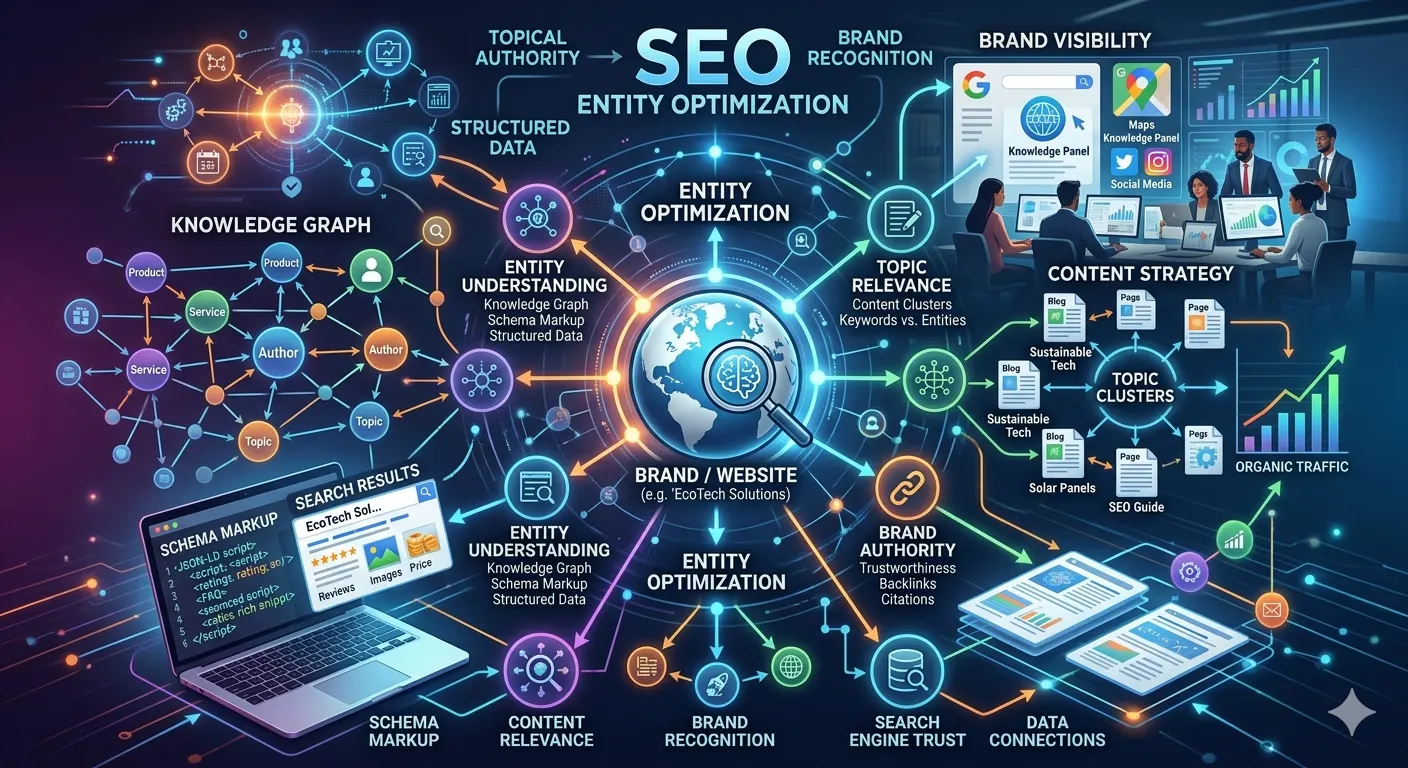
What Is SEO Entity Optimization?
SEO entity optimization is the process of structuring content around real-world concepts, people, places, and things that search engines recognize as distinct entities. Instead of relying solely on keywords, you build topical authority by connecting related entities through clear relationships, structured data, and contextual depth. This approach helps Google and AI Overviews understand your content as a trusted source on a subject, not just a page matching a query.
Table of Contents
Why Entities Matter for SEO in 2026
Search engines have moved beyond keyword matching. Google's Knowledge Graph contains over 5 billion entities, and AI Overviews pull from entity-rich content to generate answers. When your content clearly defines entities like "Peter Thiel," "venture capital," or "zero to one strategy," Google can connect those dots and surface your page for related queries.
Entity optimization directly impacts AI Overview visibility. AI systems need structured, unambiguous information about what things are and how they relate to each other. A page that mentions "blockchain" without connecting it to "decentralized ledger," "consensus mechanisms," or "smart contracts" leaves interpretive gaps. Entity-rich content fills those gaps.
Expert Insight
Entities are not just about named people or brands. Abstract concepts like "inflation hedging," "supply chain resilience," or "B2B lead generation" are entities too. The key is defining them through relationships to other well-known entities. A "B2B lead generation" page should connect to "cold emailing," "LinkedIn outreach," and "CRM software" as related entities.
The Entity Circle Framework: A Practical Methodology
Most entity optimization advice stays theoretical. The Entity Circle Framework gives you a repeatable workflow in three stages: Identify, Connect, and Validate.
Stage 1: Identify Your Core Entities
For any target topic, list the entities that matter. Use these sources:
- Google Search: Search your target term and look at the Knowledge Panel, "People also ask," and related searches in bold.
- Semrush Keyword Magic Tool: Filter for "topic clusters" to see related terms that likely represent entities.
- Ahrefs Content Gap: Compare top-ranking pages for your topic. The entities they all mention are likely important.
- Wikipedia: The infobox and "See also" section reveal key entities for almost any subject.
Example scenario: You are writing a guide on "remote team management." Your entity list should include: "asynchronous communication," "Slack," "time zone overlap," "project management software," "OKRs," "team building," and "mental health." Each of these is a distinct entity with relationships to your core topic.
Stage 2: Connect Entities Through Relationships
Entities without relationships are just keywords. Use this relationship mapping table to plan your content structure:
| Core Entity | Related Entity | Relationship Type | Example Sentence |
|---|---|---|---|
| Remote team management | Asynchronous communication | Methodology | Effective remote team management relies on asynchronous communication as its primary workflow. |
| Remote team management | Slack | Tool | Slack is the most common communication tool for remote team management. |
| Remote team management | Time zone overlap | Challenge | Time zone overlap is a core challenge in remote team management that requires careful scheduling. |
| Asynchronous communication | Time zone overlap | Solution | Asynchronous communication solves time zone overlap by removing real-time requirements. |
Stage 3: Validate with Schema.org
Structured data tells Google explicitly what your entities are. For the example above, you might use:
- Article schema with about and mentions properties that reference Schema.org types for "SoftwareApplication" (Slack) and "Organization" or "Product" for tools.
- HowTo schema if your content teaches a process like "setting up asynchronous communication workflows."
- FAQPage schema if you answer common questions about remote team management entities.
Structured Data: The Technical Backbone of Entity Optimization
Without structured data, you leave entity interpretation to chance. Google may infer relationships from context, but explicit markup removes ambiguity.
Which Schema Types Matter for Entity Optimization
Not all schema types are equally useful. Focus on these:
- Article with
aboutandmentionsproperties — directly links your content to specific entities. - Product for ecommerce — every product is an entity with attributes, reviews, and pricing.
- LocalBusiness for local SEO — your business is the entity, with location, hours, and services as related entities.
- BreadcrumbList — helps Google understand the hierarchical relationships between your site's entities.
- Organization — for brand authority, especially with
sameAslinks to social profiles.
How to Implement Entity-Centric Schema
The most common mistake is using schema as a checklist. Instead, think about which properties create entity relationships:
aboutproperty: In Article schema, list the primary entity your content discusses. Use Schema.org types likeThing,Person,Place, orCreativeWork.mentionsproperty: List secondary entities. This tells Google your content discusses multiple related concepts.sameAsproperty: Links your entity to verified external sources like Wikipedia or Wikidata. This strengthens entity recognition.
Checklist: Entity Schema Implementation
- ☐ Identify the primary entity for each page
- ☐ Add
aboutproperty to Article schema with that entity - ☐ List 3-5 secondary entities in the
mentionsproperty - ☐ Verify entities exist on Wikidata or Schema.org
- ☐ Add
sameAslinks to verified profiles - ☐ Test with Google's Rich Results Test
- ☐ Monitor in Google Search Console for schema errors
Content Strategy for Entity Authority
Entity optimization requires a different content planning approach. Instead of keyword clusters, think in entity clusters.
Building Entity Hubs
An entity hub is a collection of pages that each cover one entity comprehensively, with cross-links that show how entities relate. Example structure for a marketing blog:
- Pillar page: "Content Marketing Strategy" (core entity)
- Cluster page 1: "SEO Entity Optimization" (related entity)
- Cluster page 2: "B2B Content Workflow" (related entity)
- Cluster page 3: "Content Distribution Channels" (related entity)
Each cluster page links back to the pillar and to other cluster pages where entity relationships exist. Google sees these internal links as relationship signals.
Writing for Entity Recognition
Plain language matters more than jargon. When introducing a new entity, define it through its relationships:
- Weak: "Business Process Automation (BPA) is important."
- Strong: "Business Process Automation (BPA) uses RPA tools like UiPath to automate data entry, invoice processing, and HR workflows—reducing manual work in accounting and operations departments."
The strong version connects BPA to "RPA," "UiPath," "data entry," "invoice processing," "HR workflows," "accounting," and "operations." That is seven entity connections in one sentence.
Common Mistakes in Entity Optimization
Even experienced SEOs make these errors. Avoid them to maximize your entity authority.
| Mistake | Why It Hurts | How to Fix |
|---|---|---|
| Using vague entities | Google cannot match "great software tools" to Knowledge Graph entries. | Be specific: "Slack," "Asana," "Salesforce." |
| Ignoring relationship statements | Entities listed without connections are treated as keywords, not relationships. | Write sentences that explicitly say "X is a type of Y" or "X uses Y to achieve Z." |
| Overloading schema with wrong types | Using Product schema for an article page confuses Google. | Match schema type to content type. Use Article for articles, Product for products. |
| Entity stuffing | Listing entity names without context looks spammy. | Introduce each entity naturally with at least one descriptive sentence. |
| No internal linking to entity pages | Entity relationships only work if Google can crawl from one entity page to another. | Create a hub-and-spoke internal linking structure. |
How This Applies in Practice
Entity optimization looks different depending on your website type. Here is how to adapt the Entity Circle Framework for four common scenarios.
Beginner Website
You have a new blog about personal finance. Start with one pillar entity: "budgeting." Identify related entities: "budgeting methods," "50/30/20 rule," "YNAB," "Mint," "emergency fund," "debt repayment." Write one article per entity. Link them together. Use Article schema with about set to "budgeting" on every page. Do not worry about complex schema yet. Focus on entity-rich writing first.
SaaS Website
You sell project management software. Your core entity is your product. Related entities include "agile methodology," "sprint planning," "burndown charts," "Jira integration," "task dependencies," "team collaboration." Create comparison pages that explicitly state relationships: "Our tool connects sprint planning with burndown chart tracking." Use Product schema with category and application properties. Add sameAs to your Crunchbase or G2 profile for brand entity recognition.
Ecommerce Store
You sell organic skincare products. Each product is an entity with attributes like "ingredients," "skin type," "benefits." Related entities include "hyaluronic acid," "vitamin C," "anti-aging," "sensitive skin," "acne-prone skin." Use Product schema with material and audience properties. Create entity hub pages for ingredient categories. Link product pages to ingredient pages. This helps Google understand "Vitamin C serum" as an entity connected to "Vitamin C" (ingredient) and "brightening" (benefit).
Local Business
You run a dental practice in Austin. Your core entity is "Austin dentist." Related entities include "teeth whitening," "dental implants," "Invisalign," "TMJ treatment," "Austin, Texas." Use LocalBusiness schema with areaServed for Austin. Create entity pages for each service. Link to local landmarks, neighborhoods, and insurance providers. Add sameAs to your Google Business Profile and Yelp. Entity optimization helps you rank for "Austin dentist for Invisalign" versus just "dentist Austin."
Frequently Asked Questions
How is SEO entity optimization different from keyword optimization?
Keyword optimization focuses on exact match phrases. Entity optimization focuses on concepts and their relationships. For example, a keyword approach targets "best CRM for small business." An entity approach targets "CRM software" as the core entity, then connects it to "small business needs," "sales pipeline management," "contact management," and "affordable pricing." Google understands the relationship between these entities and can rank your page for a wider set of semantically related queries, including AI Overview citations.
Do I need Wikidata entries for my entities?
Not necessarily, but it helps. Wikidata entries give Google a verified source for your entity. If you write about a concept like "circular economy," having a Wikidata entry for that concept with your website listed as a reference strengthens entity recognition. For most businesses, focus on Schema.org structured data first. Add Wikidata entries for your core brand and key content topics as a secondary step. Small websites can skip Wikidata entirely and still benefit from entity optimization through good schema and relationship writing.
How long does entity optimization take to show results?
Entity optimization is a structural change, not a quick fix. Google needs to recrawl your pages and rebuild its understanding of your entity relationships. Most sites see initial entity signals in search console within 2 to 4 weeks. Ranking improvements for entity-related queries typically take 2 to 3 months because Google needs to associate your content with the entity in its Knowledge Graph. AI Overview visibility can be faster if your content directly answers a common question about a well-known entity, sometimes appearing within days for low-competition topics.
Can entity optimization backfire if done wrong?
Yes. Common backfire scenarios include using incorrect schema types, adding schema for entities your content does not actually discuss, and creating entity pages with no unique value. Google's algorithms can detect when schema does not match content. A page marked as about "artificial intelligence" that only mentions machine learning once will not get entity authority. Always validate your schema with Google's Rich Results Test and check that the entities in your schema appear naturally in your content text.
What tools help with entity research?
Semrush has a Topic Research tool that suggests related entities based on search data. Ahrefs offers Content Gap analysis that shows entities top-ranking pages mention. Google Search Console's queries report reveals the entity-related queries your pages already rank for. For manual research, search your core entity on Wikipedia and look at the infobox and linked articles. Each linked Wikipedia article is an entity Google likely recognizes. Moz's Keyword Explorer also provides entity suggestions through its "Related Topics" feature.
How does entity optimization affect AI Overviews specifically?
AI Overviews rely on entity relationships to generate coherent answers. When you structure content around clear entity connections, AI systems can extract precise information more easily. For example, if your article states "Chocolate chip cookies require brown sugar, butter, and chocolate chips," the AI Overview system identifies "chocolate chip cookies" as the entity, "brown sugar" as a related ingredient entity, and "baking" as an activity entity. Your page becomes a candidate for the Overview because it provides the entity relationship mapping the AI needs to generate its answer.
Conclusion
SEO entity optimization is not a replacement for keyword research. It is the layer above it. Keywords tell you what people search for. Entities tell you what they mean. By combining clear entity identification, relationship-rich writing, and accurate structured data, you build content that search engines and AI systems can trust as authoritative. Start with the Entity Circle Framework: identify your core entities, map their relationships in your content, and validate with schema. That workflow will serve you whether you are optimizing for Google search results, AI Overviews, or voice assistants.
The websites that invest in entity optimization now will have a structural advantage as AI Overviews expand. Entities are the foundation of semantic search. Build yours correctly.
About the Author
The SMARTCHAINE Editorial Team specializes in SEO, AI Search Optimization, GEO (Generative Engine Optimization), AI Overviews, Structured Data, Technical SEO, and search visibility strategies for modern search engines and AI-powered discovery platforms.