SEO for Voice Assistants: 7 Strategies to Rank in 2026
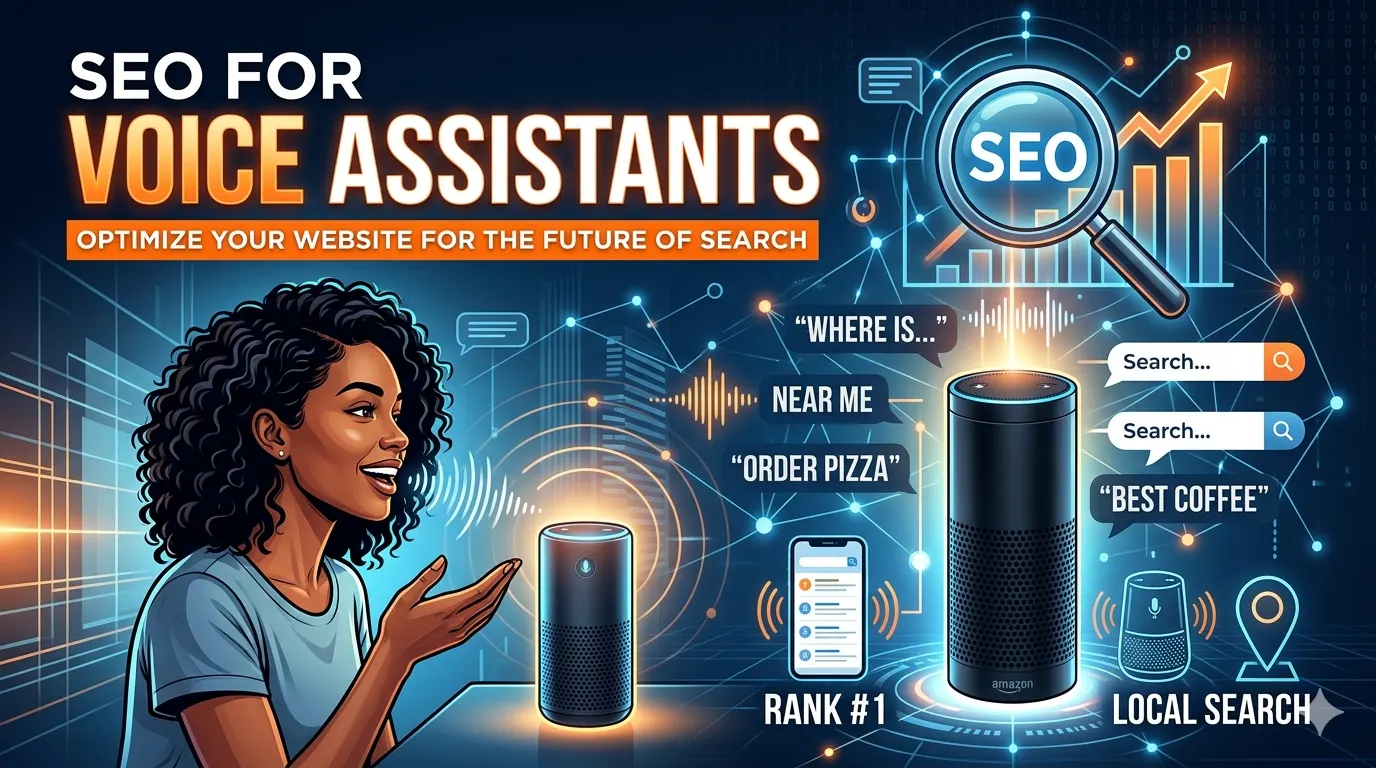
Direct Answer: SEO for Voice Assistants in 2026 requires optimizing for conversational, natural language queries that AI voice assistants like Google Assistant and Siri use to pull answers. Instead of targeting short-tail keywords, you must create concise, authoritative content structured for featured snippets and AI Overview extraction. Prioritize FAQ schemas, HowTo markup, and question-based headings to improve your chances of being read aloud by a voice assistant.
Table of Contents
- Why Voice SEO Still Matters in 2026
- Strategy 1: Optimize for the Hybrid Search-Voice Loop
- Strategy 2: Target Long-Tail Conversational Queries
- Strategy 3: Structure Content for Position Zero
- Strategy 4: Implement Structured Data for Audio Cues
- Strategy 5: Optimize for Local Voice Queries
- Strategy 6: Focus on Core Web Vitals and Page Speed
- Strategy 7: Build Entity Authority for Your Brand
- The SMARTCHAINE Voice Readiness Index
- Common Mistakes to Avoid with Voice Search Optimization
- How This Applies in Practice
- Frequently Asked Questions
- Recommended Resources
Why Voice SEO Still Matters in 2026
Voice search is no longer a futuristic feature—it is a primary input method for millions of users. The shift from typed queries to spoken conversations has fundamentally changed how Google, Bing, and AI Overviews deliver results. When a user asks "What is the best coffee grinder for espresso?", a voice assistant does not present a list of ten blue links. It reads a single answer. This means your page either wins the spoken result or becomes invisible.
Many SEO professionals treat voice optimization as a secondary tactic, but it directly influences your visibility in AI Overviews, Google Assistant, and Siri. The same structured, concise content that wins a voice query also increases your chances of appearing in a featured snippet. In practice, optimizing for voice assistants forces you to write clearer, more direct content—which benefits all search users.
Strategy 1: Optimize for the Hybrid Search-Voice Loop
Voice assistants today do not operate independently. They pull data from AI Overviews, featured snippets, and knowledge panels. This creates a hybrid loop: a user searches visually, receives a voice-friendly summary, and then clicks through for details.
To exploit this, structure your content so that the first 50–100 words of any section can stand alone as a spoken answer. Avoid preamble, unnecessary context, or fluff. If Google needs a single paragraph to read aloud, make sure that paragraph appears early in your page.
Practical workflow: After writing a section, copy its opening paragraph. Read it out loud. If it feels incomplete or awkward when spoken, rewrite it until it sounds natural in a single breath.
Expert Tip: Use the "lighthouse test" for each H2 section. If the first 100 words contain your main point, your content is voice-ready. If you have to read three paragraphs before understanding the argument, you will lose the voice assistant result.
Strategy 2: Target Long-Tail Conversational Queries
Voice queries are longer and more natural than typed searches. A typed search might be "best espresso machine 2026". A voice search will be "Hey Google, what is the best espresso machine for under five hundred dollars in 2026?"
This means your keyword research must shift from head terms to full questions. Use Google Search Console to identify queries where your pages already rank, then expand those into conversational variations. Tools like Ahrefs and Semrush allow you to filter for question-based keywords (who, what, where, when, why, how).
Example scenario: If you run a coffee equipment review site, instead of targeting "espresso machine reviews", create a dedicated section titled "What is the best espresso machine for beginners?" and answer it directly in 50–100 words. This section can be extracted by voice assistants without needing to summarize the entire review.
Strategy 3: Structure Content for Position Zero
Voice assistants nearly always read from the featured snippet (Position Zero). If your content does not hold that spot, it will not be read aloud—unless Google decides to pull from an AI Overview passage.
To optimize for Position Zero:
- Use a clear, direct question as your H2 or H3 heading.
- Answer it immediately in the next paragraph (50–60 words maximum).
- Include a list (bullet or numbered) when the answer involves multiple steps or items.
- Avoid hedging language like "it depends" or "there are several factors". If the answer genuinely varies, state the most common scenario first.
Note: Position Zero is not guaranteed, but the structure that wins it also improves your AI Overview visibility. The same concise answer format works for both voice assistants and Google's AI-generated summaries.
Implementation check: Review your top 10 articles. Rewrite the first paragraph under each H2 to be a self-contained, conversational answer of 40–60 words. This alone can shift your content into voice-friendly territory.
Strategy 4: Implement Structured Data for Audio Cues
Schema markup helps search engines understand your content, but it also signals to voice assistants that a specific block is ready for extraction. For voice optimization, three schema types are critical:
- FAQPage schema: Wraps question-and-answer pairs, making them directly usable by Google Assistant and Siri.
- HowTo schema: Ideal for step-by-step instructions. Voice assistants can read each step aloud when a user asks "how do I clean my espresso machine?"
- Product schema: Includes attributes like price, rating, and availability, which voice assistants can pull for shopping queries.
Avoid implementing schema for purely presentational reasons. Each markup type must match the actual content on the page. Google Search Console's Rich Results report will flag mismatches.
Practical note: If you run a recipe site, HowTo schema is essential. If you run an ecommerce store, Product schema with review data is more valuable than FAQPage. Choose the schema type that aligns with the most common voice query for that page.
Strategy 5: Optimize for Local Voice Queries
A significant percentage of voice searches have local intent: "find a coffee shop near me", "what time does the hardware store close?". These queries trigger local business listings and Google Maps results.
To capture this traffic:
- Ensure your Google Business Profile is complete, verified, and updated with correct hours, phone number, and address.
- Add LocalBusiness schema to your website.
- Include location-specific conversational keywords in your content (e.g., "best espresso machine repair in Austin").
- Use customer reviews with natural language—phrases like "great service" or "friendly staff" can match voice queries.
Common mistake: Many businesses optimize for "coffee shop Austin" but fail to optimize for "Hey Siri, where can I get a latte near me?" The latter is more common in voice search. Make your content answer that specific spoken question.
Strategy 6: Focus on Core Web Vitals and Page Speed
Voice assistants prioritize speed. If your page takes more than 2–3 seconds to load, Google is unlikely to use it as a voice response, even if the content is perfect. Core Web Vitals—particularly Largest Contentful Paint (LCP) and First Input Delay (FID)—directly affect this.
Use Google Search Console's Core Web Vitals report and PageSpeed Insights to identify slow pages. Common fixes include compressing images, using a CDN, reducing JavaScript, and enabling caching.
Editorial insight: Voice optimization is not just about content structure. Technical SEO is the foundation. If your page fails the speed test, the voice assistant will move to the next result before your content even loads.
Strategy 7: Build Entity Authority for Your Brand
Voice assistants prefer to attribute answers to authoritative sources. If Google Assistant recognizes your brand as an expert entity in your niche, your content is more likely to be selected for voice responses.
Entity authority is built through:
- Consistent NAP (Name, Address, Phone) across the web.
- High-quality backlinks from relevant, trusted domains.
- Structured data that defines your entity type (Organization, LocalBusiness, Person).
- Regular, high-quality content updates on your domain.
Real-world example: A home repair blog that consistently publishes authoritative guides on plumbing and uses Organization schema is more likely to be read by a voice assistant for "how do I fix a leaky faucet" than a generic forum post with similar content.
The Voice Readiness Index: A 3-Tier Framework
To systematically evaluate your content for voice assistants, use this qualitative framework. Score each page from 1 to 3 in five categories, then calculate your average.
| Category | Score 1 (Not Ready) | Score 2 (Partially Ready) | Score 3 (Voice-Optimized) |
|---|---|---|---|
| Conversational Query Match | Targets only short-tail keywords | Includes some question phrases | Directly answers a full conversational question |
| Answer Structure | Answer is buried mid-paragraph | Answer is within first 100 words | Answer is in the first 50 words, standalone |
| Schema Markup | No relevant schema | Has Article or BreadcrumbList | Has FAQPage, HowTo, or Product schema |
| Page Speed (Mobile) | LCP over 4 seconds | LCP between 2.5–4 seconds | LCP under 2.5 seconds |
| Entity Authority Signals | No schema, inconsistent NAP | Organization schema present | Multiple entity signals, consistent citations |
How to use this framework: Audit your top 20 pages. Focus improvement effort on pages scoring an average of 2.0 or lower. These are the pages most likely to be ignored by voice assistants.
Common Mistakes to Avoid with Voice Search Optimization
- Writing for a single assistant: Optimizing only for Google Assistant while ignoring Siri or Alexa. Each platform has slight differences in how they extract answers. Focus on universal structure that works across all three.
- Over-optimizing for exact match queries: Voice search is fluid. Users say "best pizza near me", "where can I get pizza", and "pizza place open now". Optimize for intent, not a specific phrase.
- Ignoring mobile experience: Most voice searches happen on mobile. If your mobile site is slow or difficult to navigate, voice assistants deprioritize it.
- Neglecting long-form content: While voice answers should be concise, the page still needs depth. Google evaluates the entire page for authority, not just the snippet.
- Treating voice optimization as a checkbox task: This is an ongoing process. Voice assistant algorithms update frequently. Re-audit your content every quarter.
How This Applies in Practice
Voice optimization is not one-size-fits-all. Here is how the strategies change depending on your website type:
Beginner Website (New Blog)
Focus: Build entity authority slowly. Start with FAQ schema on a single pillar page targeting a high-volume conversational query. Example: "how to start a garden" with HowTo schema. Do not attempt to compete for every voice query; pick one topic and own it.
SaaS Website
Focus: Target product-related voice queries. Example: "how do I reset my password in [your software]". Create a dedicated Help section with FAQPage schema. Voice assistants frequently pull from official documentation for "how-to" queries. Ensure your onboarding and troubleshooting guides are structured for extraction.
Ecommerce Store
Focus: Product schema with review data is non-negotiable. Optimize for queries like "best running shoes for flat feet under $100". Create comparison tables and listicles that can be extracted as featured snippets. Avoid thin product descriptions—each product page must answer the three most common voice questions about that item.
Local Business
Focus: Google Business Profile is your most important asset. Complete every field, including services, attributes, and photos. Add LocalBusiness schema. Create location-specific content such as "best plumber in [city]" or "emergency electrician [city]". Voice assistants prioritize local results for proximity-based queries.
Frequently Asked Questions
Does voice search SEO differ from traditional SEO?
Yes, but not as much as some experts claim. Traditional SEO focuses on ranking in a list of results; voice SEO focuses on being the single answer read aloud. The key difference is that voice SEO requires even tighter content structure, faster page speed, and a focus on conversational queries rather than short keywords. However, the foundational principles—quality content, backlinks, technical health—remain the same. Think of voice SEO as an extension of traditional SEO, not a replacement.
How long should a voice-optimized answer be?
Ideally between 40 and 60 words. This is the typical length a voice assistant can comfortably read without sounding robotic. Some voice assistants may read up to 150 words for complex answers, but shorter is safer. If your answer requires more detail, place the full explanation after the concise summary. The voice assistant will read the summary, and the user can click through for the longer version.
Does AI Overviews affect voice search results?
Yes. AI Overviews (formerly SGE) are increasingly influencing what voice assistants read. When a user asks a question, the AI Overview may generate a custom summary from multiple sources. This means your content may be combined with competitors' content. Structuring your page for standalone extraction helps ensure that, even within an AI Overview, your specific section is the primary source. The same content formats that win featured snippets also perform well in AI Overviews.
Should I optimize for all voice assistants equally?
No. Prioritize the assistant most relevant to your audience. If your audience is primarily iPhone users, focus on Siri optimization (which relies heavily on structured data and Apple's knowledge graph). If your audience uses Android, focus on Google Assistant. For home automation devices, Amazon Alexa has a large market share. Check your analytics to see which devices your users are searching from. Optimizing for one well is better than doing a mediocre job for all three.
What schema is essential for voice SEO in 2026?
FAQPage schema remains the highest-impact schema for voice search because it directly maps to the question-and-answer format voice assistants use. HowTo schema is essential for instructional content. Product schema with AggregateRating is critical for ecommerce. BreadcrumbList helps assistants understand page context. Avoid implementing schema types that do not match your content—Google treats mismatched schema as a quality signal and may ignore your page entirely.
How often should I update voice-optimized content?
Quarterly minimum. Voice assistants evolve their algorithms frequently, and what worked six months ago may stop working. Additionally, competitor content updates can displace your snippet. Review your Google Search Console data every three months to see which queries are triggering impressions and which are not. Update the content that supports those queries. For high-traffic voice queries, consider monthly reviews to maintain position.
Recommended Resources
- Google Search Central – Official documentation on how Google processes voice search and featured snippets.
- Schema.org – Complete reference for all schema types relevant to voice optimization.
- Bing Webmaster Guidelines – Bing's voice search requirements (relevant for Siri and Cortana).
- Ahrefs Blog – Practical guides on question-based keyword research.
- Semrush Blog – Voice search optimization strategies and tools.
- Moz Blog – Beginner-friendly voice search tutorials.
- Google Search Console – Monitor your voice search performance and Core Web Vitals.
- Google Analytics – Track traffic from voice search devices.
Conclusion
SEO for Voice Assistants in 2026 is not an optional add-on—it is a necessary component of any serious search strategy. The same structural discipline that makes your content voice-friendly also improves your visibility in AI Overviews, featured snippets, and traditional search results.
Start with the Voice Readiness Index framework. Audit your top pages. Implement FAQ schema and conversational answer structures. Fix page speed issues. And remember: voice optimization is about clarity, brevity, and authority. If you can write content that answers a single question perfectly in 50 words, you are already ahead of most competitors.
About the Author
The SMARTCHAINE Editorial Team specializes in SEO, AI Search Optimization, GEO (Generative Engine Optimization), AI Overviews, Structured Data, Technical SEO, and search visibility strategies for modern search engines and AI-powered discovery platforms.
About the Author
The SMARTCHAINE Editorial Team focuses on SEO, GEO optimization, AI Overviews, structured data, and practical search visibility strategies.