SEO Sandbox Effect: 5 Signs, Causes & How to Escape in 2026
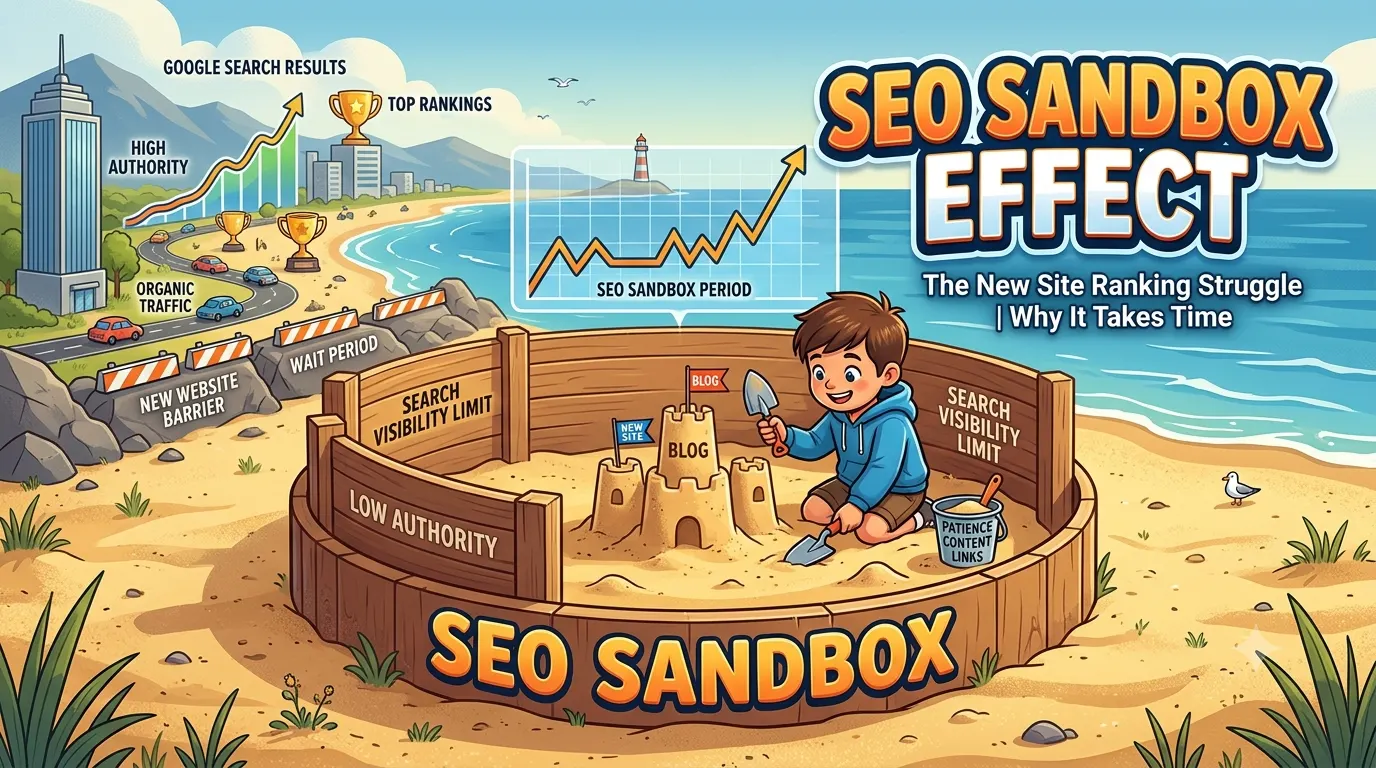
The SEO Sandbox Effect refers to the common observation that brand-new websites or pages take longer to rank in Google’s search results, regardless of content quality or on-page optimization. It’s not a confirmed algorithmic “sandbox” but a consequence of missing trust signals, low crawl budget, and the time required for Google to evaluate new domains against established competitors.
- Trust is the primary gatekeeper: Google needs signals like backlinks, user engagement, and content consistency before trusting a new site with top rankings.
- Technical crawlability is non-negotiable: Many sites mistake the sandbox for poor indexing. A solid XML sitemap, fast server response, and clean internal linking are foundational.
- Content depth beats volume: Publishing 20 thin articles is less effective than 3 comprehensive, entity-rich guides that fully satisfy search intent.
- Competitive landscapes matter: A new site in a low-competition niche may see rankings in weeks, while dominating a high-authority space like finance or health can take months.
- Active outreach accelerates the process: Earning even a few high-quality backlinks and social signals can significantly shorten the trust-building phase.
Table of Contents
What Is the SEO Sandbox Effect?
When you launch a new website, you expect to see results quickly. But more often than not, weeks or even months pass with little to no organic visibility. This frustrating period is commonly called the SEO Sandbox Effect. It is the observation that Google imposes a temporary ranking handicap on new domains, regardless of SEO effort. While Google has never officially confirmed a specific "sandbox algorithm," evidence from countless webmasters and SEO professionals points to a trust-evaluation phase that new sites must endure before they can compete.
The core problem: trust and authority
Google’s mission is to serve high-quality, trusted results. A brand-new domain has no track record. It has no history of user satisfaction, no backlink profile to reference, and no data on whether its content is accurate or spammy. The sandbox is not a penalty; it is a probationary period. During this time, Google crawls your pages, observes user behavior (click-through rates, dwell time, bounce rates), and evaluates your backlinks and content structure.
The Real Reason New Sites Struggle
It is not one single filter. It is a combination of factors that collectively delay ranking potential. Understanding these causes helps you target your efforts more effectively.
| Factor | Description | Impact on New Sites |
|---|---|---|
| Crawl Budget Limitations | Google allocates limited resources to crawl new domains. It might only check a few pages per day initially. | Content takes longer to be discovered and indexed. This delays ranking signals. |
| Backlink Profile Velocity | Earning links too quickly can look unnatural. Earning them too slowly provides no authority. | Without quality inbound links, Google lacks trust signals. The site remains in a low-authority bucket. |
| User Engagement Metrics | Google uses CTR and dwell time to assess content quality. New sites have no historical data. | Even if your content ranks, low engagement can cause it to drop immediately, reinforcing a holding pattern. |
| Domain Age vs. Content Age | Older domains often get a slight trust advantage. New domains must prove themselves over time. | Your site might be 3 months old, but your best article is only 2 weeks old. Both factors matter. |
| Competitive Terrain | In high-authority niches (e.g., insurance, loans), the entry bar is much higher. | A new site in a low-competition hobby niche may escape the sandbox in weeks. A finance blog may need 6–12 months. |
5 Signs Your Site Is Stuck in the Sandbox
Not every flat growth curve is the sandbox. Here are five specific signals to watch for when diagnosing if your new site is being held back.
- Indexing Happens, but Rankings Never Materialize: Your pages are in Google’s index (check via site:yourdomain.com), but they sit on page 5 or beyond for low-difficulty keywords.
- Traffic Drops Immediately After an Initial Spike: You rank #20 for a week, get 10 clicks, then disappear entirely. This lack of sustained ranking is a classic sign.
- New Content Is Ignored for Weeks: You publish a new article, but it takes 3–4 weeks to even appear in search results. Meanwhile, competitor sites with older domains index within days.
- Link Building Shows No Effect: You earn a few decent backlinks, yet your domain authority (or Ahrefs Domain Rating) barely moves, and rankings remain unchanged.
- Brand Searcher Only Traffic: All your organic traffic comes from people searching your brand name. Any informational or commercial queries yield nothing.
The 4-Step Framework to Accelerate Exit
Instead of waiting passively, use this structured workflow to actively signal trustworthiness to Google. This framework is designed for websites aged 0–12 months.
Step 1: Solidify the Technical Foundation (Week 1–2)
Why it matters: If Google cannot crawl and index your pages efficiently, you are wasting time. This step ensures your site is technically sound.
- Submit a clean XML sitemap to Google Search Console and Bing Webmaster Tools.
- Verify Google Search Central guidelines: Ensure no meta noindex tags, no robots.txt blocks for critical pages, and no soft 404s.
- Optimize Core Web Vitals: Use Google PageSpeed Insights to fix Largest Contentful Paint (LCP), Interaction to Next Paint (INP), and Cumulative Layout Shift (CLS). A slow site is less trusted.
- Implement Schema.org structured data: Apply
Organization,BreadcrumbList, andArticleschema to establish entity context.
Step 2: Build Content Depth Over Content Volume (Week 3–6)
Why it matters: Thin content wastes crawl budget and provides no trust signals. Deep, comprehensive content signals topical authority.
- Pick a tight cluster of 3–5 topics within your niche. Do not write about 20 different topics yet.
- Create one "pillar" page per topic (2000+ words) that covers the topic exhaustively. Include a table of contents, multiple H2s, and a FAQ section.
- Publish 2–3 supporting articles that link back to the pillar page. This creates an entity-rich internal linking hub.
- Avoid duplicate or spun content. Every article must offer unique insight or a fresh angle.
Step 3: Earn Trust Signals Actively (Week 4–12)
Why it matters: Google needs to see that other websites and users find you valuable. Passive waiting does not work here.
- Focus on backlink quality over quantity: One link from a trusted industry blog is worth 50 low-quality directory links. Use Moz Blog methods for outreach: offer a unique data point or a guest post with real substance.
- Leverage existing platforms: Write for Medium, LinkedIn Articles, or industry forums (with a link back to your site) to build a backlink profile and brand mentions.
- Encourage social signals: Share your content on Reddit (relevant subreddits), Twitter/X, or niche communities. Engagement signals matter indirectly by driving traffic and backlinks.
Step 4: Monitor, Adjust, and Be Patient (Week 12–24)
Why it matters: The sandbox does not have a fixed timer. You must track progress and pivot if a strategy fails.
- Use Google Search Console to track average position for your target keywords. If a page stays below position 30 after 8 weeks, consider rewriting the content or updating the internal links.
- Check your crawl stats: A sudden drop in crawl requests might mean Google lost interest. Add new content or fix broken links to re-engage the crawler.
- Update old content: Refresh your pillar pages with new statistics (if you have them), new examples, or additional sections. Google notices freshness signals.
How This Applies in Practice
The experience of the sandbox varies significantly by website type. Here is how to adjust the 4-step framework for different scenarios.
For a Beginner Website (e.g., a new hobby blog)
Focus: Crawlability and content depth.
Scenario: You blog about indoor gardening. You have no budget for outreach.
Action: Publish 3 in-depth guides: "A Complete Guide to Growing Herbs Indoors," "Common Pests and Solutions," and "Best Soil Mixes." Internally link them. Submit to Google Search Console. Join gardening forums and answer questions, linking back to your guide only when relevant. Expect to see initial rankings around month 4–6.
For a SaaS Website (e.g., a new project management tool)
Focus: Backlinks and trust signals.
Scenario: You launch a SaaS for remote teams. Competitors like Asana and Trello dominate.
Action: Create a high-value resource (e.g., "The Ultimate Remote Work Toolkit" PDF) and promote it to productivity bloggers. Use Ahrefs Blog techniques to find broken links on competitor posts and offer your resource as a replacement. Do not expect organic traffic for 9–12 months. Focus on direct, paid, and referral channels initially.
For an Ecommerce Store (e.g., a new handmade jewelry shop)
Focus: Product page optimization and structured data.
Scenario: You sell artisan silver rings. You have 50 products.
Action: Implement Product schema on every product page. Build a blog around "How to Choose Silver Jewelry" that links to your product categories. Optimize for long-tail keywords like "handmade silver stacking rings." Submit a product feed to Google Merchant Center. Expect to see product listings indexed but not ranking for broad terms for 3–6 months.
For a Local Business (e.g., a new coffee shop in Austin, TX)
Focus: Local SEO and citations.
Scenario: Your shop opens with no online presence.
Action: Claim your Google Business Profile. Get listed in Yelp, TripAdvisor, and local directories. Encourage 10–15 genuine customer reviews within the first month. Create a page titled "Best Coffee Shop in [Neighborhood]." Local results tend to escape the sandbox faster because Google can quickly verify physical location and reviews. Expect to see local pack visibility within 4–8 weeks.
Common Mistakes That Prolong the Wait
Even experienced SEOs make these errors. Avoid them to prevent extending your probation period.
- Publishing too much low-quality content, too fast: Google sees this as a spam signal. A burst of 30 articles in one week looks unnatural. Pace yourself.
- Ignoring internal linking: A page with no internal links pointing to it is an orphan. Google might never crawl it, or it will have very low authority within your own site.
- Building low-quality backlinks from link farms: This can trigger manual action or put your site in a deeper trust deficit. It is better to have zero backlinks than 50 spam links.
- Focusing only on high-volume keywords: You are competing with established giants. Target long-tail, informational queries first. This helps you build credibility gradually.
- Giving up after 3 months: Many site owners assume the sandbox is permanent when it is just slow. Patience combined with consistent action is the cure.
Frequently Asked Questions
1. How long does the SEO Sandbox Effect last?
There is no fixed duration. For low-competition niches with strong content and decent backlinks, you might see meaningful traffic within 3–5 months. For competitive industries (finance, health, legal), it can take 6–12 months or longer. The sandbox is not a timer but a trust-building phase. If you actively work on signals (backlinks, engagement, technical health), you shorten the duration. If you do nothing, it can last indefinitely.
2. Can I completely avoid the SEO Sandbox Effect?
No, entirely avoiding it is unlikely for a brand-new domain. However, you can minimize its impact by buying an aged domain (2+ years old with a clean history) or by leveraging a subdomain of an already-trusted site (e.g., blog.yourcompany.com if yourcompany.com is established). For most new sites, the better approach is to accept the timeframe while focusing on channels like social media, email, and PR to build a user base independently of Google.
3. Does the sandbox affect all pages on my site equally?
No. Typically, the sandbox affects the entire domain initially. However, if you have one page that earns a high-quality backlink quickly (e.g., from Forbes or a .edu site), that specific page may escape the sandbox faster while other pages remain constrained. The effect is domain-wide but can be overridden by strong page-level signals. This is why earning even one powerful backlink is a priority for new sites.
4. How do I know if it is the sandbox or just poor optimization?
Diagnose by process of elimination. First, check if your pages are indexed. If they are indexed but rank poorly, check your technical SEO (site speed, mobile usability, Core Web Vitals) using Google Search Console. Then, compare your content quality to the top 3 results for your keyword. If your content is superior yet you still rank poorly, and your domain is under 6 months old, the sandbox is the likely cause. If your technical SEO or content is weak, fix that first.
5. Does AI Overviews (formerly SGE) affect the sandbox?
Yes, indirectly. AI Overviews rely on authoritative sources. If your new site lacks trust signals, Google's AI is less likely to cite your content in an AI Overview, further reducing visibility. However, focusing on entity-rich, authoritative content (that answers questions directly) can help you get cited even if you are new. The key is to provide clear, factual answers that Google can extract, using Schema.org markup (like FAQPage and Article) to increase your chances of being featured.
6. Should I use a main domain or a subdomain to escape the sandbox?
This depends on your existing authority. If you have a trusted brand site on a separate domain, a subdomain (e.g., newproduct.brand.com) may inherit trust faster. If you are starting fresh, a main domain is better because subdomains can be treated as separate entities by Google. A fresh subdomain on an unknown brand will still face a sandbox. For most new projects, build on the main domain and focus on building brand authority from the start.
Article Summary
The SEO Sandbox Effect is not a myth, but it is also not a permanent barrier. By understanding it as a trust-evaluation phase driven by crawl budget, backlink authority, user engagement, and domain age, you can take targeted action. This article provided a 4-step framework: solidify your technical foundation, build content depth over volume, earn active trust signals, and monitor patiently. The sandbox is a test of strategy, not a punishment. With a structured approach, you can minimize its duration and emerge with a stronger, more competitive website.
Conclusion
The new site journey is often humbling. You publish content, wait, and see nothing. The SEO Sandbox Effect is the name for that waiting period, but it does not have to be a period of inaction. By systematically building technical trust, content depth, and external authority, you signal to Google that your site is here to stay.
The real differentiator is patience combined with a clear strategy. Avoid the common pitfalls of spammy backlinks and thin content. Focus on the needs of your audience and the signals that Google expects. The sandbox will pass, and when it does, your site will be better positioned for long-term growth than those that tried to cheat the system.
Recommended Resources
- Google Search Central — Official guidelines for indexing, crawling, and ranking.
- Google Search Console — Monitor your site's indexing status and performance.
- Ahrefs Blog — In-depth guides on link building and keyword research for new sites.
- Moz Blog — Whiteboard Friday and beginner-friendly SEO tactics.
- Schema.org — Official documentation for structured data markup.
About the Author
The SMARTCHAINE Editorial Team specializes in SEO, AI Search Optimization, GEO (Generative Engine Optimization), AI Overviews, Structured Data, Technical SEO, and search visibility strategies for modern search engines and AI-powered discovery platforms.