Topical Map SEO: How to Build One That Actually Works in 2026
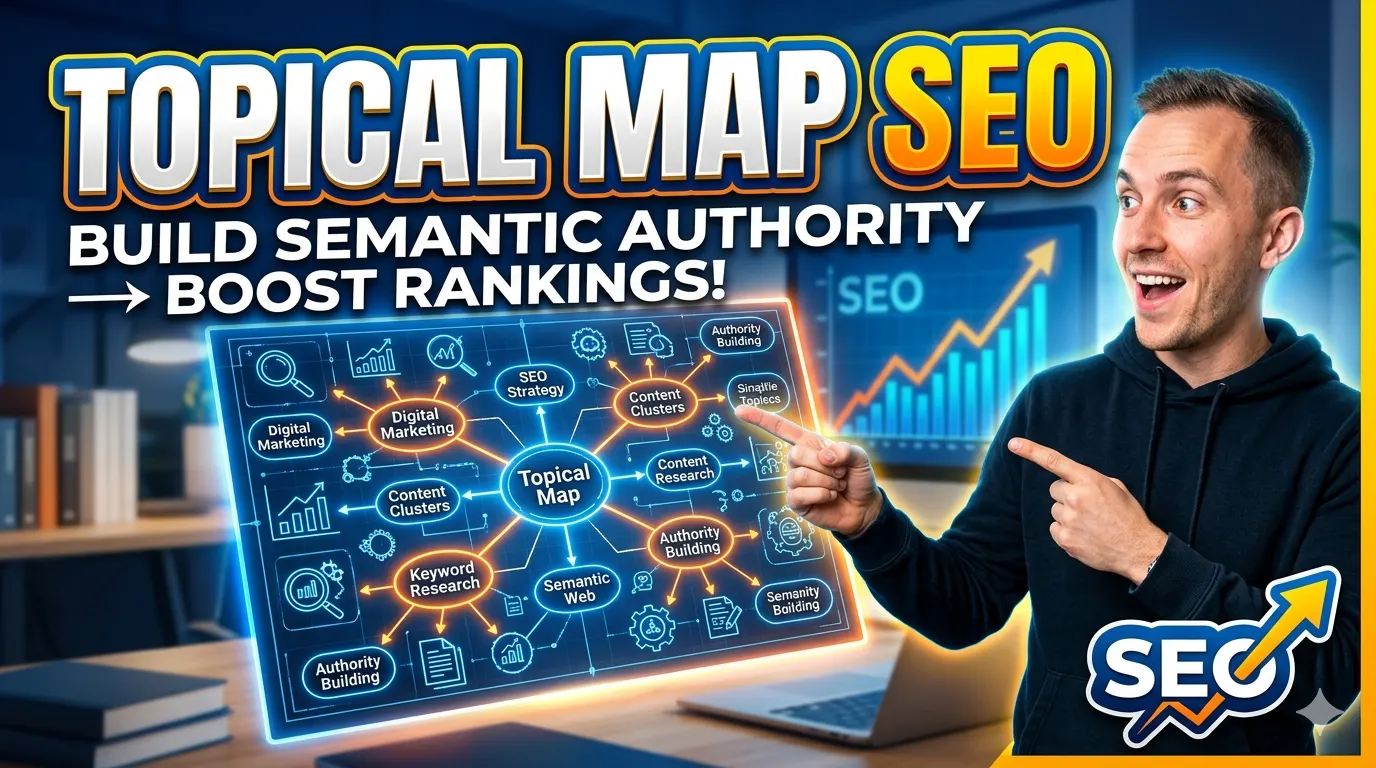
Table of Contents
- What Is a Topical Map in SEO?
- Why Authority Mapping Matters for Modern Search
- Building Your Topical Map: A 4-Step Workflow
- Common Mistakes When Creating Topical Maps
- How Topical Map SEO Impacts AI Overviews and Generative Search
- Topic Cluster vs. Traditional Keyword Research
- How This Applies in Practice
- Frequently Asked Questions
What Is a Topical Map in SEO?
A topical map is a structured document that defines the main entities, subtopics, and questions a website should cover to establish topical authority. Unlike a keyword list, it focuses on semantic relationships rather than individual search volumes.
In practice, a topical map answers three questions:
- What core subject does this site own?
- What sub-entities support that core subject?
- Which content formats and intents map to each subtopic?
For example, a site about “content strategy” might map entities like editorial planning, distribution, measurement, and AI-assisted writing. Each entity then branches into specific subtopics and queries.
Why Authority Mapping Matters for Modern Search
Google’s Search Central documentation emphasizes E-E-A-T (Experience, Expertise, Authoritativeness, Trustworthiness). A topical map directly supports this by proving breadth and depth on a subject. When search crawlers detect consistent internal linking between pillar content and supporting articles, they infer topical ownership.
This matters more in 2026 because AI Overviews pull from multiple sources to answer complex queries. If your site only covers one angle of a topic, you are less likely to be cited in the generated snippet.
Building Your Topical Map: A 4-Step Workflow
Step 1: Define Your Core Entity
Choose one primary subject your site will be known for. Avoid broad terms like “marketing” unless you have massive resources. Instead, pick a niche such as “B2B SaaS content strategy” or “local plumbing SEO.”
Decision rule: If you cannot explain your core entity in one sentence, it is too broad.
Step 2: Use Existing Tools for Entity Discovery
Run your core term through tools like Semrush’s Keyword Magic Tool or Ahrefs’ Content Explorer. Look for recurring subtopics and questions that appear in the top-ranking pages. Do not just focus on high-volume keywords—include low-competition informational queries that support entity depth.
Step 3: Map Content to Search Intent
Assign each subtopic to an intent category:
- Informational – guides, explainers, how-tos
- Commercial – comparisons, best-of lists, reviews
- Transactional – pricing pages, product demos
- Navigational – brand terms, software-specific queries
Create at least one piece of content for each intent within a subtopic cluster. This prevents gaps that competitors can exploit.
Step 4: Structure Internal Linking
Your pillar page should link to all cluster pages. Cluster pages should link back to the pillar and to each other where relevant. Use descriptive anchor text that includes the target subtopic. Avoid generic “click here” links.
Expert tip: When linking cluster pages, prioritize linking from older, established pages to newer ones. This passes link equity more effectively than linking from fresh content that has not accumulated authority yet.
Common Mistakes When Creating Topical Maps
- Overloading the map: Listing 50 subtopics when you only have resources for 10 weakens your authority. Focus on fewer, deeper clusters.
- Ignoring content refreshes: A topical map is not static. Revisit it quarterly to remove outdated subtopics and add emerging ones based on search trend data from Google Search Console.
- Separating topic clusters by separate domains: Creating microsites for each subtopic splits your authority. Keep everything under one domain unless you have a strong brand reason not to.
- Keyword stuffing anchor text: Linking with exact-match anchors on every cluster link looks unnatural. Vary between exact-match, partial-match, and branded anchors.
How Topical Map SEO Impacts AI Overviews and Generative Search
AI Overviews, previously known as SGE, generate answers by synthesizing information from multiple authoritative sources. Topical Map SEO directly influences how often your content is selected for these overviews.
Entity understanding: When your site consistently covers subtopics linked to a core entity, Google’s Knowledge Graph can better associate your domain with that entity. A well-structured topical map helps search engines map your content to schema entities like Article, HowTo, or FAQPage.
GEO / Generative Engine Optimization: This emerging discipline focuses on optimizing content for AI answer generation, not just ranking blue links. A topical map supports GEO by ensuring breadth of coverage—AI models pull from multiple pages rather than a single over-optimized article.
Snippet extraction: AI operates on structured, clear content. When you map subtopics using explicit H2/H3 headings and answer direct questions, your content becomes easier for generative models to parse and cite.
Future AI search visibility: As AI-powered discovery becomes more conversational, users rarely land on homepages. They land on specific cluster pages that answer a narrow question. A topical map ensures those cluster pages exist and are well-linked.
Topic Cluster vs. Traditional Keyword Research
| Aspect | Topic Cluster (Topical Map) | Traditional Keyword Research |
|---|---|---|
| Primary focus | Entity and subtopic relationships | Individual search queries and volumes |
| Content structure | Pillar pages + cluster content | Standalone pages targeting one keyword each |
| Internal linking | Hub-and-spoke linking between all cluster pages | Minimal linking unless incidental |
| Impact on AI Overviews | High—supports entity-level recognition | Low—pages are seen as isolated answers |
| Ease of scaling | Requires upfront planning but scales thematically | Easy to start but creates content silos |
| Best for | Authority building, long-term SEO | Quick wins, high-volume single terms |
How This Applies in Practice
For a beginner website or blog: Start with one pillar page and three to five cluster articles. Do not build a 50-page map immediately. Focus on one entity and prove you can rank for its core subtopics first.
For a SaaS website: Map your product’s features as entities. For example, if you offer “project management software,” create clusters around “task dependencies,” “Gantt charts,” “resource allocation,” and “time tracking.” Each cluster should include a product page, a use-case article, and a comparison page.
For an ecommerce store: Use product categories as your core entities. Instead of writing one “buying guide,” break it into subtopic articles like “materials comparison,” “sizing guide,” “care instructions,” and “product reviews.” Link these to category pages and individual product schema.
For a local business: Your core entity is your city + service. A plumber in Austin could map subtopics like “water heater repair Austin,” “emergency plumbing Austin,” “sewer line replacement cost,” and “drain cleaning methods.” Use LocalBusiness schema on the pillar page and link each cluster article back to it.
Actionable Checklist for Building Your First Topical Map
- Define one core entity (narrow enough to own).
- Use Google Search Console to find your top 10 existing queries—these reveal your current entity associations.
- Brainstorm 10 to 15 subtopics that support the core entity.
- Classify each subtopic by search intent (info, commercial, transactional).
- Create a pillar page that covers the core entity broadly.
- Write the first three cluster articles for informational intent.
- Link cluster articles back to the pillar with descriptive anchors.
- Add FAQPage schema to cluster articles that answer direct questions.
- Review the map every 90 days and drop or merge underperforming subtopics.
Useful Tool for This Task
When you start mapping entities and subtopics, you will likely need to add structured data to your pillar and cluster pages. Using a Schema Markup Generator helps you quickly create JSON-LD for Article, FAQPage, and HowTo types without manual code errors. This ensures your topical map content is machine-readable for both traditional search and AI Overview extraction.
Frequently Asked Questions
How long does it take for a topical map to improve rankings?
Entity-level authority builds gradually. Most sites see initial movement in 3 to 6 months after publishing the first cluster. The full effect on AI Overviews may take longer depending on crawl frequency and domain trust.
Can I use a topical map for an existing site with 200+ articles?
Yes, but you need an audit. Group existing articles by entity using tools like Moz’s Link Explorer or your own site search. Identify orphaned content that does not fit any cluster—either merge it or redirect it.
Do I need to submit my topical map to Google?
No. Do not submit maps via Search Console. Google discovers structure through internal links, site structure, and schema markup—not static documents submitted by users.
Does a topical map help with voice search?
Indirectly, yes. Voice search queries are typically longer and more conversational. A topical map that includes long-tail, question-based subtopics naturally covers these queries better than a keyword list.
Should I include competitor topics in my map?
Only if they are truly relevant to your entity. Do not add “plumbing repair” subtopics if your core entity is “landscape design” just because a competitor ranks there. It dilutes your authority.
How does a topical map differ from a content calendar?
A content calendar schedules publication dates. A topical map defines what to write and why. The map comes first; the calendar fills in when to publish each piece.
Conclusion
Topical Map SEO shifts the focus from chasing individual keywords to building recognizable entity authority. Work through the 4-step workflow, avoid the common mistakes listed here, and revisit your map quarterly. The real benefit is not short-term ranking spikes but sustainable visibility across both traditional search and generative AI answers. Start with one entity, prove it works, then expand.
Recommended Resources
About the Author
The SMARTCHAINE Editorial Team specializes in SEO, AI Search Optimization, GEO (Generative Engine Optimization), AI Overviews, Structured Data, Technical SEO, and search visibility strategies for modern search engines and AI-powered discovery platforms.