EEAT SEO Guide: How to Build Real Authority in 2026
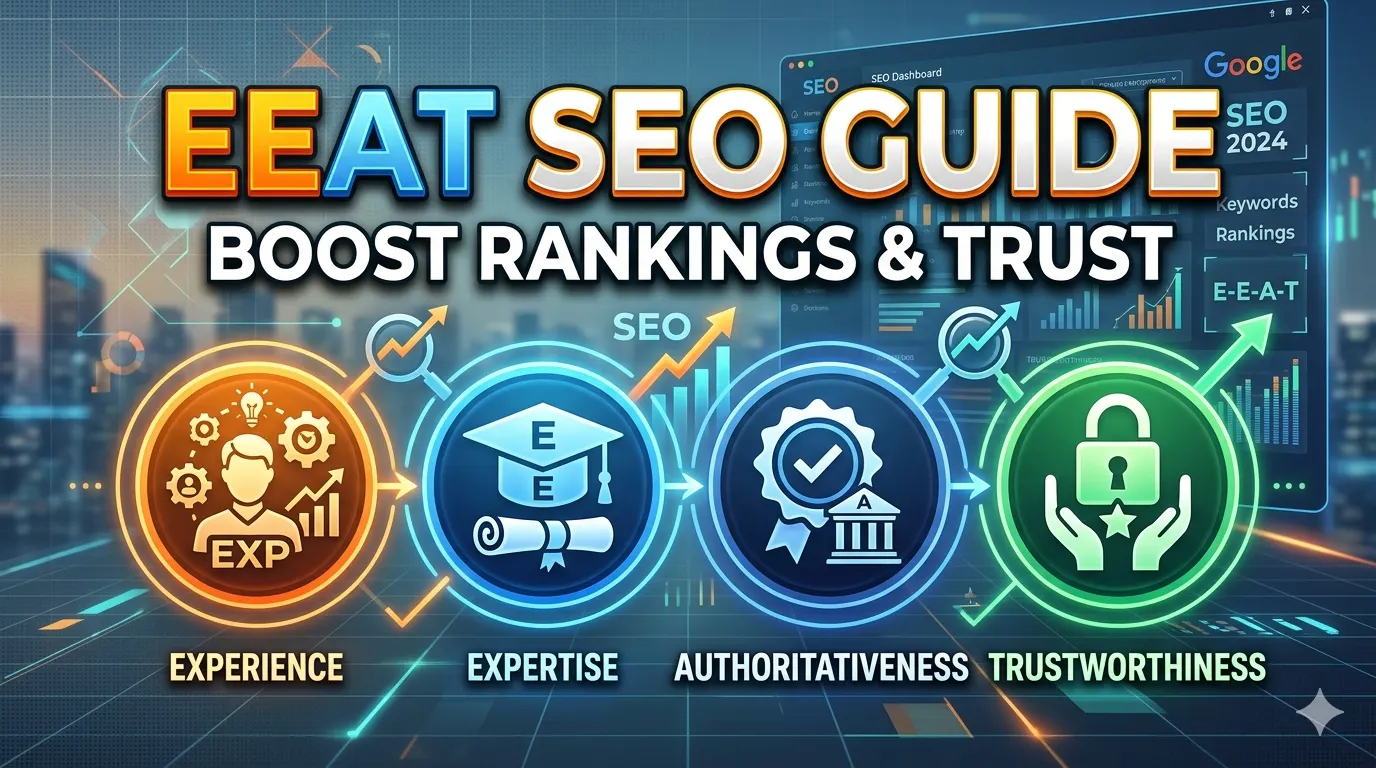
An EEAT SEO guide provides actionable strategies to improve the Experience, Expertise, Authoritativeness, and Trustworthiness signals of your website, as defined by Google Search Quality Rater Guidelines. It focuses on content quality, author credibility, transparent sourcing, and technical trust signals like clear privacy policies and secure connections. It is not a set of hacks but a long-term content quality framework.
- Google's algorithms use EEAT as a quality filter, not a direct ranking factor you can "optimize" with plugins.
- The TRUST Score framework—Transparency, Reviews, Updates, Sourcing, and Testing—helps you audit your site for genuine authority.
- For AI Overviews to cite your content, you must demonstrate clear authorship credentials and explicit sourcing, not just good grammar.
- Avoid the "fake expert" trap: ghostwritten content without author oversight can damage trust more than it helps.
- Technical EEAT includes schema markup for Organization, Author, and Review, plus a clear privacy policy and "About Us" page.
- What EEAT Actually Means for SEO in 2026
- 3 Common EEAT Mistakes That Waste Effort
- The TRUST Score Framework: A Practical Audit System
- Optimizing for AI Overviews and Featured Snippets
- Structured Data for Trust: Schema You Actually Need
- How This Applies in Practice
- Frequently Asked Questions
- Article Summary
- Conclusion
What EEAT Actually Means for SEO in 2026
EEAT stands for Experience, Expertise, Authoritativeness, and Trustworthiness. These are the four pillars Google's human evaluators use in the Search Quality Rater Guidelines to assess whether your content deserves to rank. EEAT itself is not a direct ranking algorithm—there is no "EEAT score" in Google Search Console. Instead, it is a quality rubric that Google's machine learning systems try to approximate.
Practical example: A blog post about "How to Fix a Leaky Faucet" written by a professional plumber with a verified profile, real photos of the repair process, and a clear disclaimer about safety will score higher in EEAT than a generic article rewritten by an AI without any author credentials. Google's system identifies these patterns algorithmically.
What has changed in 2026
AI Overviews (formerly SGE) now pull from sources with strong EEAT signals. If your content lacks explicit author credentials, transparent citations, or an "About Us" page, it is less likely to be cited as a source in AI-generated summaries. The requirement for "first-hand experience" has become much stronger for YMYL (Your Money or Your Life) topics.
3 Common EEAT Mistakes That Waste Effort
Many SEO practitioners invest heavily in the wrong signals. Here are the most frequent errors that undermine genuine trust-building.
1. The "Fake Expert" Trap
Hiring a freelance writer to ghostwrite a medical article and then assigning a doctor's name to it without the doctor's review is a high-risk practice. Google's system can detect inconsistencies between an author's claimed expertise and the content quality. Instead, ensure the named author has actually reviewed or contributed to the content. Use a byline policy that reflects real involvement.
2. Ignoring Negative Review Signals
For a local business or product review site, EEAT suffers when you only display positive reviews. A site that hides negative feedback appears less transparent and trustworthy. A balanced review platform—including low scores—demonstrates authenticity. Google's Quality Rater Guidelines explicitly reward transparency in reviews.
3. No "About Us" or Contact Information
A site without a clear "About Us" page explaining who runs it, how they are qualified, and how to contact them will always struggle with EEAT. This is especially true for ecommerce and local business websites. Missing contact information is a strong negative trust signal.
- Add a detailed "About Us" page with real team names, photos, and credentials.
- Ensure every YMYL article has a real author byline with a short bio and link to a professional profile (LinkedIn, personal site).
- Display both positive and negative user reviews transparently.
- Include a physical address and a working contact form or email.
- Link to sources for any data, study, or claim made in your content.
The TRUST Score Framework: A Practical Audit System
To systematically evaluate your site's EEAT signals, use the TRUST Score framework. This is not a mathematical formula but a qualitative scoring model based on five criteria. Score each category from 1 to 3 (1=weak, 2=partial, 3=strong) to identify gaps.
| Criterion | Scoring 1 (Weak) | Scoring 2 (Partial) | Scoring 3 (Strong) |
|---|---|---|---|
| Transparency | No About Us or contact page | About Us page exists but no team details | Full team, credentials, and contact |
| Reviews | Only positive, filtered reviews | Mixed reviews but no response from owner | Authentic mixed reviews with management responses |
| Updates | Content not updated in 2+ years | Some pages updated within 1 year | All key pages updated within 6 months |
| Sourcing | No external citations or links | Some links but broken or low quality | Clear, working links to authoritative sources |
| Testing (UX) | Poor mobile usability, slow load | Functional but not optimized | Passes Core Web Vitals, accessible design |
How to use the TRUST Score
- Audit 5 key pages on your site (homepage, About Us, 3 main content pages).
- Score each page from 1 to 3 for each criterion.
- Calculate an average score per criterion across all pages.
- Prioritize fixing criteria that score 1.5 or below.
Example scenario: A SaaS blog about project management scores a 3 for Transparency (has a detailed team page) but a 1 for Sourcing (no links to research on productivity). The immediate action is to add citations to academic or industry sources like Harvard Business Review or official PMI publications.
Optimizing for AI Overviews and Featured Snippets
AI Overviews (formerly SGE) prioritize content that demonstrates clear EEAT. To increase your chances of being cited, structure your content for direct answers while maintaining trust signals.
Answer-first structure
Place a concise answer directly under each H2 heading. This paragraph should be 40 to 80 words, directly addressing the user query. This structure is ideal for both featured snippets and AI Overview extraction.
Authoritative entity references
When discussing concepts like "EEAT" or "Core Web Vitals," link to authoritative sources such as Google Search Central or Schema.org naturally within the text. This confirms to Google that you are referencing primary sources.
Real-world example: Financial advice site
A personal finance blog wants its article on "How to File Taxes for Freelancers" to appear in AI Overviews. It adds a clear byline: "By Sarah Chen, CPA, with 10 years of tax preparation experience." The article cites specific IRS publications with working links. It includes a "Last Updated: January 2026" date. This combination of signals makes it far more likely to be selected by AI Overiews than a generic article without credentials or dates.
Structured Data for Trust: Schema You Actually Need
Schema markup helps search engines understand who you are and what your content represents. For EEAT signals, focus on these schema types rather than stuffing every possible type onto your pages.
| Schema Type | Where to Add | Why for EEAT |
|---|---|---|
| Organization | Homepage, About Us | Validates your entity's name, logo, and contact info |
| Person | Author pages | Connects the article to a real person with credentials |
| Article | Blog posts | Includes author, date, and publisher info |
| Review | Product or service pages | Shows first-hand experience and user feedback |
| HowTo | Tutorial or guide pages | Demonstrates experience in step-by-step instructions |
Practical limitation: Adding schema is not a guarantee of ranking. It simply helps search engines interpret your content more accurately. Without the quality behind the schema, the markup alone will not improve your EEAT score.
How This Applies in Practice
The application of EEAT strategies differs significantly depending on your website type. Here is how the same principles play out in different scenarios.
Beginner website
A new blogger about "Healthy Meal Prep" starts without credentials. Instead of pretending to be a nutritionist, they can write about their personal experience: "I tried 50 meal prep recipes in 6 months—here is what worked." This demonstrates Experience. They should also link to credible sources like the USDA dietary guidelines. Over time, they can interview actual dietitians to build authority.
SaaS website
A SaaS company selling project management software worries about EEAT for its blog. Its strongest signal is its "About Us" page featuring real engineers and product managers with LinkedIn profiles. The blog should feature bylines from these team members and case studies with real client names (with permission). Avoid generic "content writer" bylines; use "By Jane Doe, Product Lead at [Company]."
Ecommerce store
An ecommerce site selling camping gear can build EEAT by having detailed product guides written by experienced campers. Include user reviews with photos, a clear return policy (trust), and a blog that updates seasonally with real camping trip stories. Avoid fake review aggregation; display all reviews—good and bad—transparently.
Local business
A local dental clinic wants to rank for "best dentist in Austin." Its EEAT signals include a Google Business Profile with real patient reviews, a website with dentist credentials (education, certifications), and an "About Us" page with photos of the clinic and team. Regular updates to blog posts about dental procedures, written by the dentists themselves, further strengthen EEAT.
Frequently Asked Questions
Is EEAT a direct Google ranking factor?
No. Google has confirmed that EEAT is not a direct ranking signal. Instead, it is a framework used in the Search Quality Rater Guidelines to evaluate content quality. Google's algorithms attempt to replicate human quality judgments using signals such as backlinks, site authority, content accuracy, and author credentials. Improving EEAT improves those underlying signals, which can indirectly help rankings.
How long does it take to see EEAT improvements in rankings?
There is no fixed timeline. Building genuine authoritative signals—such as credible backlinks, a strong author reputation, and consistent content quality—takes months or years. Quick fixes like adding schema alone will not fast-track results. Expect at least 3 to 6 months of consistent effort before you observe noticeable changes in how Google treats your content.
Can AI-generated content pass EEAT standards?
AI-generated content can pass EEAT standards only if a human expert with verifiable credentials substantially reviews, edits, and approves it. AI content published without human oversight is unlikely to demonstrate Experience or Expertise because it lacks first-hand knowledge. For YMYL topics, always have a qualified human author named on the article.
Do I need a separate author page for every writer?
Yes, if you want to maximize EEAT signals. Each author page should include the author's full name, a short bio, an image, credentials, and links to their professional online presence (such as a LinkedIn profile or personal website). This helps search engines connect content to a real person with relevant expertise. For small sites with one writer, a single "About the Author" section may suffice.
Does having a privacy policy and terms of service improve EEAT?
Yes. Trustworthiness is partly demonstrated by how you handle user data. A clear privacy policy and terms of service page show transparency. This is especially important for sites that collect email addresses or process payments. Without these pages, your site may be perceived as less trustworthy, particularly in Google's Quality Rater evaluation.
How do AI Overviews impact EEAT strategy?
AI Overviews extract information from content that demonstrates high EEAT. This means your content must not only be correct but also clearly sourced, authored, and updated. If your content lacks dates, author names, or citations, it is less likely to be selected as a source in AI-generated answers. To optimize, add "Last Updated" dates, structured data, and explicit citations to every article.
Article Summary
Conclusion
EEAT SEO is not about chasing a secret algorithm. It is about running a transparent, expert-driven website that earns trust over time. Use the TRUST Score framework to identify weak points in your current setup, fix the sourcing and transparency gaps, and ensure every YMYL article has a real author with real credentials. This approach will not only improve how Google judges your site but will also make your content more useful and credible for human readers—which remains the ultimate goal of search.
About the Author
The SMARTCHAINE Editorial Team specializes in SEO, AI Search Optimization, GEO (Generative Engine Optimization), AI Overviews, Structured Data, Technical SEO, and search visibility strategies for modern search engines and AI-powered discovery platforms.