Google Ranking Factors Guide: What Actually Matters in 2026
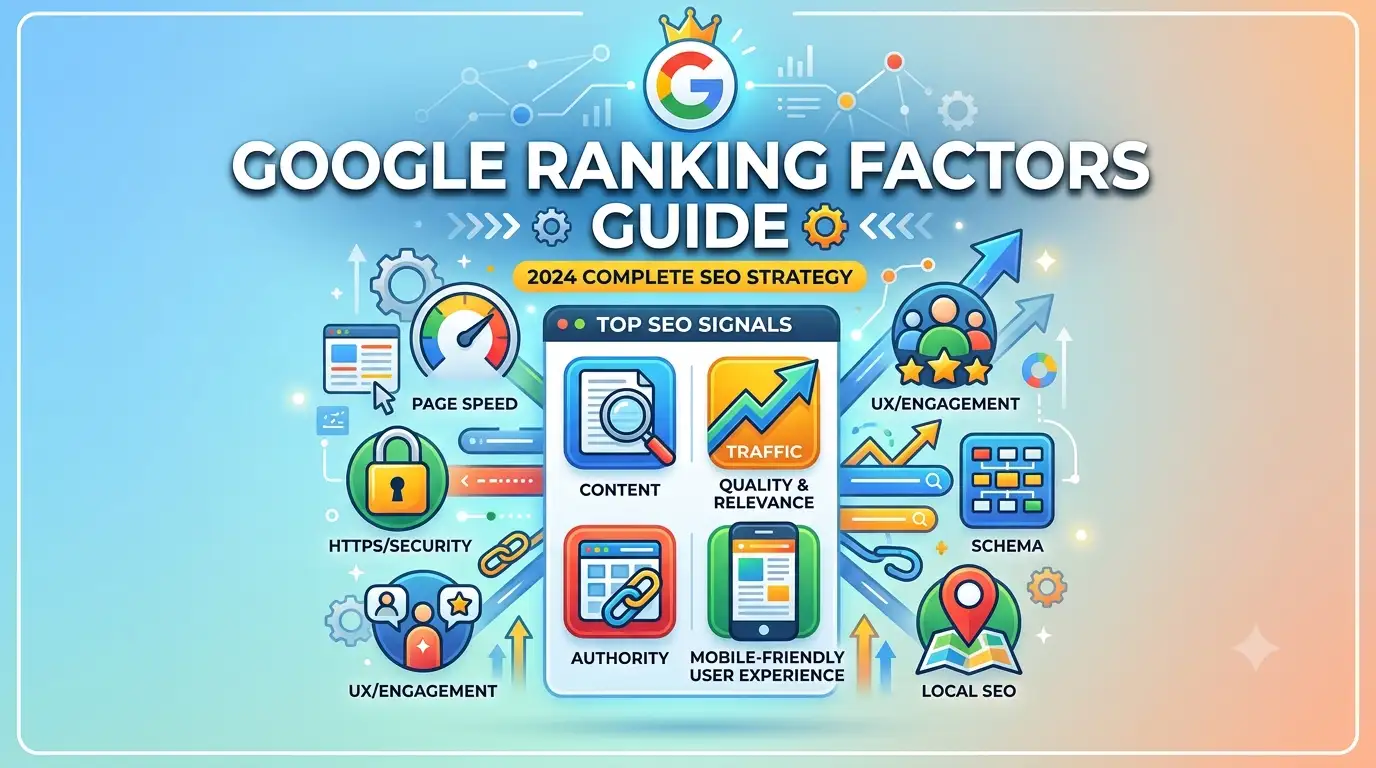
Quick Answer: The primary Google ranking factors in 2026 are not a secret list of 200 signals. They break down into four core pillars: content quality and EEAT signal fulfillment, technical infrastructure (Core Web Vitals, crawlability, indexability), user engagement signals (CTR, pogo-sticking), and entity/contextual relevance (structured data, topical authority). Ranking success comes from mastering these interdependent systems, not chasing individual "hacks."
TL;DR: Google's ranking system is an integrated AI evaluating expertise, experience, and topical depth. Focus on creating content that demonstrates verifiable EEAT, building a technically clean site indexed via Google Search Console, and structuring data for AI Overviews and featured snippets. Ignore supposed "secret factors" and prioritize what actually moves the needle: solving real user problems with authoritative, well-structured content.
Key Takeaways
- EEAT is now a gating factor: Content without demonstrable first-hand experience or cited expertise struggles to rank for competitive queries, especially in YMYL (Your Money or Your Life) topics.
- AI Overviews change the click dynamic: Optimizing for featured snippets and entity-rich answers is essential for visibility, even if it reduces traditional clicks.
- Technical health is the foundation: Single-page application (SPA) sites and heavy JavaScript loads can block Googlebot; a clean, crawlable architecture in Google Search Console is non-negotiable.
- Structured data is for understanding, not ranking: Schema.org markup (e.g., Article, FAQPage, HowTo) helps Google interpret content context, not directly boost a "score," but it is critical for rich results.
- Link relevance beats link quantity: A single relevant link from a trustworthy niche site outperforms dozens of low-authority, generic backlinks.
- Search intent alignment is the ultimate signal: If your page does not match the dominant user intent (informational, navigational, transactional, commercial investigation), no amount of optimization will save it.
Table of Contents
- 1. The Core Framework: The RankReady System
- 2. Content Quality and EEAT in Practice
- 3. Technical Foundations: Crawl, Index, Render
- 4. User Engagement Signals and Search Intent
- 5. Structured Data and Entity Signals
- 6. Links, Brand Signals, and Authority
- 7. How This Applies in Practice
- 8. Common Mistakes to Avoid
- 9. Frequently Asked Questions
- 10. Conclusion
The Core Framework: The RankReady System
The RankReady System provides a structured way to evaluate a page's ranking potential without relying on guesswork. It breaks down into three sequential gates: Technical Access, Content Authority, and Intent Fulfillment. A page must pass each gate before the next one matters. Do not worry about link-building if your content is not indexable. Do not optimize for keywords if your content lacks substantive EEAT signals.
Expert Tip: When auditing a page, start with the technical layer. Open Google Search Console, use the URL Inspection tool. If the page is not indexed, nothing else matters. Fix indexability before writing any new content.
The Three Gates
- Gate 1: Technical Access (Score: Pass/Fail). Can Googlebot reach, render, and index the content? If the page is blocked by robots.txt, uses excessive JavaScript, or has no internal links, it fails. Use the "Coverage" report in Google Search Console to find failures.
- Gate 2: Content Authority (Score: Low / Medium / High). Does the content demonstrate first-hand knowledge, cite verifiable sources, and match the author's expertise? This is the qualitative assessment. A medical article written by a marketer with no cited studies scores Low. A detailed guide from a practicing physician with cited peer-reviewed journals scores High.
- Gate 3: Intent Fulfillment (Score: Match / Partial / Mismatch). Does the content format and depth satisfy what the user wants? A searcher looking for "buy running shoes" (transactional) wants product listings and pricing, not a blog post about the history of running. A mismatch here kills ranking potential regardless of technical quality or authority.
Content Quality and EEAT in Practice
Content quality in 2026 is not about word count or keyword density. It is about demonstrating Expertise, Experience, Authoritativeness, and Trustworthiness (EEAT) as defined in the Google Search Quality Rater Guidelines. The goal is to satisfy end users, not just ranking algorithms. Start by identifying the specific experience your target audience needs and demonstrate it directly in your writing.
Demonstrating Experience vs. Expertise
Experience means you have done something. Expertise means you know something deeply. An article about "climbing Mount Kilimanjaro" written by someone who has actually climbed it (experience) will rank better than a perfectly written summary of Wikipedia entries (expertise without experience). You can signal experience by including personal observations, specific gear recommendations, and logistical details that only someone who has done it would know.
Practical Example: YMYL Content
Consider a website publishing advice about "treating anxiety without medication." If the author is a certified psychologist with a license number and the content cites clinical studies from PubMed, the page has strong EEAT signals. If the author is a freelance writer with no medical background and the content links to generic blog posts, Google will likely suppress it for sensitive queries. Use the "About" page to list credentials and link to professional registries where applicable.
Technical Foundations: Crawl, Index, Render
Google must first discover your page via links, then crawl it using Googlebot, render any JavaScript to see the final content, and finally index it. Each step is a potential failure point. A well-optimized, plain HTML website with clear internal linking will always be easier for Googlebot to process than a heavy React application that loads content asynchronously. Test your site using the "URL Inspection" tool in Google Search Console to see exactly what Googlebot sees.
Common Technical Failures
- Blocked by robots.txt: Googlebot cannot access the page at all. Check the robots.txt file in Google Search Console under "Crawl Stats."
- Noindex tag present: The page is intentionally excluded from the index. Review the page's HTML head for
<meta name="robots" content="noindex">. - JavaScript-dependent content: If your key text is loaded via client-side JavaScript (like a SPA), Googlebot might miss it. Pre-render critical content server-side or use dynamic rendering as a workaround.
- Orphan pages: No internal links point to the page. Add a link from a relevant, already-indexed page on your site.
Hypothetical scenario: A SaaS blog publishes an informative article about API rate limiting. The content is excellent, but the page is built as a JavaScript-heavy documentation portal. Googlebot renders the shell but fails to execute the API call that loads the actual article text. The page never enters the index. Fixing this required switching to server-side rendering for blog content, after which the article was indexed within 48 hours.
Core Web Vitals as a Tiebreaker
Core Web Vitals (LCP, FID/INP, CLS) are not primary ranking factors. They act as a tiebreaker: when two pages have equal relevance and authority, the one with better user experience (faster load, less layout shift) will rank higher. A slow page with unique, authoritative content will still beat a fast page with generic content. Prioritize page experience improvements only after you have solid content and technical indexability.
User Engagement Signals and Search Intent
Google interprets user behavior as a relevance signal. If searchers consistently click on your result and stay on the page without immediately returning to the search results (pogo-sticking), Google sees your page as satisfying the intent. Conversely, if many users click your link and then quickly bounce back to search for a different result, Google may demote your page over time. The best way to improve user signals is to match your content format to the search intent.
Matching Content to Intent
- Informational intent (e.g., "how to fix a leaky faucet"): Use a HowTo schema, numbered steps, images, and video. A bullet list of tips will not satisfy someone looking for a step-by-step guide.
- Commercial investigation (e.g., "best CRM for small business"): Use comparison tables, feature lists, pricing breakdowns, and pros/cons summaries. A single product review without comparisons is insufficient.
- Transactional intent (e.g., "buy organic coffee beans"): Use Product schema, pricing, availability, and clear call-to-action buttons. Long-form editorial content will harm engagement.
- Navigational intent (e.g., "Facebook login"): Provide a clear link to the target site. Any other content frustrates the user.
Structured Data and Entity Signals
Structured data (Schema.org markup) does not directly boost a Google ranking factor score. Instead, it helps Google's AI understand the entities on your page and their relationships. This understanding makes it easier for Google to surface your content in rich results, AI Overviews, and knowledge panels. Use the relevant schema type that matches your content format.
Schema Types That Matter
| Schema Type | When to Use | Rich Result Benefit |
|---|---|---|
| Article | Blog posts, news articles, guides | Top stories carousel, headline display |
| FAQPage | Pages with structured Q&A content | Expanded FAQ snippet in search results |
| HowTo | Step-by-step tutorials, recipes, guides | Rich video/step display |
| Product | Ecommerce product pages | Price, availability, review stars |
| BreadcrumbList | All sites with clear hierarchies | Breadcrumb path in search results |
| Organization | Company websites | Knowledge panel enrichment |
| LocalBusiness | Brick-and-mortar stores | Local pack display, map placement |
Use the Rich Results Test tool on Google Search Central to validate your markup before deploying it. Invalid schema can be ignored or cause penalties in rare cases.
Links, Brand Signals, and Authority
Backlinks remain a strong authority signal, but their quality is determined by relevance and trustworthiness, not just domain authority in isolation. A link from a well-known, topically relevant publication like those in the Ahrefs Blog or Semrush Blog ecosystem carries significant weight. A link from a random, unrelated directory carries almost none. Focus on earning links that come from sites where Google already trusts the content.
Link Quality Assessment Framework
- Relevance (Priority 1): The linking page must be about the same broad topic. A link from a travel blog to a tax software guide looks unnatural.
- Trust (Priority 2): Look for links from sites that have editorial standards, clear author bylines, and a legitimate business presence. Avoid sites that sell links, use private blog networks (PBNs), or have a history of spam.
- Placement (Priority 3): A link embedded naturally in the body content (editorial link) is far more valuable than a link in a footer, sidebar, or author bio.
- Anchor text (Priority 4): Use descriptive anchor text that naturally fits the sentence. Avoid exact-match keyword anchors across many links, which can trigger spam filters.
How This Applies in Practice
The tactics above change significantly depending on the type of website you manage. Here is how the Google Ranking Factors Guide advice adapts to different scenarios.
Beginner Website (Personal Blog or Hobby Site)
Focus first on technical basics: choose a clean hosting provider, use a simple WordPress theme with minimal JavaScript, and ensure every post has a clear internal link from the homepage or categories. Do not worry about link-building yet. Write comprehensive posts on topics you truly know. Use a photo of yourself or your workspace as an experience signal. Submit your sitemap to Google Search Console. Your goal is to get indexed and build a small base of genuinely helpful content.
SaaS Website (B2B Software)
The biggest challenge is content depth and technical rendering. Many SaaS sites use React or Angular, which can block indexing if not handled correctly. Ensure your blog content is server-side rendered or statically generated. Create long-form guides for each key use case, not just product features. Use comparison tables against competitors (commercial investigation intent). Demonstrate experience by sharing real implementation advice, including known limitations of your own product. Link from help docs to blog posts and vice versa.
Ecommerce Store
Product pages are transactional, but you also need informational content to capture top-of-funnel traffic. Write buying guides and "best of" articles that link naturally to your product pages. Use Product schema with accurate price and availability. Optimize category pages with unique, useful text (avoid thin content). For user experience, prioritize fast loading times (Core Web Vitals) because slow product pages kill conversion rates. Handle category-level search intent carefully: a "Men's Running Shoes" category should not look like a blog post.
Local Business (Restaurant, Dentist, Plumber)
Claim and verify your Google Business Profile (GBP). Local pack ranking is heavily influenced by proximity, GBP completeness, and review quantity/quality. On your website, use LocalBusiness schema and ensure your name, address, and phone number (NAP) are consistent across the web. Create location-specific content, such as "Best Pizza in [Neighborhood Name]" or "How to Unclog a Drain in [City]." Link-building for local businesses means getting listed in reputable local directories and earning links from local news sites or community blogs.
Common Mistakes to Avoid
Even experienced SEO professionals fall into these traps. Recognizing them early saves months of wasted effort.
- Chasing the "200 ranking factors" myth: There is no fixed list. Google's system uses machine learning. Optimizing for made-up factors like "domain age boosts" distracts from real work like intent alignment.
- Over-optimizing for features instead of meaning: Stuffing target keywords into H1 headings and image alt text does not work and can trigger keyword stuffing filters. Write naturally.
- Neglecting the user after the click: Ranking high means nothing if the page is unreadable, slow, or fails to answer the question. Bounce rates indirectly affect rankings through user signals.
- Using the same strategy for every type of query: A "how-to" post needs a different structure and schema than a "best of" comparison. Apply the intent-matching logic rigorously.
- Ignoring mobile experience: Google primarily uses the mobile version of your site for indexing and ranking. Test your site on a real phone, not a desktop emulator.
- Publishing without an indexability check: Always check the URL Inspection tool in Google Search Console immediately after publishing a new page. Fix any "Excluded" or "Crawled - currently not indexed" statuses.
Frequently Asked Questions
Is there a definitive list of the top 10 Google ranking factors?
No. Google has never published a numbered list of the "top 10 ranking factors" and has explicitly stated that their system uses hundreds of signals evaluated holistically by machine learning systems. Factors like keyword presence in the title, backlinks, and page speed are all important, but their weight varies by query, user context, and device. Instead of chasing a fixed list, focus on the three gates of the RankReady System: technical indexability, content quality with EEAT signals, and search intent alignment. A page that passes all three gates will naturally satisfy the most important signals.
How much does "domain authority" matter for ranking?
Domain Authority (DA) is a third-party metric created by Moz, not a Google ranking factor. Google uses its own assessment of site-wide trust, which is influenced by the quality of the site's backlink profile, the expertise demonstrated in its content, and its history of user satisfaction. A new site with a low Da can still rank for niche, low-competition queries if its content demonstrates strong experience and matches intent. Do not optimize for a third-party metric like DA; optimize for relevance and trustworthiness as defined by Google Search Quality Rater Guidelines.
Does Google use click-through rate (CTR) as a direct ranking signal?
Google has confirmed they use click data in some forms, but it is not a simple "higher CTR = higher rank" formula. Google uses data from the Chrome browser and Search Console to understand whether a search result is appropriately matched to the query. If a page consistently receives clicks but users immediately bounce back to search results (pogo-sticking), that is a negative signal. The goal is not to maximize CTR alone, but to ensure that the snippet (title and meta description) accurately represents the content, so users who click stay engaged.
How important are AI Overviews for my SEO strategy in 2026?
AI Overviews (formerly SGE) are now a persistent part of search results for many queries. They are especially common for informational, how-to, and comparison queries. To optimize for AI Overviews, structure your content to directly answer questions in clear, concise paragraphs (40-80 words) near the top of your page. Use lists, tables, and structured data (FAQPage, HowTo) to make your content easy for AI to extract. Understand that AI Overviews may reduce organic click-through rates for some queries, but being cited in an overview still provides brand visibility and authority.
Should I focus on writing long-form content or short, punchy posts?
There is no universally ideal word count. The correct length is determined by the search intent and the completeness of the topic. A direct informational query like "current time in Tokyo" requires a very short answer. A comprehensive guide like "how to start an online store from scratch" requires 3,000+ words to be considered thorough. Publish the minimum word count necessary to fully satisfy the user's core question and any common follow-up questions. A 500-word post that perfectly answers the intent will outrank a 5,000-word post that goes off-topic.
How often should I update my content to maintain rankings?
Update content when it becomes factually inaccurate, when new information or methods emerge in the field, or when the search landscape changes (e.g., new competitors, different featured snippet formats). Do not update on a fixed calendar schedule "just because." Use Google Search Console to identify pages with declining clicks or impressions. For those pages, perform a focused update: verify the accuracy of all claims, add new examples or data, improve readability, and check that the schema markup is still valid. A targeted update every 6-12 months is reasonable for most evergreen topics. News and YMYL topics need more frequent checks.
Conclusion
The Google Ranking Factors Guide for 2026 is not a secret checklist. It is a strategic approach that prioritizes technical soundness, demonstrable content authority, and precise search intent alignment. Master the RankReady System: verify your pages are indexable, ensure your content proves your experience and expertise, and make every page a direct answer to the user's real question. Ignore the noise about fictional ranking factors. Apply the workflows, tables, and checklists provided here to your own site, and use Google Search Console as your primary source of truth. The path to sustainable search visibility is built on user trust, which Google's systems increasingly reward.
Article Summary
This guide broke down the core Google ranking factors into the RankReady System: technical access, content authority with EEAT signals, and search intent fulfillment. You learned how to demonstrate first-hand experience in your content, how to fix common technical indexing failures, how to match content format to user intent, and how to use structured data for entity understanding. The advice adapts for beginner sites, SaaS, ecommerce, and local businesses. Common mistakes like chasing "200 ranking factors" or neglecting mobile experience were identified. By applying the three-gate framework and intent-matching logic, you can build a ranking strategy that works with Google's AI, not against it.
Recommended Resources
- Google Search Central - Official documentation for crawling, indexing, and ranking guidelines.
- Schema.org - Full reference for structured data vocabulary.
- Google Search Console - Monitor and troubleshoot your site's Google presence.
- Moz Blog - Authoritative content on link building and SEO strategy.
- Ahrefs Blog - In-depth guides on keyword research and content marketing.
- Semrush Blog - Practical tips on competitive analysis and technical audits.
About the Author
The SMARTCHAINE Editorial Team specializes in SEO, AI Search Optimization, GEO (Generative Engine Optimization), AI Overviews, Structured Data, Technical SEO, and search visibility strategies for modern search engines and AI-powered discovery platforms.