Keyword Clustering Guide: How to Group Keywords for SEO in 2026
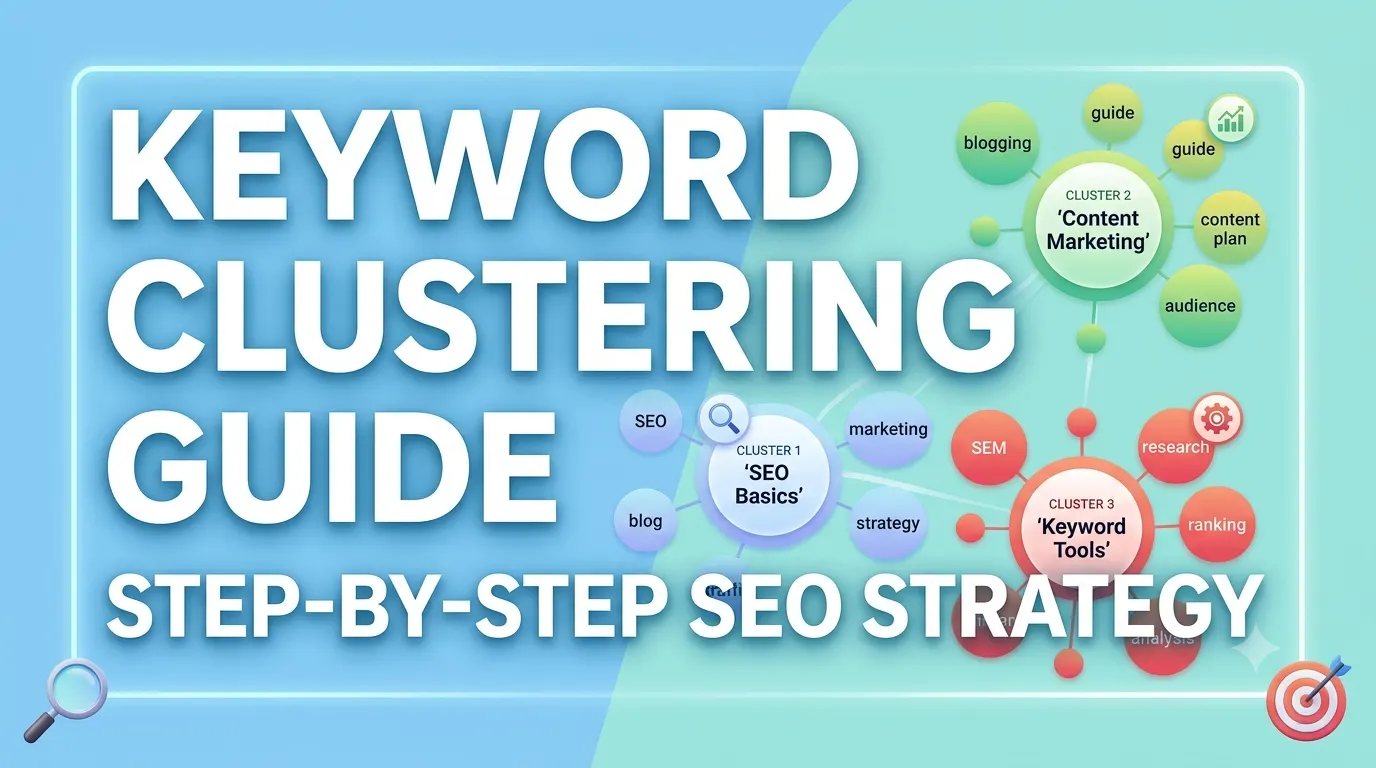
- Group keywords by search intent first, not just by word overlap
- One cluster = one focused article or pillar page, not a separate page per keyword
- Tight clusters work well for transactional intent; broad clusters suit informational topics
- Use the Priority–Intent–Volume–Gap (PIVG) Framework to decide which clusters to write first
- Tools like Semrush, Ahrefs, and Google Search Console can identify cluster candidates automatically
- Review clusters every 3–6 months because search intent shifts as AI Overviews update
Table of Contents
- What Is Keyword Clustering?
- Why Clustering Matters More in 2026
- Key Mistakes to Avoid
- Step-by-Step Clustering Workflow
- How This Applies in Practice
- The PIVG Framework: Priority–Intent–Volume–Gap
- Clustering for AI Overviews and Featured Snippets
- Recommended Tools and Sources
- Frequently Asked Questions
- Article Summary
- Conclusion
What Is Keyword Clustering?
Keyword clustering means grouping search queries that share similar search intent or semantic context. Rather than creating one page per keyword, you create one comprehensive page that naturally covers multiple related terms. This approach matches how Google has shifted toward topic-based ranking and entity recognition.
The Difference Between Traditional and Cluster-Based SEO
| Traditional Single-Keyword Targeting | Cluster-Based Targeting |
|---|---|
| One keyword per page | Multiple related keywords per page |
| Exact match focus | Semantic and intent-based grouping |
| Thin content risk | Comprehensive topic coverage |
| Harder to rank for variations | Natural long-tail coverage |
| Static, rarely updated | Adapted to shifting search intent |
Why Clustering Matters More in 2026
AI Overviews extract answers from pages that cover an entire topic, not just a single query. When Google’s generative AI pulls information for “how to start a blog,” it looks for content that covers hosting, platform choice, content strategy, and monetization as a unified set. Clustered content increases the chance of being used as a source.
How AI Overviews Change Keyword Strategy
Google uses entity-based retrieval. Keywords that appear in the same cluster of meaning are more likely to be served as a group. If your content addresses the cluster as a coherent article, you improve extractability. This is not about optimization tricks — it about natural topical coverage.
Key Mistakes to Avoid
- Clustering by word overlap only: Two queries may share a word but have different intent. “Buy running shoes” and “best running shoes reviews” should not be in the same cluster — one is transactional, the other is commercial investigation.
- Creating one page per cluster regardless of volume: If a cluster has only 20 searches per month total, a dedicated article probably is not worth the effort. Use a volume floor.
- Ignoring SERP features: If the SERP for a cluster shows only product listings and no organic articles, a blog post will likely fail to rank.
- Never updating clusters: Search intent changes. A query that was informational two years ago may now be transactional. Review clusters every quarter.
- Forcing clusters into existing pages: If your existing article about “email marketing tools” is 800 words, trying to stuff 15 additional keywords into it will hurt readability. Start a new, comprehensive guide instead.
Step-by-Step Clustering Workflow
This workflow assumes you already have a raw keyword list. If exporting from Semrush or Ahrefs, use a minimum of 50–100 queries for meaningful clustering.
- Step 1 — Identify intent for each query: Label every keyword as informational, commercial, transactional, or navigational. Use the SERP to verify — if the top results are product pages, intent is transactional.
- Step 2 — Group by topic seed: Group keywords that fit under a single broad topic. For example, “vegan protein powder,” “best vegan protein,” and “vegan protein for muscle gain” all belong under the topic “vegan protein.”
- Step 3 — Refine by subtopic and difficulty: Within each topic seed, form tighter clusters based on specific subtopics. Check keyword difficulty. If the cluster contains 80% high-difficulty terms, consider writing a pillar page and using supporting clusters for linkable assets.
- Step 4 — Assign to a content type: An informational cluster gets a blog guide. A transactional cluster gets a product comparison or category page. A commercial cluster gets a review roundup. Do not mix content types in one cluster.
- Commercial cluster → “Best Home Gym Equipment: 2026 Buyer’s Guide”
- Informational cluster → “How to Build Muscle at Home Without a Gym”
- Transactional cluster → Product category page for “Adjustable Dumbbells”
How This Applies in Practice
For a Beginner Website
A new site has no authority, so competing for high-volume transactional clusters is risky. Instead, cluster around low-difficulty informational topics. A personal finance blog, for example, could cluster “budgeting for beginners,” “50/30/20 rule explained,” and “how to start a budget spreadsheet” into one thorough guide. This builds topical trust before moving toward commercial keywords.
For a SaaS Website
SaaS sites often target feature-driven queries. Cluster by use case, not by feature name. “Project management for remote teams,” “task automation for agencies,” and “workflow software for freelancers” can live under a pillar page about remote work productivity. Each cluster includes a comparison table or integration guide to satisfy commercial intent.
For an Ecommerce Store
Product keywords naturally cluster around categories. But many ecommerce sites create separate pages for “women’s running shoes,” “trail running shoes women,” and “road running shoes women.” These can merge into a single category page with sub-sections. The page ranks for the commercial intent cluster while users can filter within the page.
For a Local Business
Local clusters center on geography. “Plumber in Austin,” “emergency plumber Austin,” and “water heater repair Austin” should all live on one service page for “Austin Plumber.” Create sub-headings for each service type. Avoid creating 10 thin location pages that differ only by one street name.
The PIVG Framework: Priority–Intent–Volume–Gap
Instead of guessing which cluster to write first, score each cluster on four criteria:
- Priority (P): Does this cluster support your main business goal? A cluster about “enterprise API pricing” is Priority 1 for a SaaS company but Priority 3 for a local restaurant.
- Intent (I): Commercial and transactional clusters usually generate more conversions than informational. Score 3 for transactional, 2 for commercial, 1 for informational.
- Volume (V): Total combined monthly search volume for the cluster. Score 3 if over 1,000, 2 if 300–1,000, 1 if under 300. (Use 500 as a floor if traffic from the cluster is your primary goal.)
- Gap (G): How well do existing top results cover the topic? If the SERP shows thin pages, score 3. If the SERP has strong, detailed guides, score 1.
Decision: Add P + I + V + G. Clusters scoring 10–12 are immediate priorities. Scores 7–9 are secondary. Scores below 7 can wait or be merged into other clusters.
Example PIVG Scoring
| Cluster Topic | P | I | V | G | Total | Action |
|---|---|---|---|---|---|---|
| Enterprise API pricing guide | 3 | 3 | 2 | 3 | 11 | Write now |
| Best free project management tools | 2 | 2 | 3 | 1 | 8 | Write later |
| History of project scheduling | 1 | 1 | 1 | 2 | 5 | Skip or merge |
Clustering for AI Overviews and Featured Snippets
AI Overviews prefer content that directly answers a question and then covers related subtopics in a structured hierarchy. When you build content around a cluster, you naturally create that hierarchy. The primary question becomes your main heading, and the cluster terms become subheadings.
Structured Data Considerations
Use FAQPage or HowTo schema when your cluster contains multiple question-based queries. For example, if your cluster includes “how to clean a cast iron skillet” and “best oil for cast iron,” a HowTo schema covering the steps and a FAQ schema for the oil question increases the chance of structured snippet extraction. Schema.org defines these types clearly.
Content Structure for Extractability
- Open each H2 section with a direct answer (40–80 words)
- Use bullet lists for enumerations
- Include a “Quick Answer” or definition at the top of the page
- Use simple language and avoid jargon in the first paragraph
- Place tables where comparisons help answer the cluster intent
Recommended Tools and Sources
For actual clustering work, the following tools and resources are reliable:
- Semrush Blog — has a keyword grouping tool that clusters by intent and topic
- Ahrefs Blog — provides keyword explorer with clustering features and difficulty scores
- Moz Blog — useful for understanding keyword difficulty and SERP analysis
- Google Search Console — identify which queries your pages already rank for, then cluster around them
- Google Search Central — official documentation on search fundamentals and structured data
- Schema.org — reference for choosing correct structured data types
Frequently Asked Questions
How many keywords should be in one cluster?
Between 5 and 20 keywords per cluster is a practical range. Smaller clusters (5–8 keywords) work for transactional intent where specificity matters. Larger clusters (12–20) suit informational guides where you cover a broad topic. If a cluster exceeds 20 keywords, split it into two subtopics. A cluster with 50 terms becomes unmanageable and often mixes unrelated queries.
Can I use the same keyword in multiple clusters?
Yes, but carefully. A keyword like “organic coffee beans” can belong to a “best organic coffee beans” commercial cluster and also to a “how to roast coffee beans” informational cluster. The deciding factor is the dominant intent in the SERP. If most results for that keyword are product reviews, place it in the commercial cluster. Create a separate page for each cluster, even if keywords overlap.
Does keyword clustering help with internal linking?
Yes. When you cluster keywords around a pillar topic, you naturally identify which pages should link to each other. The pillar page covers the broad cluster, and supporting articles cover sub-clusters. Internal links from the pillar to supported articles signal topic depth to Google. Google Search Console’s “Links” report can show if your internal linking aligns with your cluster structure.
How often should I update my keyword clusters?
Every 3 to 6 months for active content. Search intent can shift quickly, especially for trending industries like AI tools, health, and finance. Set a calendar reminder to re-export keywords from Ahrefs or Semrush and re-evaluate clusters quarterly. Stale clusters lead to content that no longer matches what users actually want.
Is clustering useful for AI Overview optimization?
Directly. AI Overviews pull from content that covers an entire query space, not just one phrase. When your article addresses a cluster of 8–15 related questions naturally, Google’s generative AI can extract multiple facts from the same page. This increases your chance of being cited as a source in an AI Overview. Google Search Quality Rater Guidelines emphasize E-E-A-T signals and topical depth, which clustering supports.
What is the biggest mistake in keyword clustering?
Clustering by word similarity instead of intent. Two keywords that both contain “vegan protein” can have completely different user goals. “Best vegan protein powder” is commercial — the user wants a recommendation. “How to use vegan protein powder” is informational — the user wants instructions. Forcing both into one cluster creates a page that fails to fully satisfy either intent. Always label intent before grouping.
Article Summary
This keyword clustering guide explained why grouping queries by search intent — not just word overlap — leads to better rankings and AI Overview visibility. The primary workflow involves four steps: label intent, group by topic seed, refine by subtopic, and assign content types. The PIVG Framework (Priority-Intent-Volume-Gap) helps prioritize which clusters to create first. We covered specific applications for beginner sites, SaaS, ecommerce, and local businesses. Clusters work best when reviewed quarterly, structured for extractability, and supported by the correct schema types.
Useful Tool for This Task
If you want to review keyword usage and content balance, use the SMARTCHAINE Keyword Density Checker to analyze your text.
Conclusion
Keyword clustering is not about building more pages. It is about building the right pages that answer entire groups of questions. The practical challenge is resisting the old habit of targeting one keyword per article. Start small: pick one topic, cluster 8–12 keywords around it, and create a single comprehensive guide. Review the SERP again after 8 weeks. That single page will likely rank for more terms than your previous approach of five separate thin posts.
About the Author
The SMARTCHAINE Editorial Team specializes in SEO, AI Search Optimization, GEO (Generative Engine Optimization), AI Overviews, Structured Data, Technical SEO, and search visibility strategies for modern search engines and AI-powered discovery platforms.